

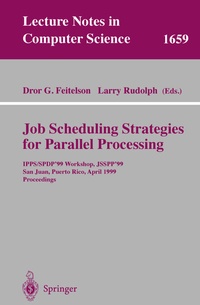
Job Scheduling Strategies for Parallel Processing
IPPS/SPDP'99 Workshop, JSSPP'99, San Juan, Puerto Rico, April 16, 1999, Proceedings
Published on 13. October 1999
Book
Paperback/Softback
VIII, 244 pages
978-3-540-66676-9 (ISBN)
Description
This volume contains the papers presented at the f th workshop on Job SchedulingStrategiesforParallelProcessing,whichwasheldinconjunctionwith the IPPS/SPDP'99conference in San Juan, Puerto Rico, on April 16, 1999.The papers have been through a complete refereeing process, with the full version beingreadandevaluatedbyv etosevenmembersoftheprogramcommittee.We would like to take this opportunity to thank the program committee, Andrea Arpaci-Dusseau, Stephen Booth, Allen Downey, Allan Gottlieb, Atsushi Hori, PhilKrueger,RichardLagerstrom,MironLivny,VirginiaLo,ReaganMoore,Bill Nitzberg,UweSchwiegelshohn,KenSevcik,MarkSquillante,andJohnZahorjan, for an excellent job. Thanks are also due to the authors for their submissions, presentations,and nal revisionsfor this volume. Finally,we wouldlike to thank the MIT Laboratory for Computer Science and the Computer Science Institute at the Hebrew Universityfor the use of their facilities in the preparationof these proceedings. Thiswasthe fth annualworkshopinthis series,whichre?ectsthe continued interest in this eld. The previous four were held in conjunction with IPPS'95 through IPPS/SPDP'98.
Their proceedings are available from Springer-Verlag as volumes 949, 1162, 1291, and 1459 of the Lecture Notes in Computer Science series. Sinceour rstworkshop,parallelprocessinghas evolvedtothe pointwhereit is no longer synonymous with scienti c computing on massively parallel sup- computers. In fact, enterprise computing on one hand and metasystems on the other hand often overshadow the original uses of parallel processing. This shift has underscored the importance of job scheduling in multi-user parallelsystems. Correspondingly, we had a session in the workshop devoted to job scheduling on standalonesystems, emphasizing gang scheduling, and another on scheduling for meta-systems. A third session continued the trend from previous workshops of discussing evaluation methodology and workloads. Aninnovationthisyearwasapaneldiscussiononthepossiblestandardization ofaworkloadbenchmarkthatwillservefortheevaluationofdi erentschedulers.
Their proceedings are available from Springer-Verlag as volumes 949, 1162, 1291, and 1459 of the Lecture Notes in Computer Science series. Sinceour rstworkshop,parallelprocessinghas evolvedtothe pointwhereit is no longer synonymous with scienti c computing on massively parallel sup- computers. In fact, enterprise computing on one hand and metasystems on the other hand often overshadow the original uses of parallel processing. This shift has underscored the importance of job scheduling in multi-user parallelsystems. Correspondingly, we had a session in the workshop devoted to job scheduling on standalonesystems, emphasizing gang scheduling, and another on scheduling for meta-systems. A third session continued the trend from previous workshops of discussing evaluation methodology and workloads. Aninnovationthisyearwasapaneldiscussiononthepossiblestandardization ofaworkloadbenchmarkthatwillservefortheevaluationofdi erentschedulers.
More details
Series
Edition
1999 ed.
Language
English
Place of publication
Berlin
Germany
Publishing group
Springer Berlin
Target group
Professional and scholarly
Research
Illustrations
VIII, 244 p.
Dimensions
Height: 235 mm
Width: 155 mm
Thickness: 14 mm
Weight
388 gr
ISBN-13
978-3-540-66676-9 (9783540666769)
DOI
10.1007/3-540-47954-6
Schweitzer Classification
Other editions
Additional editions
Dror G. Feitelson | Larry Rudolph
Job Scheduling Strategies for Parallel Processing
IPPS/SPDP'99 Workshop, JSSPP'99, San Juan, Puerto Rico, April 16, 1999, Proceedings
E-Book
06/2003
Springer
€53.49
Available for download
Content
Scheduling for Parallel Supercomputing: A Historical Perspective of Achievable Utilization.- On the Design and Evaluation of Job Scheduling Algorithms.- Comparing Logs and Models of Parallel Workloads Using the Co-plot Method.- Benchmarks and Standards for the Evaluation of Parallel Job Schedulers.- The Effect of Correlating Quantum Allocation and Job Size for Gang Scheduling.- Scheduling on AP/Linux for Fine and Coarse Grain Parallel Processes.- Job Re-packing for Enhancing the Performance of Gang Scheduling.- Process Tracking for Parallel Job Control.- The Legion Resource Management System.- Scheduling a Metacomputer with Uncooperative Sub-schedulers.- Using Run-Time Predictions to Estimate Queue Wait Times and Improve Scheduler Performance.- Deterministic Batch Scheduling without Static Partitioning.