

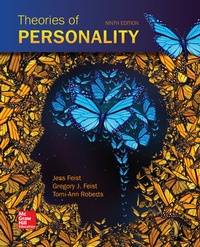
Theories of Personality
9th Edition
Published on 16. May 2017
Book
Paperback/Softback
672 pages
978-0-07-786192-6 (ISBN)
Description
Theories of Personality provides a comprehensive foundation on the nature of personality theory, as well as its contributions to science. Coverage of each theory encompasses a biographical sketch of each theorist, related research, and applications to real life. Written by three preeminent psychology professors-Jess Feist, Gregory J. Feist, and Tomi-Ann Roberts-this program is engaging and student-friendly. The ninth edition provides new studies and sections on topics such as ego identity, gender studies, mindfulness and self-actualization, and more. The Connect course for this offering includes SmartBook, an adaptive reading and study experience which guides students to master, recall, and apply key concepts while providing automatically-graded assessments.
McGraw-Hill Connect (R) is a subscription-based learning service accessible online through your personal computer or tablet. Choose this option if your instructor will require Connect to be used in the course. Your subscription to Connect includes the following:
* SmartBook (R) - an adaptive digital version of the course textbook that personalizes your reading experience based on how well you are learning the content.
* Access to your instructor's homework assignments, quizzes, syllabus, notes, reminders, and other important files for the course.
* Progress dashboards that quickly show how you are performing on your assignments and tips for improvement.
* The option to purchase (for a small fee) a print version of the book. This binder-ready, loose-leaf version includes free shipping.
Complete system requirements to use Connect can be found here: http://www.mheducation.com/highered/platforms/connect/training-support-students.html
McGraw-Hill Connect (R) is a subscription-based learning service accessible online through your personal computer or tablet. Choose this option if your instructor will require Connect to be used in the course. Your subscription to Connect includes the following:
* SmartBook (R) - an adaptive digital version of the course textbook that personalizes your reading experience based on how well you are learning the content.
* Access to your instructor's homework assignments, quizzes, syllabus, notes, reminders, and other important files for the course.
* Progress dashboards that quickly show how you are performing on your assignments and tips for improvement.
* The option to purchase (for a small fee) a print version of the book. This binder-ready, loose-leaf version includes free shipping.
Complete system requirements to use Connect can be found here: http://www.mheducation.com/highered/platforms/connect/training-support-students.html
More details
Edition
9th edition
Language
English
Place of publication
New York
United States
Publishing group
McGraw-Hill Education - Europe
Target group
College/higher education
US School Grade: College Freshman
Illustrations
40 Illustrations
Dimensions
Height: 231 mm
Width: 188 mm
Thickness: 25 mm
Weight
983 gr
ISBN-13
978-0-07-786192-6 (9780077861926)
Schweitzer Classification
Persons
Jess Feist is emeritus professor of Psychology at McNeese State University in Louisiana.
Gregory Feist (Ph.D. University of California, Berkeley) is Associate Professor of Psychology in Adult Development at San Jose State University. Dr. Feist is widely published in the psychology of creativity, the psychology of science, and the development of scientific talent. One of his major goals is establishing the psychology of science as a healthy and independent study of science, along the lines of the history, philosophy, and sociology of science. His teaching efforts have been recognized by outstanding teaching awards at both the University of California, Davis and the University of California, Berkeley.
Tomi-Ann Roberts (PhD, Stanford University) is Professor of Psychology at Colorado College. Her research and teaching center on the consequences of sexual and self-objectification for the physical, emotional, and cognitive wellbeing of girls and women. The first paper she co-authored on this topic, Objectification Theory, is the most cited article in the over 40-year history of the APA journal Psychology of Women Quarterly. She leverages psychological science as an expert witness and consultant in cases involving objectification as a form of sexism and gender discrimination.
Gregory Feist (Ph.D. University of California, Berkeley) is Associate Professor of Psychology in Adult Development at San Jose State University. Dr. Feist is widely published in the psychology of creativity, the psychology of science, and the development of scientific talent. One of his major goals is establishing the psychology of science as a healthy and independent study of science, along the lines of the history, philosophy, and sociology of science. His teaching efforts have been recognized by outstanding teaching awards at both the University of California, Davis and the University of California, Berkeley.
Tomi-Ann Roberts (PhD, Stanford University) is Professor of Psychology at Colorado College. Her research and teaching center on the consequences of sexual and self-objectification for the physical, emotional, and cognitive wellbeing of girls and women. The first paper she co-authored on this topic, Objectification Theory, is the most cited article in the over 40-year history of the APA journal Psychology of Women Quarterly. She leverages psychological science as an expert witness and consultant in cases involving objectification as a form of sexism and gender discrimination.
Content
CHAPTER 1: Introduction to Personality TheoryCHAPTER 2 Freud: PsychoanalysisCHAPTER 3: Adler: Individual PsychologyCHAPTER 4: Jung: Analytical PsychologyCHAPTER 5: Klein: Object Relations TheoryCHAPTER 6: Horney: Psychoanalytic Social TheoryCHAPTER 7: Erikson: Post-Freudian TheoryCHAPTER 8: Fromm: Humanistic PsychoanalysisCHAPTER 9: Maslow: Holistic-Dynamic TheoryCHAPTER 10: Rogers: Person-Centered TheoryCHAPTER 11: May: Existential PsychologyCHAPTER 12: Allport: Psychology of the IndividualCHAPTER 13: McCrae and Costa's Five Factor Trait TheoryCHAPTER 14: Eysenck's Biologically Based Factor TheoryCHAPTER 15: Buss: Evolutionary Theory of PersonalityCHAPTER 16: Skinner: Behavioral AnalysisCHAPTER 17: Bandura: Social Cognitive TheoryCHAPTER 18: Rotter and Mischel: Cognitive Social Learning TheoryCHAPTER 19: Kelly: Psychology of Personal ConstructsGlossaryReferences RPhoto Credits CName Index N-1Subject Index S-1