

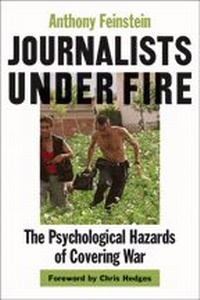
Journalists under Fire
The Psychological Hazards of Covering War
Published on 3. November 2006
Book
Hardback
216 pages
978-0-8018-8441-2 (ISBN)
Description
As journalists in Iraq and other hot spots around the world continue to face harrowing dangers and personal threats, neuropsychiatrist Anthony Feinstein offers a timely and important exploration into the psychological damage of those who, armed only with pen, tape recorder, or camera, bear witness to horror. Based on a series of recent studies investigating the emotional impact of war on the profession, Journalists under Fire breaks new ground in the study of trauma-related disorders. Feinstein opens with an overview of the life-threatening hazards war reporters face-abductions, mock executions, the deaths of close colleagues-and discusses their psychological consequences: post-traumatic stress disorder, depression, deterioration of personal relationships, and substance abuse. In recounting the experiences of reporters who encounter trauma on the job, Feinstein observes that few adequate support systems are in place for them. He tells the stories of media veterans who have "seen it all," only to find themselves and their employers blindsided by psychological aftershocks.
The book explores the biological and psychological factors that motivate journalists to take extraordinary risks. Feinstein looks into the psyches of freelancers who wade into war zones with little or no financial backing; he examines the different stresses encountered by women working in a historically male-dominated profession; and he probes the effects of the September 11 attacks on reporters who thought they had sworn off conflict reporting. His interviews with many of this generation's greatest reporters, photographers, and videographers often reveal extraordinary resilience in the face of adversity. Journalists under Fire is a look behind the public persona of war journalists at a time when the profession faces unprecedented risk. Plucking common threads from disparate stories, Feinstein weaves a narrative that is as fascinating to read as it is sobering to contemplate. What emerges are unique insights into lives lived dangerously.
The book explores the biological and psychological factors that motivate journalists to take extraordinary risks. Feinstein looks into the psyches of freelancers who wade into war zones with little or no financial backing; he examines the different stresses encountered by women working in a historically male-dominated profession; and he probes the effects of the September 11 attacks on reporters who thought they had sworn off conflict reporting. His interviews with many of this generation's greatest reporters, photographers, and videographers often reveal extraordinary resilience in the face of adversity. Journalists under Fire is a look behind the public persona of war journalists at a time when the profession faces unprecedented risk. Plucking common threads from disparate stories, Feinstein weaves a narrative that is as fascinating to read as it is sobering to contemplate. What emerges are unique insights into lives lived dangerously.
Reviews / Votes
[A] singular feat. -- Carlin Romano Philadelphia Inquirer 2006 Any college-level collection strong in journalism must have Journalists under Fire. California Bookwatch 2006 Feinstein's eye-opener should be compulsory reading for all news managers, for whom 'dramatic war footage will always prove irresistible.' The Australian Feinstein is a consummate researcher with an insightful and beautifully poetic writing style... As soon as I finished reading this book, I wanted to start all over again. -- Rick Hughes Counselling at Work 2007 Journalists Under Fire is not a textbook of post-traumatic stress disorder or psychological trauma; rather it puts flesh on the bones of the sanitised, sterile descriptions of psychopathology in the academic literature... sometimes disturbing and upsetting but always compelling. -- Martin Deahl British Journal of Psychiatry 2007 Blending fact, interpretation, and fierce poignancy, this first-rate, readable book is a scholarly triumph. Choice 2007 Feinstein captures an intimate view of this tight-knit community and encourages a deeper appreciation for the reality of war journalism-and its accompanying emotional fallout. Journal of Peace Research 2009More details
Language
English
Place of publication
Baltimore, MD
United States
Target group
College/higher education
Professional and scholarly
Dimensions
Height: 229 mm
Width: 152 mm
Thickness: 20 mm
Weight
454 gr
ISBN-13
978-0-8018-8441-2 (9780801884412)
DOI
10.1353/book.3270
Copyright in bibliographic data and cover images is held by Nielsen Book Services Limited or by the publishers or by their respective licensors: all rights reserved.
Schweitzer Classification
Other editions
Additional editions
E-Book
11/2006
Johns Hopkins University Press
€34.99
Available for download
Person
Anthony Feinstein is a professor of psychiatry at the University of Toronto and a Guggenheim Fellow.
Content
Foreword, by Chris Hedges
Acknowledgments
1. A Hazardous Profession
2. Danger's Troubled Legacy: Post-traumatic Stress Disorder
3. Why Take the Risks?
4. Depression, Drink, and Drugs
5. Freelance War Journalists
6. War, Women, Wives, and Widows
7. Domestic Journalists and Urban Terror: The Aftermath of September 11
8. The Iraq War: In Bed with the Military
Afterword
Suggested Reading
Index
Acknowledgments
1. A Hazardous Profession
2. Danger's Troubled Legacy: Post-traumatic Stress Disorder
3. Why Take the Risks?
4. Depression, Drink, and Drugs
5. Freelance War Journalists
6. War, Women, Wives, and Widows
7. Domestic Journalists and Urban Terror: The Aftermath of September 11
8. The Iraq War: In Bed with the Military
Afterword
Suggested Reading
Index