

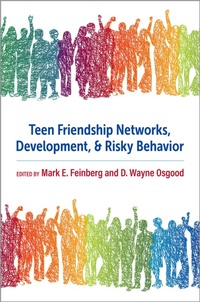
Teen Friendship Networks, Development, and Risky Behavior
Published on 7. December 2023
Book
Hardback
408 pages
978-0-19-760231-7 (ISBN)
Description
The PROSPER study is the premier study of adolescent peer networks in the world, with a scope of over 12,000 youth in 28 school districts, and with 8 annual waves of data collection covering grades 6-12. Research output from the PROSPER study has provided extensive new insights in the areas of adolescent development, risky behaviors, and social networks.
Through the lens of the PROSPER study, Teen Friendship Networks, Development, and Risky Behavior describes the many ways that adolescent friendship networks channel and facilitate the spread of adolescent substance use, delinquent behaviors, mental health problems, educational success, romantic relationships, and future development. Introductory chapters explain the theories of adolescent development and the elements of peer network science. The chapters of the main part of the book each focus on a domain of adolescent behavior, providing background on the topic and highlighting the contribution of the PROSPER study to understanding the way teen friendships operate to promote initiation or diffusion of the behavior or attribute.
With coverage of major themes such as the ways that teens select friends based on particular characteristics or similarity between them, and the ways that friends, once selected, influence each other, as well as discussion of how friendship and network patterns are linked to the uptake and spread of positive prevention messages, Teen Friendship Networks, Development, and Risky Behavior will appeal to researchers and students across several fields.
Through the lens of the PROSPER study, Teen Friendship Networks, Development, and Risky Behavior describes the many ways that adolescent friendship networks channel and facilitate the spread of adolescent substance use, delinquent behaviors, mental health problems, educational success, romantic relationships, and future development. Introductory chapters explain the theories of adolescent development and the elements of peer network science. The chapters of the main part of the book each focus on a domain of adolescent behavior, providing background on the topic and highlighting the contribution of the PROSPER study to understanding the way teen friendships operate to promote initiation or diffusion of the behavior or attribute.
With coverage of major themes such as the ways that teens select friends based on particular characteristics or similarity between them, and the ways that friends, once selected, influence each other, as well as discussion of how friendship and network patterns are linked to the uptake and spread of positive prevention messages, Teen Friendship Networks, Development, and Risky Behavior will appeal to researchers and students across several fields.
Reviews / Votes
The impetus for this edited volume is the wealth of data that emerged from the ambitious PROSPER (Promoting School-Community-University Partnerships to Enhance Resilience) research study. PROSPER was a longitudinal investigation of two cohorts of students in grades 6-12, which incorporated experimental interventions and social network methodologies. Even though the scope of the book is limited to examining substance use, sexual behavior, contact with the criminal justice system, and other problematic adolescent behaviors, it is an ambitious undertaking. * Choice *More details
Language
English
Place of publication
New York
United States
Product notice
sewn/stitched
Cloth over boards
Illustrations
57 b/w illustrations
Dimensions
Height: 229 mm
Width: 160 mm
Thickness: 48 mm
Weight
703 gr
ISBN-13
978-0-19-760231-7 (9780197602317)
Copyright in bibliographic data and cover images is held by Nielsen Book Services Limited or by the publishers or by their respective licensors: all rights reserved.
Schweitzer Classification
Other editions
Additional editions
Mark E. Feinberg | D. Wayne Osgood
Teen Friendship Networks, Development, and Risky Behavior
E-Book
09/2023
OUP eBook
€40.99
Available for download
Mark E. Feinberg | D. Wayne Osgood
Teen Friendship Networks, Development, and Risky Behavior
E-Book
09/2023
OUP eBook
€40.99
Available for download
Persons
Mark E. Feinberg, PhD, is Research Professor at the Prevention Research Center, The Pennsylvania State University and Director of the International Center for Coparenting Policy and Research, The Pennsylvania State University. He has made contributions to theory and research in areas such as co-parenting, sibling relationships, the epidemiology of adolescent behavior problems, and the efficacy of community prevention initiatives. He also developed the evidence-based Family Foundations program to promote positive co-parenting relations.
D. Wayne Osgood, PhD, is Professor Emeritus of Criminology and Sociology at The Pennsylvania State University, University Park. His research has focused on peers and risky behavior, time use and offending, crime and the life course, evaluating programs to prevent and reduce delinquency, and quantitative research methods. He is a Fellow of the American Society of Criminology, received its Sutherland Award in 2022, and was Lead Editor of the journal
Criminology for 2012-2017.
D. Wayne Osgood, PhD, is Professor Emeritus of Criminology and Sociology at The Pennsylvania State University, University Park. His research has focused on peers and risky behavior, time use and offending, crime and the life course, evaluating programs to prevent and reduce delinquency, and quantitative research methods. He is a Fellow of the American Society of Criminology, received its Sutherland Award in 2022, and was Lead Editor of the journal
Criminology for 2012-2017.
Editor
Research Professor, Prevention Research Center, The Pennsylvania State University;Research Professor, Prevention Research Center, The Pennsylvania State University;, Director, International Center for Coparenting Policy and Research, The Pennsylvania State University
Professor Emeritus of Criminology and SociologyProfessor Emeritus of Criminology and Sociology, Pennsylvania State University, University Park
Content
Section I: Setting the Stage Chapter 1: Friendships and Peer Groups in the Teen Years-Our Perspective
D. Wayne Osgood Chapter 2: Overview of the PROSPER Prevention Trial's Rationale, Methods, and Findings: The Context for Friendship Network Study
Richard Spoth, Lisa M. Schainker, Mark Greenberg, and Janet Welsh Chapter 3: Network Methods: Explanations and Issues
James Moody and D. Wayne Osgood Chapter 4: A Descriptive Overview of Social Networks and Behavior Among PROSPER Youth
Erin Tinney Section II: Risky Behaviors, Relationships, and Development Chapter 5: Teen Friendships, Networks, and Substance Use Daniel T. Ragan and D. Wayne Osgood Chapter 6: Does Criminal Justice Contact Alter Friendship Ties?
Wade C. Jacobsen and Erin Tinney Chapter 7: Depression, Isolation, and Self-Harm Molly Copeland and Sonja Siennick Chapter 8: The Role of Parenting in Shaping the Friendship Context of Adolescent Substance Use Kelly L. Rulison, Avery Chahl, and Evelien M. Hoeben Chapter 9: Dating, Sexuality, and Adolescent Friendship Networks
Nayan G. Ramirez, Rose Wesche, and Derek A. Kreager Chapter 10: Variation in Network Processes Across Community and School District Contexts
Cassie McMillan, Daniel Ragan, and Alana Colindres Chapter 11: Peer Networks and the Diffusion of Intervention Outcomes Kelly L. Rulison and Mark E. Feinberg Chapter 12: Genetic Susceptibility to Peers
Gabriel L. Schlomer, Amanda M. Griffin, H. Harrington Cleveland, and David J. Vandenbergh Section III: Discussion and Conclusions Chapter 13: Future Directions for Research on Networks and Adolescent Health
Thomas W. Valente Chapter 14: The Growth of Longitudinal Social Network Analysis
Rene Veenstra, Teresa Bertogna, and Lydia Laninga-Wijnen Chapter 15: Social Capital and Adolescent Development
Mark Feinberg Publications of the PROSPER Peers Project
PROSPER Peers Project Personnel
D. Wayne Osgood Chapter 2: Overview of the PROSPER Prevention Trial's Rationale, Methods, and Findings: The Context for Friendship Network Study
Richard Spoth, Lisa M. Schainker, Mark Greenberg, and Janet Welsh Chapter 3: Network Methods: Explanations and Issues
James Moody and D. Wayne Osgood Chapter 4: A Descriptive Overview of Social Networks and Behavior Among PROSPER Youth
Erin Tinney Section II: Risky Behaviors, Relationships, and Development Chapter 5: Teen Friendships, Networks, and Substance Use Daniel T. Ragan and D. Wayne Osgood Chapter 6: Does Criminal Justice Contact Alter Friendship Ties?
Wade C. Jacobsen and Erin Tinney Chapter 7: Depression, Isolation, and Self-Harm Molly Copeland and Sonja Siennick Chapter 8: The Role of Parenting in Shaping the Friendship Context of Adolescent Substance Use Kelly L. Rulison, Avery Chahl, and Evelien M. Hoeben Chapter 9: Dating, Sexuality, and Adolescent Friendship Networks
Nayan G. Ramirez, Rose Wesche, and Derek A. Kreager Chapter 10: Variation in Network Processes Across Community and School District Contexts
Cassie McMillan, Daniel Ragan, and Alana Colindres Chapter 11: Peer Networks and the Diffusion of Intervention Outcomes Kelly L. Rulison and Mark E. Feinberg Chapter 12: Genetic Susceptibility to Peers
Gabriel L. Schlomer, Amanda M. Griffin, H. Harrington Cleveland, and David J. Vandenbergh Section III: Discussion and Conclusions Chapter 13: Future Directions for Research on Networks and Adolescent Health
Thomas W. Valente Chapter 14: The Growth of Longitudinal Social Network Analysis
Rene Veenstra, Teresa Bertogna, and Lydia Laninga-Wijnen Chapter 15: Social Capital and Adolescent Development
Mark Feinberg Publications of the PROSPER Peers Project
PROSPER Peers Project Personnel