

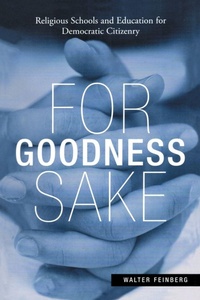
For Goodness Sake
Religious Schools and Education for Democratic Citizenry
1st Edition
Published on 28. March 2006
Book
Paperback/Softback
270 pages
978-0-415-95379-5 (ISBN)
Description
While the fierce debate over religion in public schools receives ample media attention, we rarely consider the implications of religious schools on moral education and liberal democracy. In this groundbreaking work, Walter Feinberg opens up a critical new dialogue to offer a complete discussion of the important role religious schools play in the formation of a democratic citizenry. Feinberg, a leading philosopher of education, approaches the subject of religious education with a rare evenhandedness, drawing on examples from Christian, Jewish, and Muslim schools and exploring topics as disparate as sex education and creationism. For Goodness Sake provides a much-needed take on a controversial topic, demonstrating that the relationship between religion and schooling is not simply the exclusive concern of members of a given religious community, but a relevant and vital issue for everyone who cares about education.
More details
Language
English
Place of publication
London
United Kingdom
Publishing group
Taylor & Francis Ltd
Target group
College/higher education
Dimensions
Height: 229 mm
Width: 152 mm
Thickness: 15 mm
Weight
399 gr
ISBN-13
978-0-415-95379-5 (9780415953795)
Copyright in bibliographic data and cover images is held by Nielsen Book Services Limited or by the publishers or by their respective licensors: all rights reserved.
Schweitzer Classification
Other editions
Additional editions
E-Book
01/2013
Routledge
€63.49
Available for download
E-Book
01/2013
Routledge
€63.49
Available for download
Book
03/2006
1st Edition
Routledge
€252.10
Shipment within 15-20 days
Person
Walter Feinberg is the Charles Dunn Hardie Professor of Philosophy of Education at the University of Illinois at Urbana Champaign.
Content
1. Religious Instruction and Moral Education Part One: Back to School 2. The Construction of Religious Communities 3. Criticism and Commitment 4. Faith and the Pedagogical Limits of Critical Inquiry Part Two: The Nature of the Public Interest in Religious Education 5. Safety and the Question of Educational Negligence 6. Intellectual Growth, Autonomy and Religious Education 7. Religious Chauvinism and the Democratic Citizen Part Three: The Reconstruction of Religious Education 8. The Challenge of Religious Education for Pluralism 9. The Challenge of Religious Education for Liberalism