

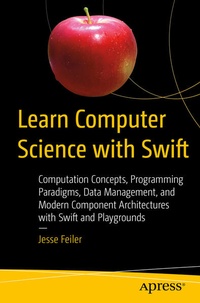
Learn Computer Science with Swift
Computation Concepts, Programming Paradigms, Data Management, and Modern Component Architectures with Swift and Playgrounds
Published on 17. December 2017
Book
Paperback/Softback
XVI, 303 pages
978-1-4842-3065-7 (ISBN)
Description
Think computationally to use Swift to solve logic puzzles and create algorithmsCollect lines of code into blocks, functions, procedures, and methods Structure data with Swift
More details
Edition
1st ed.
Language
English
Place of publication
Berkeley
United States
Target group
Professional and scholarly
Illustrations
3 s/w Abbildungen, 113 farbige Abbildungen
XVI, 303 p. 116 illus., 113 illus. in color.
Dimensions
Height: 235 mm
Width: 155 mm
Thickness: 18 mm
Weight
493 gr
ISBN-13
978-1-4842-3065-7 (9781484230657)
DOI
10.1007/978-1-4842-3066-4
Schweitzer Classification
Other editions
Additional editions
Jesse Feiler
Learn Computer Science with Swift
Computation Concepts, Programming Paradigms, Data Management, and Modern Component Architectures with Swift and Playgrounds
E-Book
12/2017
APress
€28.88
Available for download
Person
Jesse Feiler
is a developer, consultant, and author specializing in database technologies and location-based apps. He is the creator of Minutes Machine the meeting management app, as well as Saranac River Trail app a guide to the Trail that includes location-based updates as well as social media tools. His apps are available in the App Store and are published by Champlain Arts Corp (champlainarts.com). Jesse is heard regularly on WAMC Public Radio for the Northeast's The Roundtable. founder of Friends of Saranac River Trail, Inc. A native of Washington DC, he has lived in New York City and currently lives in Plattsburgh NY.
Content
1. Thinking Computationally
2. Writing Code and Using Swift Playgrounds
3. Exploring Programming Paradigms
4. Using Algorithms
5. Managing Control Flow: Repetition
6. Working with Data - Collections
7. Working with Data - Types
8. Managing Control Flow: Beyond Repetitions
9. Storing data and Sharing Data
10. Building Components
11. Using Events to Guide Actions
12. Getting into Xcode in depth
13. Bringing in People
14. Graphics and Visualization Techniques and Problems