

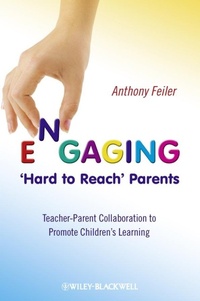
Engaging 'Hard to Reach' Parents
Teacher-Parent Collaboration to Promote Children's Learning
1st Edition
Published on 22. January 2010
Book
Hardback
192 pages
978-0-470-68229-6 (ISBN)
Description
Engaging 'Hard to Reach' Parents "This is a readable yet academically rigorous book that draws together findings from contemporary theory, research and practice. It provides a range of positive and constructive approaches for schools and other organizations which will help them to meet the challenge of engaging effectively with parents, and in so doing improve the quality of education for all children, especially those from disadvantaged communities."
Peter Farrell, Sarah Fielden Professor of Special Needs and Educational Psychology, School of Education, University of Manchester
"Clarity and integrity permeate this important book. An excellent variety of real-life examples of school-parent collaboration is discussed, and the balance of policy, theory and practice is outstandingly well-handled. This highly readable book will appeal to both practitioners and education students from the UK and from international contexts."
Professor Gary Thomas, Head of School of Education, University of Birmingham
Teachers often comment that the parents they most want to speak to have least contact with the school. There are many reasons why families' participation in schooling may be low - from difficulties with English to pressures of work - but there is consistent evidence that all parents are acutely interested in their children's education and want to know how to help. Parents are a child's first and most enduring teachers, and they create home environments where children spend much of their waking lives. Their involvement has an impact throughout children's school careers.
In Engaging 'Hard to Reach' Parents, Anthony Feiler emphasizes what schools can do to facilitatethe communication process, rather than adopting a 'blaming' or 'deficit' view of families. Real-world case studies of initiatives that promote effective cooperation between parents and teachers are presented, allowing readers to learn about successful strategies rooted in practical experience. Feiler highlights the particular benefits of home-school collaboration in circumstances that are challenging, and focuses on tactics that schools can adopt in order to better engage with so-called 'hard to reach' parents. By supporting the drive for stronger relationships between schools and the communities they serve, this book makes an important contribution to the development of inclusive education.
Peter Farrell, Sarah Fielden Professor of Special Needs and Educational Psychology, School of Education, University of Manchester
"Clarity and integrity permeate this important book. An excellent variety of real-life examples of school-parent collaboration is discussed, and the balance of policy, theory and practice is outstandingly well-handled. This highly readable book will appeal to both practitioners and education students from the UK and from international contexts."
Professor Gary Thomas, Head of School of Education, University of Birmingham
Teachers often comment that the parents they most want to speak to have least contact with the school. There are many reasons why families' participation in schooling may be low - from difficulties with English to pressures of work - but there is consistent evidence that all parents are acutely interested in their children's education and want to know how to help. Parents are a child's first and most enduring teachers, and they create home environments where children spend much of their waking lives. Their involvement has an impact throughout children's school careers.
In Engaging 'Hard to Reach' Parents, Anthony Feiler emphasizes what schools can do to facilitatethe communication process, rather than adopting a 'blaming' or 'deficit' view of families. Real-world case studies of initiatives that promote effective cooperation between parents and teachers are presented, allowing readers to learn about successful strategies rooted in practical experience. Feiler highlights the particular benefits of home-school collaboration in circumstances that are challenging, and focuses on tactics that schools can adopt in order to better engage with so-called 'hard to reach' parents. By supporting the drive for stronger relationships between schools and the communities they serve, this book makes an important contribution to the development of inclusive education.
Reviews / Votes
"Nevertheless, the book presents a readable and scholarly account of important issues regarding the involvement of "hard to reach" parents. In my opinion it will be more appreciated by researchers and academics wanting to study parental involvement in education than it will by teachers wanting to improve what their schools do to optimize this." (Educational Review, 31 August 2011)More details
Language
English
Place of publication
New York
United States
Target group
Professional and scholarly
Product notice
sewn/stitched
Cloth over boards
Dimensions
Height: 231 mm
Width: 152 mm
Thickness: 15 mm
Weight
408 gr
ISBN-13
978-0-470-68229-6 (9780470682296)
Copyright in bibliographic data and cover images is held by Nielsen Book Services Limited or by the publishers or by their respective licensors: all rights reserved.
Schweitzer Classification
Other editions
Additional editions
Anthony Feiler
Engaging 'Hard to Reach' Parents
Teacher-Parent Collaboration to Promote Children's Learning
Book
01/2010
1st Edition
Wiley
€43.34
Shipment within 10-20 days
Anthony Feiler
Engaging 'Hard to Reach' Parents
Teacher-Parent Collaboration to Promote Children's Learning
E-Book
11/2009
1st Edition
Wiley
€38.99
Available for download
Person
Anthony Feiler is a Reader in Education at The Graduate School of Education, University of Bristol, and was previously Head of Psychology at Bath Spa University. After teaching in a London primary school, Anthony spent fourteen years in professional practice as an educational psychologist. His research interests include teacher-parent collaboration, special educational needs and inclusive education, support strategies for disabled children and early literacy intervention.
Content
About the Author vii
Preface ix
Acknowledgements xi
1 Introduction 1
2 Types of Engagement, Explanations and Risk Factors 19
3 International Perspectives 55
4 Successful Projects in the United Kingdom 81
5 The Place of Home Visiting 101
6 Caveats and Concerns 125
7 Creating More Approachable Schools and Other Settings 137
References 155
Index 167
Preface ix
Acknowledgements xi
1 Introduction 1
2 Types of Engagement, Explanations and Risk Factors 19
3 International Perspectives 55
4 Successful Projects in the United Kingdom 81
5 The Place of Home Visiting 101
6 Caveats and Concerns 125
7 Creating More Approachable Schools and Other Settings 137
References 155
Index 167