

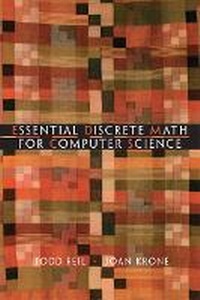
Essential Discrete Mathematics
Published on 9. December 2002
Book
Paperback/Softback
216 pages
978-0-13-018661-4 (ISBN)
Description
For freshman/sophomore one-semester introductory courses in discrete math that include intermediate programming for computer science and mathematics students.
This brief introduction to the mathematics of computer science prepares students for the math they will encounter in later courses. With applications that are specific to computer science, this text helps students develop reasoning skills and provides them with an early introduction to fundamental mathematics necessary for future math and computer science courses.
This brief introduction to the mathematics of computer science prepares students for the math they will encounter in later courses. With applications that are specific to computer science, this text helps students develop reasoning skills and provides them with an early introduction to fundamental mathematics necessary for future math and computer science courses.
More details
Language
English
Place of publication
United States
Publishing group
Pearson Education (US)
Target group
Professional and scholarly
Dimensions
Width: 228 mm
Thickness: 10 mm
Weight
263 gr
ISBN-13
978-0-13-018661-4 (9780130186614)
Copyright in bibliographic data and cover images is held by Nielsen Book Services Limited or by the publishers or by their respective licensors: all rights reserved.
Schweitzer Classification
Content
0. Notes on Proofs.
Propositional Logic. Implication. Direct Proof. The Contrapositive. Proof by Contradiction. If And Only If.
1. Sets.
What Are Sets? New Sets from Old. Properties of Sets. A Paradox. Large Collection of Sets.
2. Functions and Relations.
Exponential and Log Functions. Floor and Ceiling Functions. Relations.
3. Boolean Algebra.
Propositional Logic. Sets. Boolean Algebras. Some Boolean Algebra Theorems. Switching Circuits. Storing Numbers in a Digital Computer. Circuitry to Add.
4. Natural Numbers and Induction.
Well-ordering and Mathematical Induction. Well-ordering Implies Mathematical Induction. The Peano Axioms.
5. Number Theory.
The Division Theorem. Greatest Common Divisors. Primes. Modular Arithmetic. A Cryptological Example. Modular Multiplication and Division. More Cryptology. Fermat's Little Theorem. Fast Exponentiation. Euler's Theorem. RSA Encryption.
6. Recursion.
Binary Search. Euclid's Algorithm. Tower of Hanoi.
7. Solving Recurrences.
8. Counting.
The Rules of Sum and Product. Permutations. Combinations. Calculation Considerations. The Binomial Theorem. Applications of Counting to Probability.
9. Matrices.
Matrix Operations. Systems of Equations. The Determinant. Gaussian Elimination. Computing Multiplicative Inverses. Encryption Revisited.
10. Graphs.
Euler Circuits and Tours. Symbols and Terms for Graphs. A Return to Euler Circuits. Minimal Spanning Tree. Some Programming Considerations.
Solutions.
Index.
Propositional Logic. Implication. Direct Proof. The Contrapositive. Proof by Contradiction. If And Only If.
1. Sets.
What Are Sets? New Sets from Old. Properties of Sets. A Paradox. Large Collection of Sets.
2. Functions and Relations.
Exponential and Log Functions. Floor and Ceiling Functions. Relations.
3. Boolean Algebra.
Propositional Logic. Sets. Boolean Algebras. Some Boolean Algebra Theorems. Switching Circuits. Storing Numbers in a Digital Computer. Circuitry to Add.
4. Natural Numbers and Induction.
Well-ordering and Mathematical Induction. Well-ordering Implies Mathematical Induction. The Peano Axioms.
5. Number Theory.
The Division Theorem. Greatest Common Divisors. Primes. Modular Arithmetic. A Cryptological Example. Modular Multiplication and Division. More Cryptology. Fermat's Little Theorem. Fast Exponentiation. Euler's Theorem. RSA Encryption.
6. Recursion.
Binary Search. Euclid's Algorithm. Tower of Hanoi.
7. Solving Recurrences.
8. Counting.
The Rules of Sum and Product. Permutations. Combinations. Calculation Considerations. The Binomial Theorem. Applications of Counting to Probability.
9. Matrices.
Matrix Operations. Systems of Equations. The Determinant. Gaussian Elimination. Computing Multiplicative Inverses. Encryption Revisited.
10. Graphs.
Euler Circuits and Tours. Symbols and Terms for Graphs. A Return to Euler Circuits. Minimal Spanning Tree. Some Programming Considerations.
Solutions.
Index.