

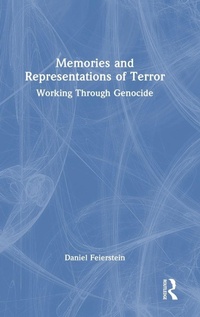
Memories and Representations of Terror
Working Through Genocide
1st Edition
Published on 6. October 2023
Book
Hardback
140 pages
978-1-032-37328-7 (ISBN)
Description
Memories and Representations of Terror: Working Through Genocide explores how memories and representations shape our understanding of historical events, particularly the ways in which societies create narratives about genocide and its aftermath, using Argentina's last military dictatorship (1976-1983) and its contested legacy as a case study.
Feierstein examines how memories and representations of genocide are the terrain in which both the strategic objectives of genocide and the possibilities of challenging those objectives are contested. These memories and representations provide the foundation upon which critical judgments about the past are constructed and offer the potential for assuming responsibility and working through the consequences of genocide. This book proposes that terror continues to hijack the actions and identities of surviving societies via a process of the construction of memories and social representations of the lived experience in a final stage of genocide Feierstein terms "symbolic enactment". In doing so, Feierstein examines the contributions of various disciplines to comprehending memory processes and social representations. It covers a range of topics, from the nature of memory based on the neuroscientific discoveries of the last half-century to psychoanalytic theories on the functioning of the mind, including the role of psychic defense mechanisms, the unconscious mind, collective pacts of denial and different forms of desensitization. It also explores historiographical debates between forms of history and forms of memory, as well as sociological contributions to the analysis of social frames of memory, cultural memory, generational transmission and related issues.
The first volume of a three-volume work that aims to identify and evaluate the various consequences of genocidal social practices and the possibility of healing the scars left on individuals' subjectivities and the social fabric by genocide. This book is essential reading for students and academics in the humanities and social sciences with an interest in genocide, collective memory and identity.
Feierstein examines how memories and representations of genocide are the terrain in which both the strategic objectives of genocide and the possibilities of challenging those objectives are contested. These memories and representations provide the foundation upon which critical judgments about the past are constructed and offer the potential for assuming responsibility and working through the consequences of genocide. This book proposes that terror continues to hijack the actions and identities of surviving societies via a process of the construction of memories and social representations of the lived experience in a final stage of genocide Feierstein terms "symbolic enactment". In doing so, Feierstein examines the contributions of various disciplines to comprehending memory processes and social representations. It covers a range of topics, from the nature of memory based on the neuroscientific discoveries of the last half-century to psychoanalytic theories on the functioning of the mind, including the role of psychic defense mechanisms, the unconscious mind, collective pacts of denial and different forms of desensitization. It also explores historiographical debates between forms of history and forms of memory, as well as sociological contributions to the analysis of social frames of memory, cultural memory, generational transmission and related issues.
The first volume of a three-volume work that aims to identify and evaluate the various consequences of genocidal social practices and the possibility of healing the scars left on individuals' subjectivities and the social fabric by genocide. This book is essential reading for students and academics in the humanities and social sciences with an interest in genocide, collective memory and identity.
More details
Language
English
Place of publication
London
United Kingdom
Publishing group
Taylor & Francis Ltd
Target group
College/higher education
Postgraduate and Undergraduate Advanced
Dimensions
Height: 240 mm
Width: 161 mm
Thickness: 13 mm
Weight
399 gr
ISBN-13
978-1-032-37328-7 (9781032373287)
Copyright in bibliographic data and cover images is held by Nielsen Book Services Limited or by the publishers or by their respective licensors: all rights reserved.
Schweitzer Classification
Other editions
Additional editions
E-Book
10/2023
1st Edition
Routledge
€55.49
Available for download
Book
10/2023
1st Edition
Routledge
€62.40
Shipment within 10-20 days
E-Book
10/2023
1st Edition
Routledge
€55.49
Available for download
Person
Daniel Feierstein is Director of the Centre of Genocide Studies at the National University of Tres de Febrero, Argentina and Director of the Observatory of State Crimes at the University of Buenos Aires, Argentina. He is also a Senior Researcher at the National Research Council of Argentina (CONICET). His work primarily focuses on genocidal social practices and has been crucial in the increased recognition of the Argentine military junta's crimes as genocide. He is a previous President of the International Association of Genocide Scholars and has acted as a judge on the Permanent People's Tribunal in Sri Lanka, Mexico, Myanmar and Colombia. He is the author of several books, including Genocide as a Social Practice: Reorganizing Society under the Nazis and Argentina?s Military Juntas (2014) and Social and Political Representations of the COVID-19 Crisis (Routledge, 2022). During the COVID-19 pandemic, Feierstein participated in numerous National and Provincial Advisory Councils in Argentina assessing the social aspects of the crisis.
Content
Introduction
1. Neuroscience and memory processes
2. Memory, trauma and working through
3. Memory processes in the social sciences, history and philosophy
4. Implications of concepts and representations for identity processes
5. The symbolic enactment of genocidal social practices
1. Neuroscience and memory processes
2. Memory, trauma and working through
3. Memory processes in the social sciences, history and philosophy
4. Implications of concepts and representations for identity processes
5. The symbolic enactment of genocidal social practices