

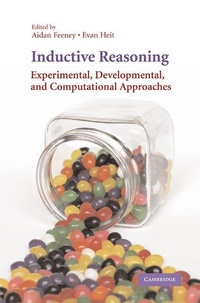
Inductive Reasoning
Experimental, Developmental, and Computational Approaches
Published on 3. September 2007
Book
Paperback/Softback
376 pages
978-0-521-67244-3 (ISBN)
Description
Without inductive reasoning, we couldn't generalize from one instance to another, derive scientific hypotheses, or predict that the sun will rise again tomorrow morning. Despite the widespread nature of inductive reasoning, books on this topic are rare. Indeed, this is the first book on the psychology of inductive reasoning in twenty years. The chapters survey recent advances in the study of inductive reasoning and address questions about how it develops, the role of knowledge in induction, how best to model people's reasoning, and how induction relates to other forms of thinking. Written by experts in philosophy, developmental science, cognitive psychology, and computational modeling, the contributions here will be of interest to a general cognitive science audience as well as to those with a more specialized interest in the study of thinking.
More details
Language
English
Place of publication
Cambridge
United Kingdom
Target group
Professional and scholarly
Product notice
Paperback (trade)
Illustrations
Worked examples or Exercises
Dimensions
Height: 229 mm
Width: 152 mm
Thickness: 22 mm
Weight
609 gr
ISBN-13
978-0-521-67244-3 (9780521672443)
Copyright in bibliographic data and cover images is held by Nielsen Book Services Limited or by the publishers or by their respective licensors: all rights reserved.
Schweitzer Classification
Other editions
Additional editions
Aidan Feeney | Evan Heit
Inductive Reasoning
Experimental, Developmental, and Computational Approaches
E-Book
01/2008
1st Edition
Cambridge University Press
€30.99
Available for download
Aidan Feeney | Evan Heit
Inductive Reasoning
Experimental, Developmental, and Computational Approaches
Book
09/2007
Cambridge University Press
€94.00
Shipment within 15-20 days
Persons
Aidan Feeney is Senior Lecturer in Psychology at Durham University. He received his B.A. in Psychology from Trinity College, Dublin in 1992 and completed his Ph.D. in the Centre for Thinking and Language at the University of Plymouth. He was appointed Lecturer in the Department of Psychology at Durham University in 1998 where he became Senior Lecturer in 2005. Dr Feeney's research has been supported by a number of grants from the Economic and Social Research Council (UK). He has published approximately twenty journal articles, book chapters, and papers on the psychology of hypothesis testing and reasoning. He has published articles in Thinking and Reasoning, Memory and Cognition, Psychonomic Bulletin and Review, British Journal of Psychology, Quarterly Journal of Experimental Psychology, and Applied Cognitive Psychology. Evan Heit is currently Professor of Psychology and Cognitive Science, and Founding Faculty, at the University of California, Merced. Previously, Professor Heit was on the faculty in the Psychology Department of the University of Warwick, UK. He has undergraduate degrees in Computer Science and Psychology from the University of Pennsylvania and a Ph.D. from Stanford University. He also carried out post-doctoral research at the University of Michigan and Northwestern University. Professor Heit has published more than fifty papers on the psychology of reasoning, memory, and categorization. His research has been funded by the National Science Foundation, the National Institutes of Health, the Economic and Social Research Council (UK), and the Biotechnology and Biological Sciences Research Council (UK). He is currently on the editorial board of Memory and Cognition and the Journal of Experimental Psychology: Learning, Memory, and Cognition, and is Associate Editor of the Journal of Memory and Language.
Content
Preface Aidan Feeney and Evan Heit; 1. What is induction and why study it? Evan Heit; 2. The development of inductive reasoning Brett K. Hayes; 3. Interpreting asymmetries of projection in children's inductive reasoning Douglas Medin and Sandra Waxman; 4. Property generalization as causal reasoning Bob Rehder; 5. Availability in category-based induction Patrick Shafto, John Coley and Anna Vitkin; 6. From similarity to chance Sergey Blok, Daniel Osherson and Douglas Medin; 7. Theory-based Bayesian models of inductive reasoning Joshua Tenenbaum, Charles Spence and Patrick Shafto; 8. Use of single or multiple categories in category-based induction Gregory Murphy and Brian Ross; 9. Abductive inference: From philosophical analysis to neutral mechanisms Paul Thagard; 10. Mathematical induction and induction in mathematics Lance Rips and Jennifer Asmuth; 11. Induction, deduction, and argument strength in human reasoning and argumentation Mike Oaksford and Ulrike Hahn; 12. Individual differences, dual processes, and induction Aidan Feeney; 13. Taxonomising induction Steve Sloman.