

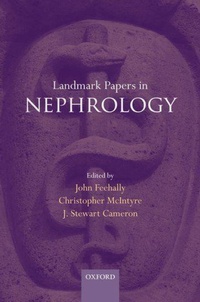
Landmark Papers in Nephrology
Published on 7. March 2013
Book
Hardback
464 pages
978-0-19-969925-4 (ISBN)
Description
Landmarks in Nephrology points the reader to some of the seminal observations which have led to the practice of nephrology as we know it today.
Twenty areas of nephrology are covered by discrete chapters, with the editors selecting the ten most important papers ever published in that field. These range from observational and experimental studies from the 18th century, which laid the groundwork for our current understanding of the kidney, through to recent randomized controlled clinical trials. The papers also reflect the emergence of nephrology as a speciality in the last fifty years, stimulated particularly by the introduction of renal biopsy and the development of dialysis and transplantation as effective forms of renal replacement therapy. For each paper, there is a succinct commentary which highlights the importance of the work in its historical context, as well as a recommended reading section to encourage the interested reader to explore further.
It is of course a near-impossible task to choose only two hundred papers from the whole oeuvre of nephrology. However, these chosen few are undoubtedly among the great landmarks of nephrology, reflecting the varying coincidences of brilliance, persistence, and good fortune which are necessary for progress in medical science. Encompassing the breadth, range and depth of the intellectual journey which precedes us in the development of nephrology, they provide a telling illustration of Sir Isaac Newton's words to Robert Hooke in 1675: 'If I have seen further, it is by standing on the shoulders of giants'.
Twenty areas of nephrology are covered by discrete chapters, with the editors selecting the ten most important papers ever published in that field. These range from observational and experimental studies from the 18th century, which laid the groundwork for our current understanding of the kidney, through to recent randomized controlled clinical trials. The papers also reflect the emergence of nephrology as a speciality in the last fifty years, stimulated particularly by the introduction of renal biopsy and the development of dialysis and transplantation as effective forms of renal replacement therapy. For each paper, there is a succinct commentary which highlights the importance of the work in its historical context, as well as a recommended reading section to encourage the interested reader to explore further.
It is of course a near-impossible task to choose only two hundred papers from the whole oeuvre of nephrology. However, these chosen few are undoubtedly among the great landmarks of nephrology, reflecting the varying coincidences of brilliance, persistence, and good fortune which are necessary for progress in medical science. Encompassing the breadth, range and depth of the intellectual journey which precedes us in the development of nephrology, they provide a telling illustration of Sir Isaac Newton's words to Robert Hooke in 1675: 'If I have seen further, it is by standing on the shoulders of giants'.
Reviews / Votes
What is the niche for this book and who should buy it? First and foremost, it has to be said that it is truly unique. It will be quite useful for seasoned nephrologists and trainees alike, especially if they want to take a closer look at the origins of our current clinical practice. Young researchers may find it thought provoking as well in that one can learn how seminal discoveries and renal research evolved throughout the centuries ... what it does well is give a fascinating insight into the history of our specialty and presents many of the groundbreaking papers that shaped this history. * Arvind Ponnusamy and Alexander Woywodt, Clinical Kidney Journal *More details
Series
Language
English
Place of publication
Oxford
United Kingdom
Target group
Professional and scholarly
Essential reading for clinical nephrologists (adult and paediatric), renal pathologists, and any student of medical history.
Product notice
sewn/stitched
Cloth over boards
Illustrations
100 black and white line drawings
Dimensions
Height: 246 mm
Width: 168 mm
Thickness: 30 mm
Weight
939 gr
ISBN-13
978-0-19-969925-4 (9780199699254)
Copyright in bibliographic data and cover images is held by Nielsen Book Services Limited or by the publishers or by their respective licensors: all rights reserved.
Schweitzer Classification
Other editions
Additional editions
John Feehally | Christopher McIntyre | J. Stewart Cameron
Landmark Papers in Nephrology
E-Book
03/2013
OUP eBook
€100.99
Available for download
Persons
John Feehally is Consultant Nephrologist at Leicester General Hospital, and Professor of Renal Medicine at the University of Leicester. His particular clinical interests are in glomerulonephritis and renal transplantation. His major laboratory research programme is in immune renal disease, especially IgA nephropathy. He was President of the UK Renal Association [2004-2007], and is now President of the International Society of Nephrology [2011-2013].
Prof Chris McIntyre graduated in Medicine from Charing Cross and Westminster Medical School (London University). Specialising in renal disease, Dr McIntyre was initially a registrar at University College Hospitals in London prior to becoming a Lecturer in Nephrology at The Royal London Hospitals.
Prof McIntyre leads a team of multidisciplinary researchers focussed largely on the pathophysiology of the widespread abnormalities of cardiovascular function and body composition in chronic kidney disease patients. These studies have increasingly focussed on the adverse consequences resulting from dialysis therapy itself.
J. Stewart Cameron is Emeritus Professor of Renal Medicine Department of Nephrology, Dialysis and Transplantation, King's College London (Guy's Hospital). He was President of the International Society of Nephrology from 1993 to 1995. His interests include the growth and formation of science-based studies
of the kidney from the eighteenth century onwards.
Prof Chris McIntyre graduated in Medicine from Charing Cross and Westminster Medical School (London University). Specialising in renal disease, Dr McIntyre was initially a registrar at University College Hospitals in London prior to becoming a Lecturer in Nephrology at The Royal London Hospitals.
Prof McIntyre leads a team of multidisciplinary researchers focussed largely on the pathophysiology of the widespread abnormalities of cardiovascular function and body composition in chronic kidney disease patients. These studies have increasingly focussed on the adverse consequences resulting from dialysis therapy itself.
J. Stewart Cameron is Emeritus Professor of Renal Medicine Department of Nephrology, Dialysis and Transplantation, King's College London (Guy's Hospital). He was President of the International Society of Nephrology from 1993 to 1995. His interests include the growth and formation of science-based studies
of the kidney from the eighteenth century onwards.
Content
1. Glomerular Structure & Function ; 2. Tubular Structure & Function ; 3. Investigation of Renal Disease ; 4. Inherited Renal Disease ; 5. Glomerular Disease before 1950 ; 6. Primary Glomerular Disease since 1950 ; 7. Secondary Glomerular Disease ; 8. Infection and Renal Disease ; 9. Diabetes and renal disease ; 10. Acute Kidney Injury ; 11. Chronic Kidney Disease ; 12. Haemodialysis ; 13. Vascular Access for Haemodialysis ; 14. Peritoneal Dialysis ; 15. Transplantation ; 16. Cardiovascular disease ; 17. Bone and Mineral Metabolism in Chronic Kidney Disease ; 18. Renal Anaemia ; 19. Clinical Epidemiology ; 20. Health-related quality of life and the patient perspective