

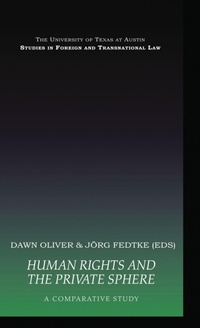
Human Rights and the Private Sphere vol 1
A Comparative Study
1st Edition
Published on 28. June 2007
Book
Hardback
604 pages
978-0-415-42301-4 (ISBN)
Description
Particularly valuable for both academics and practitioners, Human Rights and the Private Sphere: A Comparative Study analyzes the interaction between constitutional rights, freedoms and private law.
Focusing primarily on civil and political rights, an international team of constitutional and private law experts have contributed a collection of chapters, each based around a different jurisdiction. They include Denmark, France, Germany, India, Ireland, Israel, Italy, New Zealand, the UK, the US, the European Convention for the Protection of Human Rights and Fundamental Freedoms and the European Union.
As well as exploring, chapter by chapter, the key topics and debates in each jurisdiction, a comparative analysis draws the sections together; setting-out the common features and differences in the jurisdictions under review and identifies some common trends in this important area of the law.
Cross-references between the various chapters and an appendix containing relevant legislative material and translated quotations from important court decisions makes this volume a valuable tool for those studying and working in the field of international human rights law.
Focusing primarily on civil and political rights, an international team of constitutional and private law experts have contributed a collection of chapters, each based around a different jurisdiction. They include Denmark, France, Germany, India, Ireland, Israel, Italy, New Zealand, the UK, the US, the European Convention for the Protection of Human Rights and Fundamental Freedoms and the European Union.
As well as exploring, chapter by chapter, the key topics and debates in each jurisdiction, a comparative analysis draws the sections together; setting-out the common features and differences in the jurisdictions under review and identifies some common trends in this important area of the law.
Cross-references between the various chapters and an appendix containing relevant legislative material and translated quotations from important court decisions makes this volume a valuable tool for those studying and working in the field of international human rights law.
More details
Series
Language
English
Place of publication
London
United Kingdom
Publishing group
Taylor & Francis Ltd
Target group
College/higher education
Professional and scholarly
Illustrations
15 s/w Tabellen
15 Tables, black and white
Dimensions
Height: 222 mm
Width: 145 mm
Thickness: 36 mm
Weight
883 gr
ISBN-13
978-0-415-42301-4 (9780415423014)
Copyright in bibliographic data and cover images is held by Nielsen Book Services Limited or by the publishers or by their respective licensors: all rights reserved.
Schweitzer Classification
Other editions
Additional editions
Book
07/2008
1st Edition
Routledge Cavendish
€73.00
Shipment within 15-20 days
E-Book
08/2007
1st Edition
Routledge Cavendish
€64.49
Available for download
E-Book
08/2007
1st Edition
Routledge Cavendish
€64.49
Available for download
Persons
Dawn Oliver is Professor of Constitutional Law at University College London. She is particularly interested in constitutional reform, the UK Human Rights Act 1998, and the public law/private law divide. She recently published Constitutional Reform in the United Kingdom (OUP, 2003) and is co-editor of The Changing Constitution (OUP, 6th edn 2007). In 2005 she was elected a Fellow of the British Academy.
Joerg Fedtke is Reader in Laws at University College London, where he is Director of the Institute of Global Law. He also holds a post as Visiting Professor at the University of Texas at Austin, where he teaches European Union and comparative constitutional law. In 2005 he was invited by the United Nations to act as an external advisor to the constitutional negotiations in Iraq. His research interests are in constitutional law, administrative law, comparative methodology and tort law.
Joerg Fedtke is Reader in Laws at University College London, where he is Director of the Institute of Global Law. He also holds a post as Visiting Professor at the University of Texas at Austin, where he teaches European Union and comparative constitutional law. In 2005 he was invited by the United Nations to act as an external advisor to the constitutional negotiations in Iraq. His research interests are in constitutional law, administrative law, comparative methodology and tort law.
Content
Part 1: Introduction General Introduction 1. Common Lines of Enquiry Part 2: Jurisdiction-based Chapters 2. European Court of Human Rights 3. European Union 4. Denmark 5. France 6. Germany 7. Greece 8. India 9. Ireland 10. Israel 11. Italy 12. South Africa 13. Spain 14. United Kingdom 15. USA and Canada 14. Hypothetical Part 3 Conclusions 15. Comparative Analysis 16. Conclusions