

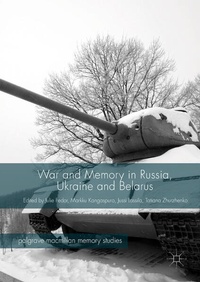
War and Memory in Russia, Ukraine and Belarus
Published on 18. December 2017
Book
Hardback
XXVII, 506 pages
978-3-319-66522-1 (ISBN)
Description
This edited collection contributes to the current vivid multidisciplinary debate on East European memory politics and the post-communist instrumentalization and re-mythologization of World War II memories. The book focuses on the three Slavic countries of post-Soviet Eastern Europe - Russia, Ukraine and Belarus - the epicentre of Soviet war suffering, and the heartland of the Soviet war myth. The collection gives insight into the persistence of the Soviet commemorative culture and the myth of the Great Patriotic War in the post-Soviet space. It also demonstrates that for geopolitical, cultural, and historical reasons the political uses of World War II differ significantly across Ukraine, Russia and Belarus, with important ramifications for future developments in the region and beyond.
The chapters 'Introduction: War and Memory in Russia, Ukraine and Belarus', 'From the Trauma of Stalinism to the Triumph of Stalingrad: The Toponymic Dispute over Volgograd' and 'The "Partisan Republic": Colonial Myths and Memory Wars in Belarus' are published open access under a CC BY 4.0 license at link.springer.com.
The chapter 'Memory, Kinship, and Mobilization of the Dead: The Russian State and the "Immortal Regiment" Movement' is published open access under a CC BY-NC-ND 4.0 license at link.springer.com.
The chapters 'Introduction: War and Memory in Russia, Ukraine and Belarus', 'From the Trauma of Stalinism to the Triumph of Stalingrad: The Toponymic Dispute over Volgograd' and 'The "Partisan Republic": Colonial Myths and Memory Wars in Belarus' are published open access under a CC BY 4.0 license at link.springer.com.
The chapter 'Memory, Kinship, and Mobilization of the Dead: The Russian State and the "Immortal Regiment" Movement' is published open access under a CC BY-NC-ND 4.0 license at link.springer.com.
Reviews / Votes
"As information war and political fiction blurs the boundaries between past, present, and future, we are very fortunate to have this collection of sober and precise studies from noted historians and social scientists. As we are beginning to understand, in matters concerning the exploitation of the past, trends are now moving from east to west, and so a study of Russia, Ukraine, and Belarus is also of great interest in the contemporary West." (Timothy Snyder, Housum Professor of History at Yale University, USA and permanent fellow at the Institute for Human Sciences in Vienna, Austria)
"This book gives convincing answers to the question how World War II is remembered in the three East Slavic countries and how this memory is instrumentalized in politics of history, both on the national and regional level. It is based on an impressive array of new sources and previous research on the topic in English, Russian, Ukrainian, Belarusian and German." (Stefan Troebst, Leipzig University,GermanyMore details
Series
Edition
2017 ed.
Language
English
Place of publication
Cham
Switzerland
Publishing group
Springer International Publishing
Target group
Professional and scholarly
Illustrations
2 s/w Abbildungen, 19 farbige Abbildungen
XXVII, 506 p. 21 illus., 19 illus. in color.
Dimensions
Height: 216 mm
Width: 153 mm
Thickness: 34 mm
Weight
798 gr
ISBN-13
978-3-319-66522-1 (9783319665221)
DOI
10.1007/978-3-319-66523-8
Schweitzer Classification
Other editions
Additional editions
Julie Fedor | Markku Kangaspuro | Jussi Lassila
War and Memory in Russia, Ukraine and Belarus
Book
09/2018
Palgrave Macmillan
€160.49
Shipment within 10-15 days
Julie Fedor | Markku Kangaspuro | Jussi Lassila
War and Memory in Russia, Ukraine and Belarus
E-Book
12/2017
1st Edition
Palgrave Macmillan
€149.79
Available for download
Persons
Julie Fedor is Lecturer in Modern European History in the School of Historical and Philosophical Studies at the University of Melbourne, Australia.
Markku Kangaspuro is Professor and Research Director at the Aleksanteri Institute at the University of Helsinki, Finland.
Jussi Lassila works as a Senior Research Fellow at the Finnish Institute of International Affairs, Finland.
Tatiana Zhurzhenko is Research Director of the Ukraine and Russia Programs at the Institute for Human Sciences (IWM) in Vienna, Austria.
Markku Kangaspuro is Professor and Research Director at the Aleksanteri Institute at the University of Helsinki, Finland.
Jussi Lassila works as a Senior Research Fellow at the Finnish Institute of International Affairs, Finland.
Tatiana Zhurzhenko is Research Director of the Ukraine and Russia Programs at the Institute for Human Sciences (IWM) in Vienna, Austria.
Content
1. Introduction: War and Memory in Russia, Ukraine, and Belarus, by Julie Fedor, Simon M. Lewis and Tatiana Zhurzhenko.- Part I. Nation-Building and Memories of World War II.- 2. Political Uses of the Great Patriotic War in Post-Soviet Russia from Yeltsin to Putin, by Olga Malinova.- 3. "Unhappy is the Person who has no Motherland": National Ideology and History Writing in Lukashenka's Belarus, by Per Anders Rudling.- 4. Reclaiming the Past, Confronting the Past: OUN-UPA Memory Politics and Nation-Building in Ukraine (1991-2016), by Yuliya Yurchuk.- Part II. In Stalin's Shadow.- 5. From the Trauma of Stalinism to the Triumph of Stalingrad: The Toponymic Dispute over Volgograd, by Markku Kangaspuro and Jussi Lassila.- 6. When Stalin Lost His Head: World War II and Memory Wars in Contemporary Ukraine, by Serhii Plokhy.- 7. "We Should be Proud not Sorry": Neo-Stalinist Literature in Contemporary Russia, by Philipp Chapkovski.- Part III. New Agents and Communities of Memory.- 8. Successors to the Great Victory: Afghan Veterans in Post-Soviet Belarus, by Felix Ackermann.- 9. Generational Memory and the Post-Soviet Welfare State: Institutionalizing the "Children of War" in Post-Soviet Russia, by Tatiana Zhurzhenko.- 10. Ostarbeiters of the Third Reich in Ukrainian and European Public Discourses: Restitution, Recognition, Commemoration, by Gelinada Grinchenko.- Part IV. Old/New Narratives and Myths.- 11. Memory, Kinship, and Mobilization of the Dead: the Russian State and the "Immortal Regiment" Movement, by Julie Fedor.- 12. The Holocaust in the Public Discourse of Post-Soviet Ukraine, by Andriy Portnov.- 13. The "Partisan Republic": Colonial Myths and Memory Wars in Belarus, by Simon M. Lewis.- Part V. Local Cases.-14. Great Patriotic War Memory in Sevastopol: Making Sense of Suffering in the "City of Military Glory", by Judy Brown.- 15. On Victims and Heroes: (Re)assembling World War II Memory in Border City of Narva, by Elena Nikiforova.- 16. War Memorials in Karelia: A Place of Sorrow or Glory?, by Aleksandr V. Antoshchenko, Irina S. Shtykova, and Valentina V. Volokhova.