

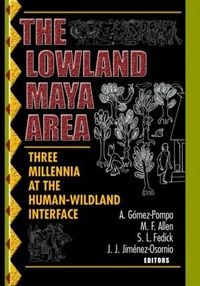
The Lowland Maya Area
Three Millennia at the Human-Wildland Interface
1st Edition
Will be published approx. on 3. October 2003
Book
Hardback
660 pages
978-1-56022-970-4 (ISBN)
Description
What can we learn from the people of the Maya Lowlands?
Integrating history, biodiversity, ethnobotany, geology, ecology, archaeology, anthropology, and other disciplines, The Lowland Maya Area is a valuable guide to the fascinating relationship between man and his environment in the Yucatan peninsula. This book covers virtually every aspect of the biology and ecology of the Maya Lowlands and the many ways that human beings have interacted with their surroundings in that area for the last three thousand years. You'll learn about newly discovered archaeological evidence of wetland use; the domestication and use of cacao and henequen plants; a biodiversity assessment of a select group of plants, animals, and microorganisms; the area's forgotten cotton, indigo, and wax industries; the ecological history of the Yucatan Peninsula; and much more. This comprehensive book will open your eyes to all that we can learn from the Maya people, who continue to live on their native lands, integrating modern life with their old ways and teaching valuable lessons about human dependence on and management of environmental resources.
The Lowland Maya Area explores:
the impact of hurricanes and fire on local environments
historic and modern Maya concepts of forests
the geologic history of the Yucatan
challenges to preserving Maya architecture
newly-discovered evidence of fertilizer use among the ancient Maya
cooperation between locals and researchers that fosters greater knowledge on both sides
recommendations to help safeguard the future
The Lowland Maya Area is an ideal single source for reliable information on the many ecological and social issues of this dynamic area. Providing you with the results of the most recent research into many diverse fields, including traditional ecological knowledge, the difficult transition to capitalism, agave production, and the diversity of insect species, this book will be a valuable addition to your collection.
As the editors of The Lowland Maya Area say in their concluding chapter: If we are to gain global perspective from the changing Maya world, it is that understanding space and time is absolutely critical to human persistence. Understanding how the Maya have interacted with their environment for thousands of years while maintaining biodiversity will help us understand how we too can work for sustainable development in our own environments.
Integrating history, biodiversity, ethnobotany, geology, ecology, archaeology, anthropology, and other disciplines, The Lowland Maya Area is a valuable guide to the fascinating relationship between man and his environment in the Yucatan peninsula. This book covers virtually every aspect of the biology and ecology of the Maya Lowlands and the many ways that human beings have interacted with their surroundings in that area for the last three thousand years. You'll learn about newly discovered archaeological evidence of wetland use; the domestication and use of cacao and henequen plants; a biodiversity assessment of a select group of plants, animals, and microorganisms; the area's forgotten cotton, indigo, and wax industries; the ecological history of the Yucatan Peninsula; and much more. This comprehensive book will open your eyes to all that we can learn from the Maya people, who continue to live on their native lands, integrating modern life with their old ways and teaching valuable lessons about human dependence on and management of environmental resources.
The Lowland Maya Area explores:
the impact of hurricanes and fire on local environments
historic and modern Maya concepts of forests
the geologic history of the Yucatan
challenges to preserving Maya architecture
newly-discovered evidence of fertilizer use among the ancient Maya
cooperation between locals and researchers that fosters greater knowledge on both sides
recommendations to help safeguard the future
The Lowland Maya Area is an ideal single source for reliable information on the many ecological and social issues of this dynamic area. Providing you with the results of the most recent research into many diverse fields, including traditional ecological knowledge, the difficult transition to capitalism, agave production, and the diversity of insect species, this book will be a valuable addition to your collection.
As the editors of The Lowland Maya Area say in their concluding chapter: If we are to gain global perspective from the changing Maya world, it is that understanding space and time is absolutely critical to human persistence. Understanding how the Maya have interacted with their environment for thousands of years while maintaining biodiversity will help us understand how we too can work for sustainable development in our own environments.
More details
Language
English
Place of publication
Bosa Roca
United States
Publishing group
Taylor & Francis Inc
Target group
Professional
Dimensions
Height: 210 mm
Width: 148 mm
Weight
1179 gr
ISBN-13
978-1-56022-970-4 (9781560229704)
Copyright in bibliographic data and cover images is held by Nielsen Book Services Limited or by the publishers or by their respective licensors: all rights reserved.
Schweitzer Classification
Other editions
Additional editions
Scott Fedick | Michael Allen | Juan Jim?nez-Osornio
The Lowland Maya Area
Three Millennia at the Human-Wildland Interface
E-Book
11/2024
1st Edition
CRC Press
€165.99
Available for download
Scott Fedick | Michael Allen | Juan Jim?nez-Osornio
The Lowland Maya Area
Three Millennia at the Human-Wildland Interface
E-Book
11/2024
1st Edition
CRC Press
€165.99
Available for download
Scott Fedick | Michael Allen | Juan Jim?nez-Osornio
The Lowland Maya Area
Three Millennia at the Human-Wildland Interface
Book
09/2003
1st Edition
CRC Press
€166.50
Shipment within 3-4 weeks
Persons
Scott Fedick, Michael Allen, Juan Jimmez-Osornio, A. Gomez-Pompa
Content
About the Editors , Contributors , Foreword , Acknowledgments , Part I: Introduction , Chapter 1. Research Challenges for the Lowland Maya Area: An Introduction , Part II: The Biological and Physical Environment , Chapter 2. The Changing Global Environment and the Lowland Maya: Past Patterns and Current Dynamics , Introduction , Past Environments and the Yucatan Peninsula , The El Eden Tropical Seasonal Forest: Current Ecosystem Structure , Ecosystem Dynamics: Current versus Past , Current and Projected Environmental Change and the Yucatan Peninsula , Conclusion , Chapter 3. In the Beginning: Early Events in the Development of Mesoamerica and the Lowland Maya Area , Introduction , Geologic History , Climatic History , Vegetational History , Conclusion , Chapter 4. Paleolimnological Approaches for Inferring Past Climate Change in the Maya Region: Recent Advances and Methodological Limitations , Introduction , Theoretical Basis for Isotope-Based Paleoclimate Studies , Choosing a Study Site , Complementary Sediment Proxies , Results and Discussion , Chapter 5. Rhythms of Precipitation in the Yucatan Peninsula , Introduction , Experimental Details , Normal Conditions for the Yucatan Peninsula , Yucatan in the Context of SPI-12 of All Mexico , Periodicity , Typical Patterns , Conclusion , Chapter 6. Structure and Diversity of the Forests at the El Eden Ecological Reserve , Introduction , Study Area , Methods and Materials , Results , Discussion , Chapter 7. Hydrogeology of the Yucatan Peninsula , General Geology of the Northern Yucatan Peninsula , Soils , Regional Hydroge