

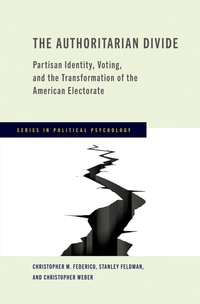
The Authoritarian Divide
Partisan Identity, Voting, and the Transformation of the American Electorate
Will be published approx. on 4. June 2026
Book
Hardback
240 pages
978-0-19-781334-8 (ISBN)
Description
Concerns about political polarization and threats to democratic ideals are on the rise in the US. The Authoritarian Divide takes on both of these issues by showing how authoritarian predispositions--desires for social conformity and in-group conformity--have influenced American political preferences, voting, and partisanship in recent decades. Voters have increasingly sorted into political parties based on their levels of authoritarianism, with higher levels tending toward the Republican Party and lower levels to Democratic. The authors reveal complexities in this trend, including the outsized effect on White Americans, the dependence on parties offering certain types of choices, and the different ways education level factors into the sorting process. Drawing from nationally representative samples, panel data, and experiments, the book demonstrates that authoritarianism has increasingly structured a wide range of attitudes and has become a growing influence on vote choice. The analysis carries crucial implications for partisan conflict and the future of American democracy.
More details
Series
Language
English
Place of publication
New York
United States
Product notice
sewn/stitched
Cloth over boards
Dimensions
Height: 236 mm
Width: 164 mm
Thickness: 22 mm
Weight
476 gr
ISBN-13
978-0-19-781334-8 (9780197813348)
Copyright in bibliographic data and cover images is held by Nielsen Book Services Limited or by the publishers or by their respective licensors: all rights reserved.
Schweitzer Classification
Persons
Christopher M. Federico is Professor of Political Science and Psychology at the University of Minnesota and the Arleen C. Carlson Professor of American Government and Politics. He currently serves as President of the International Society of Political Psychology and he is a former Director of the University of Minnesota's Center for the Study of Political Psychology. A political psychologist with interests that cross disciplinary boundaries, his research focuses in particular on the nature of ideology and belief systems, the psychological foundations of political preferences, and intergroup attitudes.
Stanley Feldman is a Toll Professor of Political Science at Stony Brook University. He is a past president of the International Society for Political Psychology and the Political Methodology section of the American Political Science Association. His research focuses on the origins of political preferences. He is particularly interested in the structure of political ideology and values, and
the psychological bases of attitudes and opinions. His published work has examined the impact of personality characteristics on political attitudes, particularly authoritarianism.
Christopher Weber is a Professor in the School of Government and Public Policy at the University of Arizona. His interests reside in political psychology and methodology, with a focus on political ideology, measurement, and causal inference. He currently serves as Director of the Arizona Voter Project, a non-partisan initiative supported by the University of Arizona to advance knowledge of the Arizona population through data visualization and analysis.
Stanley Feldman is a Toll Professor of Political Science at Stony Brook University. He is a past president of the International Society for Political Psychology and the Political Methodology section of the American Political Science Association. His research focuses on the origins of political preferences. He is particularly interested in the structure of political ideology and values, and
the psychological bases of attitudes and opinions. His published work has examined the impact of personality characteristics on political attitudes, particularly authoritarianism.
Christopher Weber is a Professor in the School of Government and Public Policy at the University of Arizona. His interests reside in political psychology and methodology, with a focus on political ideology, measurement, and causal inference. He currently serves as Director of the Arizona Voter Project, a non-partisan initiative supported by the University of Arizona to advance knowledge of the Arizona population through data visualization and analysis.
Author
Professor of Political Science and PsychologyProfessor of Political Science and Psychology, University of Minnesota
Toll Professor of Political ScienceToll Professor of Political Science, Stony Brook University
Professor, School of Government and Public PolicyProfessor, School of Government and Public Policy, University of Arizona
Content
- 1: The Authoritarian Tide
- 2: The Political and Psychological Dynamics of Authoritarianism
- 3: Assessing Authoritarianism in the American Public
- 4: The Authoritarian Belief System
- 5: The Contingent Trajectory of Authoritarian Sorting Among White Americans
- 6: Authoritarianism and the Mechanisms of Partisan Sorting
- 7: Authoritarianism and Sociocultural Issue Defection
- 8: Authoritarianism and Its Consequences in an Ideologically Divided Party System
- 9: Authoritarianism and Antidemocratic Attitudes in the Trump Era
- 10: Authoritarianism and the Future of American Democracy
- 11: Chapter Appendices