

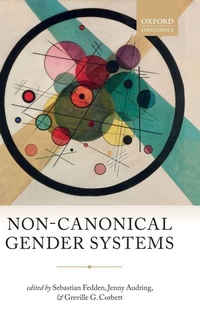
Non-Canonical Gender Systems
Published on 22. March 2018
Book
Hardback
300 pages
978-0-19-879543-8 (ISBN)
Description
This book explores the boundaries of the category of gender and their theoretical significance within the framework of Canonical Typology. Grammatical gender is a famously puzzling category: although it has been widely explored from a typological perspective, studies are constantly identifying exciting and unexpected patterns in gender systems, many of which cannot be easily classified or straightforwardly analysed. Some of these patterns stretch or even threaten to cross the largely unexplored outer boundaries of the category.
In the canonical approach, morphosyntactic features like gender are established in terms of a canonical ideal: the clearest instance of the phenomenon. The canonical ideal is a clustering of properties that serves as a baseline to measure the actual examples observed. In this volume, international experts use this approach to analyse a range of gender systems that diverge from the canonical ideal, and to determine to what extent each component property of these systems can be considered canonical. Chapters explore a wide range of typologically diverse languages from all over the world, from South America to Melanesia, and from Central Italy to Northern Australia. The book will be of interest to all linguists working in the field of typology, from graduate level upwards, as well as to morphologists and syntacticians of all theoretical stripes who have an interest in grammatical gender.
In the canonical approach, morphosyntactic features like gender are established in terms of a canonical ideal: the clearest instance of the phenomenon. The canonical ideal is a clustering of properties that serves as a baseline to measure the actual examples observed. In this volume, international experts use this approach to analyse a range of gender systems that diverge from the canonical ideal, and to determine to what extent each component property of these systems can be considered canonical. Chapters explore a wide range of typologically diverse languages from all over the world, from South America to Melanesia, and from Central Italy to Northern Australia. The book will be of interest to all linguists working in the field of typology, from graduate level upwards, as well as to morphologists and syntacticians of all theoretical stripes who have an interest in grammatical gender.
More details
Language
English
Place of publication
Oxford
United Kingdom
Target group
College/higher education
Professional and scholarly
Dimensions
Height: 240 mm
Width: 161 mm
Thickness: 21 mm
Weight
617 gr
ISBN-13
978-0-19-879543-8 (9780198795438)
Copyright in bibliographic data and cover images is held by Nielsen Book Services Limited or by the publishers or by their respective licensors: all rights reserved.
Schweitzer Classification
Other editions
Additional editions
Sebastian Fedden | Jenny Audring | Greville G. Corbett
Non-Canonical Gender Systems
E-Book
03/2018
1st Edition
OUP eBook
€58.99
Available for download
Persons
Sebastian Fedden is Professor of Linguistics at the University of Paris 3 (Sorbonne Nouvelle). He has an MA from the University of Bielefeld and a PhD from the University of Melbourne. He is a typologist who specializes in morphology, nominal classification, and Papuan languages. His book A Grammar of Mian (De Gruyter Mouton, 2011) won the Gabelentz Award Association for Linguistic Typology for the best published grammar from 2009 to 2012. He is currently working with Greville G. Corbett on refining the typology of nominal classification from the perspective of Canonical Typology.
Jenny Audring is Assistant Professor at the University of Leiden. She specializes in morphology and has written extensively on grammatical gender. Her research interests range from linguistic complexity and Canonical Typology to Construction Morphology. She is currently working on morphological theory together with Ray Jackendoff and Geert Booij. Her forthcoming volumes with OUP include The Texture of the Mental Lexicon (with Ray Jackendoff) and The Oxford Handbook of Morphological Theory (co-edited with Francesca Masini).
Greville G. Corbett is Distinguished Professor of Linguistics, University of Surrey, where he leads the Surrey Morphology Group. He researches the typology of features: Gender (1991), Number (2000), Agreement (2006), and Features (2012), all with CUP. With several colleagues, he has been developing the canonical approach to typology, as in the papers in Language, on suppletion (2007) and lexical splits (2015). He is co-editor, with Dunstan Brown and Marina Chumakina, of Canonical Morphology and Syntax (OUP 2012) and, with Matthew Baerman and Dunstan Brown, of Understanding and Measuring Morphological Complexity (OUP 2015).
Jenny Audring is Assistant Professor at the University of Leiden. She specializes in morphology and has written extensively on grammatical gender. Her research interests range from linguistic complexity and Canonical Typology to Construction Morphology. She is currently working on morphological theory together with Ray Jackendoff and Geert Booij. Her forthcoming volumes with OUP include The Texture of the Mental Lexicon (with Ray Jackendoff) and The Oxford Handbook of Morphological Theory (co-edited with Francesca Masini).
Greville G. Corbett is Distinguished Professor of Linguistics, University of Surrey, where he leads the Surrey Morphology Group. He researches the typology of features: Gender (1991), Number (2000), Agreement (2006), and Features (2012), all with CUP. With several colleagues, he has been developing the canonical approach to typology, as in the papers in Language, on suppletion (2007) and lexical splits (2015). He is co-editor, with Dunstan Brown and Marina Chumakina, of Canonical Morphology and Syntax (OUP 2012) and, with Matthew Baerman and Dunstan Brown, of Understanding and Measuring Morphological Complexity (OUP 2015).
Content
1: Jenny Audring & Sebastian Fedden: Introduction
2: Greville G. Corbett & Sebastian Fedden: New approaches to the typology of gender
3: Michael Franjieh: North Ambrym possessive classifiers from the perspective of canonical gender
4: Bernhard Waelchli: The rise of gender in Nalca (Mek, Tanah Papua): the drift towards the canonical gender attractor
5: Ruth Singer: The role of flexibility in a more integrated typology of nominal classification
6: Ellen Contini-Morava & Eve Danziger: Non-canonical gender in Mopan Maya
7: Tania Paciaroni & Michele Loporcaro: Overt gender marking depending on syntactic context in Ripano
8: Francesca Di Garbo & Yvonne Agbetsoamedo: Non-canonical gender in African languages: A typological survey of interactions between gender and number, and between gender and evaluative morphology
9: Francoise Rose: A typology of languages with genderlects and grammatical gender
2: Greville G. Corbett & Sebastian Fedden: New approaches to the typology of gender
3: Michael Franjieh: North Ambrym possessive classifiers from the perspective of canonical gender
4: Bernhard Waelchli: The rise of gender in Nalca (Mek, Tanah Papua): the drift towards the canonical gender attractor
5: Ruth Singer: The role of flexibility in a more integrated typology of nominal classification
6: Ellen Contini-Morava & Eve Danziger: Non-canonical gender in Mopan Maya
7: Tania Paciaroni & Michele Loporcaro: Overt gender marking depending on syntactic context in Ripano
8: Francesca Di Garbo & Yvonne Agbetsoamedo: Non-canonical gender in African languages: A typological survey of interactions between gender and number, and between gender and evaluative morphology
9: Francoise Rose: A typology of languages with genderlects and grammatical gender