

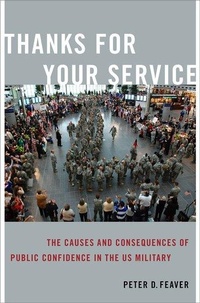
Thanks for Your Service
The Causes and Consequences of Public Confidence in the US Military
Published on 15. February 2024
Book
Paperback/Softback
328 pages
978-0-19-768113-8 (ISBN)
Description
A definitive study on the decades-long run of high public confidence in the military and why it may rest on some shaky foundations.
What explains the high levels of public confidence in the US military and does high confidence matter? In Thanks for Your Service, the eminent civil-military relations scholar Peter D. Feaver addresses this question and focuses on what it means for the military. Proprietary survey data show that confidence is partly based on public beliefs about the military's high competence, adherence to high professional ethics, and a determination to stand apart from the bitter divisions of partisan politics. However, as Feaver argues, confidence is also shaped by a partisan gap and by social desirability bias, the idea that some individuals express confidence in the military because they believe that is the socially approved attitude to hold. Not only does Feaver help us understand how and why the public has confidence in the military, but he also exposes problems that policymakers need to be aware of. Specifically, this book traces how confidence in the institution shapes public attitudes on the use of force and may not always reinforce best practices in democratic civil-military relations.
What explains the high levels of public confidence in the US military and does high confidence matter? In Thanks for Your Service, the eminent civil-military relations scholar Peter D. Feaver addresses this question and focuses on what it means for the military. Proprietary survey data show that confidence is partly based on public beliefs about the military's high competence, adherence to high professional ethics, and a determination to stand apart from the bitter divisions of partisan politics. However, as Feaver argues, confidence is also shaped by a partisan gap and by social desirability bias, the idea that some individuals express confidence in the military because they believe that is the socially approved attitude to hold. Not only does Feaver help us understand how and why the public has confidence in the military, but he also exposes problems that policymakers need to be aware of. Specifically, this book traces how confidence in the institution shapes public attitudes on the use of force and may not always reinforce best practices in democratic civil-military relations.
Reviews / Votes
This important book provides data that is going to fuel a decade of civil-military scholarship. Peter Feaver is the lighthouse for all of us in the field and shows conclusively that our military needs to work harder to keep its feet out of the wolf trap of partisan politics if it is to remain broadly respected by Americans. * Kori Schake, Director of Foreign and Defense Policy Studies, American Enterprise Institute * Peter Feaver is one of academe's most acute observers of American civil-military relations-and this book demonstrates both his scholarly rigor and his practical sense of how policy is actually made. A pathbreaking piece of scholarship. * Eliot A. Cohen, Robert E. Osgood Professor, Johns Hopkins SAIS * This searching analysis of the sources and impacts of our public's regard for its military provides a hard-eyed, unsentimental examination of potential dangers ahead. With currency, clarity, and rigor into how and why the military holds public confidence, this masterwork will be the go-to book providing both warning and direction at a crucial point in our history. * General Jim Mattis, US Marines (ret.) and 26th Secretary of Defense * No one-and I mean no one-knows more about the relationship among the military, our elected civilian officials, and the general populace than Peter Feaver. An insightful, important, and timely work. * General Martin Dempsey, 18th Chairman of the Joint Chiefs of Staff * One of Feaver's greatest contributions in Thanks for Your Service is his replication data available through Harvard's dataverse...the contribution made by his important new book, subsequent generations of civil - military relations scholars should thank Professor Feaver for his service to the field. * Heidi A. Urben, Armed Forces & Society * Peter Feaver's latest book is a must-read for Army general officers and command sergeants major, as well as for students and faculty at the U.S. Army War College and the U.S. Army Sergeants Major Academy. And it's a should-read for every senior officer and NCO. The substance of the book is that important. * Lt. Gen. James Dubik, ARMY magazine * Thanks for Your Service does an excellent job of empirically explaining why the public has high confidence in the US Armed Forces. * Lieutenant Colonel James "Andy" Nichols, Parameters Bookshelf *More details
Series
Language
English
Place of publication
New York
United States
Target group
Professional and scholarly
Product notice
Paperback (trade)
Unsewn / adhesive bound
Illustrations
67 b/w figures; 51 tables
Dimensions
Height: 235 mm
Width: 156 mm
Thickness: 21 mm
Weight
454 gr
ISBN-13
978-0-19-768113-8 (9780197681138)
Copyright in bibliographic data and cover images is held by Nielsen Book Services Limited or by the publishers or by their respective licensors: all rights reserved.
Schweitzer Classification
Other editions
Additional editions
Peter D. Feaver
Thanks for Your Service
The Causes and Consequences of Public Confidence in the US Military
Book
02/2024
Oxford University Press Inc
€84.18
Shipment within 15-20 days
Peter D. Feaver
Thanks for Your Service
The Causes and Consequences of Public Confidence in the US Military
E-Book
07/2023
OUP eBook
€18.49
Available for download
Peter D. Feaver
Thanks for Your Service
The Causes and Consequences of Public Confidence in the US Military
E-Book
07/2023
OUP eBook
€18.49
Available for download
Person
Peter D. Feaver is a Professor of Political Science and Public Policy at Duke University. He is Director of the Duke Program in American Grand Strategy and co-PI of the America in the World Consortium. Feaver is also the author of Armed Servants: Agency, Oversight, and Civil-Military Relations (2003) and Guarding the Guardians: Civilian Control of Nuclear Weapons in the United States (1992). He is co-author of Paying the Human Costs of War (with Christopher Gelpi and Jason Reifler, 2009); Getting the Best Out of College (with Susan Wasiolek and Anne Crossman, 2008, 2nd edition 2012); and Choosing Your Battles: American Civil-Military Relations and the Use of Force (with Christopher Gelpi, 2004). He has published numerous other monographs, scholarly articles, book chapters, and policy pieces on grand strategy, American foreign policy, public opinion, nuclear proliferation, civil-military relations, and cybersecurity. Feaver served on the NSC staff in both the Clinton (as a
Director for Defense Policy and Arms Control, 1993-1994) and Bush (as Special Advisor for Strategic Planning and Institutional Reform, 2005-2007) administrations. He is a member of the Aspen Strategy Group.
Director for Defense Policy and Arms Control, 1993-1994) and Bush (as Special Advisor for Strategic Planning and Institutional Reform, 2005-2007) administrations. He is a member of the Aspen Strategy Group.
Content
Acknowledgments
List of Tables
List of Figures
Chapter 1: Introduction
PART I: Who Has Confidence in the Military?
Chapter 2: Confidence in the Military Over Time and Today
Chapter 3: Confidence and the Gaps: Knowledge, Media, Education, Social Contact
PART II: Why Do People Have Confidence in the Military
Chapter 4: How Confidence in the Military Relates to Confidence in other Institutions
Chapter 5: Performance, Professional Ethics and Public Confidence
Chapter 6: Politics, Politicization and Public Confidence
Chapter 7: How Social Desirability Bias Props Up Public Support for the Military
PART III: Why Confidence in the Military Matters
Chapter 8: Whether/How Confidence Shapes Concrete Support for the Military
Chapter 9: Whether/How Confidence Shapes Attitudes about the Military as an Instrument of Foreign Policy
Chapter 10: Whether/How Confidence Shapes Intangible Benefits Enjoyed By the Military
Chapter 11: Conclusion
List of References
Index
List of Tables
List of Figures
Chapter 1: Introduction
PART I: Who Has Confidence in the Military?
Chapter 2: Confidence in the Military Over Time and Today
Chapter 3: Confidence and the Gaps: Knowledge, Media, Education, Social Contact
PART II: Why Do People Have Confidence in the Military
Chapter 4: How Confidence in the Military Relates to Confidence in other Institutions
Chapter 5: Performance, Professional Ethics and Public Confidence
Chapter 6: Politics, Politicization and Public Confidence
Chapter 7: How Social Desirability Bias Props Up Public Support for the Military
PART III: Why Confidence in the Military Matters
Chapter 8: Whether/How Confidence Shapes Concrete Support for the Military
Chapter 9: Whether/How Confidence Shapes Attitudes about the Military as an Instrument of Foreign Policy
Chapter 10: Whether/How Confidence Shapes Intangible Benefits Enjoyed By the Military
Chapter 11: Conclusion
List of References
Index