

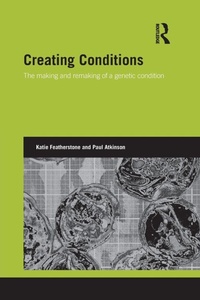
Creating Conditions
The making and remaking of a genetic syndrome
1st Edition
Published on 18. February 2014
Book
Paperback/Softback
144 pages
978-1-138-01992-8 (ISBN)
Description
Based on original ethnographic research with scientists, clinicians and families, this book examines Rett syndrome to illuminate more general issues concerning the construction and interpretation of diseases and syndromes. It derives from research with a specialist team of clinicians and scientists, and a series of families referred with a potential diagnosis of Rett syndrome, and documents the scientific, clinical, patient and family experiences over a three-year period.
Although Rett syndrome itself is rare, it is one of some 2,000 such syndromes, and its genetic basis has recently been linked to the much broader Autism spectrum. From a sociological or anthropological point of view, it is also of considerable interest as a clinical entity that is undergoing transformation in the light of recent post-genomic research. Traditionally, such syndromes have been diagnosed clinically, but increasingly genetic technologies are having an impact on the diagnosis, description and classification of conditions. Rett Syndrome is thus a key exemplar of the implications of genetic medicine that are far-reaching and extend well beyond this particular syndrome.
Although Rett syndrome itself is rare, it is one of some 2,000 such syndromes, and its genetic basis has recently been linked to the much broader Autism spectrum. From a sociological or anthropological point of view, it is also of considerable interest as a clinical entity that is undergoing transformation in the light of recent post-genomic research. Traditionally, such syndromes have been diagnosed clinically, but increasingly genetic technologies are having an impact on the diagnosis, description and classification of conditions. Rett Syndrome is thus a key exemplar of the implications of genetic medicine that are far-reaching and extend well beyond this particular syndrome.
More details
Series
Language
English
Place of publication
London
United Kingdom
Publishing group
Taylor & Francis Ltd
Target group
College/higher education
Dimensions
Height: 234 mm
Width: 156 mm
Thickness: 8 mm
Weight
231 gr
ISBN-13
978-1-138-01992-8 (9781138019928)
Copyright in bibliographic data and cover images is held by Nielsen Book Services Limited or by the publishers or by their respective licensors: all rights reserved.
Schweitzer Classification
Other editions
Additional editions
E-Book
03/2013
1st Edition
Routledge
€55.49
Available for download
E-Book
03/2013
1st Edition
Routledge
€55.49
Available for download
Book
09/2011
1st Edition
Routledge
€241.20
Shipment within 15-20 days
Persons
Katie Featherstone is Senior Lecturer within the Cardiff School of Nursing and Midwifery and a Research Fellow at Cesagen, Cardiff University. A sociologist of medicine, her recent ethnographic work includes an examination of the social consequences and clinical utilization of new genetic technologies, specifically within dysmorphology, a specialism of clinical genetics, and an examination of kinship and disclosure in the context of genetic information (The Wellcome Trust).
Paul Atkinson is Distinguished Research Professor of Sociology at Cardiff University. He is an Academician of the Academy of Social Sciences. Recent publications include Everyday Arias: An Operatic Ethnography and Contours of Culture, with Sara Delamont and William Housley. Together with Sara Delamont he edits the journal Qualitative Research. He is currently conducting ethnographic work in art-makers' studios.
Paul Atkinson is Distinguished Research Professor of Sociology at Cardiff University. He is an Academician of the Academy of Social Sciences. Recent publications include Everyday Arias: An Operatic Ethnography and Contours of Culture, with Sara Delamont and William Housley. Together with Sara Delamont he edits the journal Qualitative Research. He is currently conducting ethnographic work in art-makers' studios.
Content
1. Multiple Sites of a Syndrome 2. Making Medical Entities 3. The Culture of the Clinic 4. The Transformation of Patienthood 5. Transforming Rett Syndrome 6. The Making and Re-making of Medical Classifications