

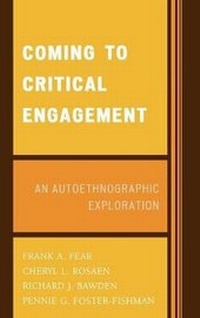
Coming to Critical Engagement
An Autoethnographic Exploration
Published on 27. September 2006
Book
Hardback
324 pages
978-0-7618-3470-0 (ISBN)
Description
Engagement is the label increasingly embraced by higher education to describe activities associated with serving the public interest. What had been viewed previously as service to, extension of, and outreach from is now engagement with as faculty members, students, and staff collaborate with partners in community affairs. This book describes how members of a faculty learning community have come to understand engagement as both intellectual endeavor and scholarly practice at the interface between academy and citizenry. Coming to Critical Engagement argues that the academy has a moral imperative to participate deliberately and consistently in democratic and systemic discourse with the public.
Reviews / Votes
Coming to Critical Engagement suggests helpful, hopeful thinking for people in academic contexts who wish to establish transformative practices as they interact with community partners. The [book] mov[es] away from the politics of institutional identity and mov[es] toward the pursuit of transformational discovery...and dramatically increases our chances of serving the greater good. -- Stephen M. Buhler, Professor and Past Project Convener for the W. K. Kellogg Foundation's Leadership for Institutional Change, University of Nebras This is an insightful, critical, and scholarly book that sets out why universities should engage and what that might entail...More than ever [there is] a need for new forms of democratic discourse and collaborative actions to solve problems...This timely book will be widely welcomed. -- Jules Pretty, Professor & Head of Biological Sciences Department, University of Essex and Chief Editor, International Journal of Agricultu This work is distinguished by its thoughtful and scholarly foundations. Though engagement is guided by intuition, trial and error, and seat-of-the-pants notions, it fundamentally progresses because of its scholarly foundations, thoughtful reflections, and deep commitments. -- Peg Barratt, Professor, Michigan State University [This book] encourages all of us to think about, write about, and share our reflections on our work as engaged scholars. The book is a call...[to] question our assumptions, collaborate with colleagues, and learn from and with those we claim we are trying to understand. -- Alan Mandell, professor; director, Mentoring Institute, Empire State CollegeMore details
Language
English
Place of publication
Lanham, MD
United States
Dimensions
Height: 240 mm
Width: 162 mm
Thickness: 29 mm
Weight
612 gr
ISBN-13
978-0-7618-3470-0 (9780761834700)
Copyright in bibliographic data and cover images is held by Nielsen Book Services Limited or by the publishers or by their respective licensors: all rights reserved.
Schweitzer Classification
Persons
Frank A. Fear is Professor in the Department of Community, Agriculture, Recreation, and Resource Studies at Michigan State University. Cheryl L. Rosaen is Associate Professor in the Department of Teacher Education at Michigan State University. Richard J. Bawden is Distinguished Visiting Professor at Michigan State University. Pennie G. Foster-Fishman is Associate Professor in the Department of Psychology at Michigan State University.
Content
Chapter 1 Foreword Chapter 2 Acknowledgments Chapter 3 Authors' Notes Chapter 4 Introduction Part 5 Part I. A Frame of Reference: Chapter 1. Finding Our Voice: Locating Our Place; Chapter 2: Stories of Critical Engagement; Chapter 3. Living Our Way into a New Way of Thinking: An Exploration of Mindful Inquiry; Chapter 4. Have We Ever Been Cr Part 6 Part II. Digging into Engagement: Chapter 5. Learning Through Discourse; Chapter 6. From Building Connections to Developing Social Capital to Leverage Change; Chapter 7. Co-Empowerment and Working Toward Betterment; Chapter 8. Critical Engagement, T Part 7 Part III. Making Sense of it All: Chapter 9. Coming to Critical Engagement: Personal Implications; Chapter 10. Coming to Critical Engagement: Intellectual Implications Chapter 8 About the Authors