

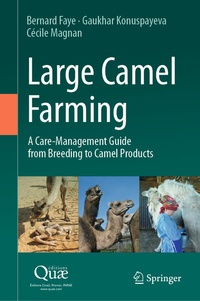
Large Camel Farming
Description
Large camels (camels and Bactrian camels) are domestic animals that are increasingly used in Western countries, as well as in Africa and Asia, for tourism, sport, and production of milk, meat, and wool. In addition, camel husbandry systems are changing, taking a greater share of sedentary systems, specializing in breeding, and intensifying production. At the same time, many veterinarians and breeders are not familiar with the animal, its needs, physiology, diseases, and management, which is often based on practicesintroduced for cattle and proving ineffective.
This work is a practical aid for all interested readers who want to embark on the adventure of working with large camelids in a cultural context where they are not yet a dominant element of the agricultural landscape. The numerous photographs and drawings that support the text make it a unique and entertaining read.
More details
Other editions
Additional editions
Persons
Dr. Bernard Faye , veterinarian and doctor of the University PARIS XII, is an INRA research engineer and currently emeritus expert at CIRAD. As a specialist in camel breeding and production he brings more than 40 years of experience with this species. He is author of the "Guide de l'élevage du dromadaire" (Ed. SANOFI, 1997), of "Bergers du monde" (Ed. QUAE and E&C, 2008), and contributor to the "Dromadaire pédagogique" (Ed. CIRAD-Les Savoirs partagés, 2002). Bernard further co-authored "Camel Clinical Biochemistry and Hematology" (Ed. Springer, 2018).
Prof. Gaukhar Konuspayeva (Al-Farabi University in Almaty, Kazakhstan), is a biochemist and doctor of the University of Montpellier. She serves as a consultant for FAO and has been a visiting researcher at CIRAD. Gaukhar is a specialist in camel milk and -processing. The present book has greatly benefited from her contribution on the processing of dairy products.
Dr. Cécile Magnan is a veterinary doctorand equine specialty practitioner committed to the protection of circus animals. As such, Cécile has extensive experience in the care to be given to large camelids of which she keeps some specimens on her own farm transformed into a retirement home for old circus animals. Her contribution to this volume has been decisive on the aspects of health management.