

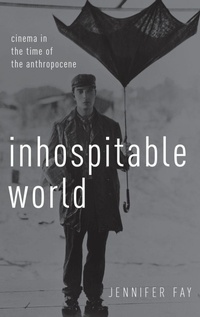
Inhospitable World
Cinema in the Time of the Anthropocene
Published on 19. April 2018
Book
Hardback
270 pages
978-0-19-069677-1 (ISBN)
Description
In recent years, environmental and human rights advocates have suggested that we have entered the first new geological epoch since the end of the ice age: the Anthropocene. In this new epoch, humans have come to reshape unwittingly both the climate and natural world; humankind has caused mass extinctions of plant and animal species, polluted the oceans, and irreversibly altered the atmosphere. Ironically, our efforts to make the planet more hospitable to ourselves seem to be driving us toward our inevitable extinction. A force of nature, humanity is now decentered as the agent of history. As Jennifer Fay argues, this new situation is to geological science what cinema has always been to human culture.
Film, like the Anthropocene, is a product of the industrial revolution, but arises out of a desire to preserve life and master time and space. It also calls for the creation of artificial worlds, unnatural weather, and deadly environments for entertainment, scientific study, and devising military strategy. Filmmaking stages, quite literally, the process by which worlds and weather come into being and meaning, and it mimics the forces that are driving this new planetary inhospitality. Cinema, in other words, provides an image of "nature" in the age of its mechanical reproducability. Fay argues that cinema exemplifies the philosophical, political, and perhaps even logistical processes by which we can adapt to these forces and also imagine a world without humans in it. Whereas standard ecological criticism attends to the environmental crisis as an unraveling of our natural state, this book looks to film (from Buster Keaton, to Jia Zhangke, to films of atomic testing and early polar exploration) to consider how it reflects upon the creation and destruction of human environments. What are the implications of ecological inhospitality? What role might cinema and media theory play in challenging our presumed right to occupy and populate the world? As an art form, film enjoys a unique relationship to the material, elemental world it captures and produces. Through it, we may appreciate the ambitions to design an unhomely planet that may no longer accommodate us.
Film, like the Anthropocene, is a product of the industrial revolution, but arises out of a desire to preserve life and master time and space. It also calls for the creation of artificial worlds, unnatural weather, and deadly environments for entertainment, scientific study, and devising military strategy. Filmmaking stages, quite literally, the process by which worlds and weather come into being and meaning, and it mimics the forces that are driving this new planetary inhospitality. Cinema, in other words, provides an image of "nature" in the age of its mechanical reproducability. Fay argues that cinema exemplifies the philosophical, political, and perhaps even logistical processes by which we can adapt to these forces and also imagine a world without humans in it. Whereas standard ecological criticism attends to the environmental crisis as an unraveling of our natural state, this book looks to film (from Buster Keaton, to Jia Zhangke, to films of atomic testing and early polar exploration) to consider how it reflects upon the creation and destruction of human environments. What are the implications of ecological inhospitality? What role might cinema and media theory play in challenging our presumed right to occupy and populate the world? As an art form, film enjoys a unique relationship to the material, elemental world it captures and produces. Through it, we may appreciate the ambitions to design an unhomely planet that may no longer accommodate us.
Reviews / Votes
[A] stunningly original and deeply troubling book... Throughout the text, Fay makes astonishing and compelling connections between these films and the collapse of a once ecologically stable world. The result is a groundbreaking, one-of-a-kind book destined to be a classic. This is film criticism at its most urgent and impressive. Essential. * CHOICE * ...[an] elegant new book... * Moira Weigel, Journal of Cinema and Media Studies * Jennifer Fay beautifully writes a wide-ranging and suggestive theory of cinema in the atomic light of the Anthropocene. * William Brown, University of Roehampton, London, Film-Philosophy *More details
Language
English
Place of publication
New York
United States
Target group
Professional and scholarly
Dimensions
Height: 240 mm
Width: 161 mm
Thickness: 19 mm
Weight
570 gr
ISBN-13
978-0-19-069677-1 (9780190696771)
Copyright in bibliographic data and cover images is held by Nielsen Book Services Limited or by the publishers or by their respective licensors: all rights reserved.
Schweitzer Classification
Other editions
Additional editions
Book
04/2018
Oxford University Press Inc
€53.00
Shipment within 15-20 days
E-Book
03/2018
1st Edition
OUP eBook
€23.99
Available for download
E-Book
03/2018
1st Edition
OUP eBook
€23.99
Available for download
Person
Jennifer Fay is Associate Professor of Film and English at Vanderbilt University where she also directs the Program in Cinema and Media Arts. Her books include Theaters of Occupation: Hollywood and the Reeducation of Postwar Germany (Minnesota, 2008) and Film Noir: Hard-Boiled Modernity and the Cultures of Globalization co-authored with Justus Nieland (Routledge, 2010).
Content
Acknowledgments
Introduction
Part One: On Location
1. Buster Keaton's Climate Change
2. Nuclear Conditioning
3. The Ecologies of Film Noir
Part Two: At the End of the World
4. Still Life
5. Antarctica and Siegfried Kracauer's Extraterrestrial Film Theory
Conclusion: The Epoch and the Archive
Notes
Bibliography
Index
Introduction
Part One: On Location
1. Buster Keaton's Climate Change
2. Nuclear Conditioning
3. The Ecologies of Film Noir
Part Two: At the End of the World
4. Still Life
5. Antarctica and Siegfried Kracauer's Extraterrestrial Film Theory
Conclusion: The Epoch and the Archive
Notes
Bibliography
Index