

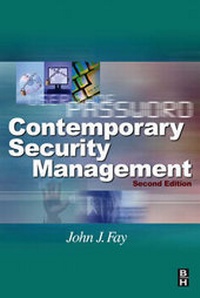
Contemporary Security Management
2nd Edition
Published on 8. November 2005
Book
Hardback
544 pages
978-0-7506-7928-2 (ISBN)
Description
Contemporary Security Management, Second Edition, is the most comprehensive and up-to-date security management book available. The book is designed to provide the hard facts on modern practices to efficiently and effectively run a security department.
It covers such vital topics as leadership in management, employee relations, risk management and mitigation, terrorism, information security, access control, investigations, substance abuse, workplace violence, and emergency management. New topics covered include terrorism and the post 9/11 government mandate to perform standard vulnerability assessments for various industries.
All the chapters have been updated and include the latest trends, technologies, and best practice procedures. Case studies throughout the text provide real-world examples and solutions to management issues. Samples of security plans and procedures, checklists, diagrams and illustrations aid in explaining a wide range of critical concepts.
The book serves as an indispensable working tool for students in security management courses, security managers, and other security professionals at all levels of experience.
It covers such vital topics as leadership in management, employee relations, risk management and mitigation, terrorism, information security, access control, investigations, substance abuse, workplace violence, and emergency management. New topics covered include terrorism and the post 9/11 government mandate to perform standard vulnerability assessments for various industries.
All the chapters have been updated and include the latest trends, technologies, and best practice procedures. Case studies throughout the text provide real-world examples and solutions to management issues. Samples of security plans and procedures, checklists, diagrams and illustrations aid in explaining a wide range of critical concepts.
The book serves as an indispensable working tool for students in security management courses, security managers, and other security professionals at all levels of experience.
Reviews / Votes
"Fay's emphasis on current, state-of-the-art technologies, business practices, and problems such as workplace violence make this book the natural choice for use as a platform to discuss contemporary security issues." --Dr. Jeffrey T. Fowler, American Military University"Fay does an excellent job in this section, with the most illuminating material covering management concepts...this book is a valuable reference, especially for incipient security managers." --Security Management
More details
Edition
2nd edition
Language
English
Place of publication
Oxford
United Kingdom
Publishing group
Elsevier Science & Technology
Target group
Professional and scholarly
PRIMARY MARKET: (audience)
Students in security management courses; Security Managers, other security professionals
SECONDARY MARKET: (audience)
Edition type
New edition
Dimensions
Height: 260 mm
Width: 184 mm
Weight
1157 gr
ISBN-13
978-0-7506-7928-2 (9780750679282)
Copyright in bibliographic data and cover images is held by Nielsen Book Services Limited or by the publishers or by their respective licensors: all rights reserved.
Schweitzer Classification
Other editions
New editions
John Fay
Contemporary Security Management
Book
12/2010
3rd Edition
Butterworth-Heinemann
€70.00
Shipment within 15-20 days
Additional editions
John J Fay | John Fay
Contemporary Security Management
E-Book
05/2014
2nd Edition
Butterworth-Heinemann
€59.95
Available for download
Previous edition
John Fay
Contemporary Security Management
Book
03/2002
Butterworth-Heinemann
€59.95
Shipment within 10-15 days
Person
Mr. Fay was a special agent of the U.S. Army Criminal Investigation Division (CID) and later the Director of the National Crime Prevention Institute at the University of Louisville. He has held security management positions in the petroleum industry while teaching at the university level. He holds the Master of Business Administration degree from the University of Hawaii, and is a well-known and respected author of many books, including Butterworth's Security Dictionary: Terms and Concepts, Drug Testing, Encyclopedia of Security Management: Techniques and Technology, and Model Security Policies, Plans, and Procedures, all by Butterworth-Heinemann.Was a special agent of the U.S. Army Criminal Investigation Division (CID) and later the Director of the National Crime Prevention Institute. Former manager of security for British Petroleum's operations in the Gulf of Mexico. He was previously an adjunct professor at the University of North Florida and the University of Houston.
Content
Chapter 1: Historical Roots
Chapter 2: Strategy
Chapter 3: Leading
Chapter 4: Organizing
Chapter 5: Managing People
Chapter 6: Budget Management
Chapter 7: Managing Change
Chapter 8: Making Decisions
Chapter 9: Managing Risk
Chapter 10: Managing Guard Operations
Chapter 11: Managing Physical Security
Chapter 12: Managing Access Control
Chapter 13: Managing Investigations
Chapter 14: Preemployment Screening
Chapter 15: Emergency Management
Chapter 16: Incident Management
Chapter 17: Information Security
Chapter 18: Substance Abuse Prevention
Chapter 19: Executive Protection
Chapter 20: Workplace Violence
Chapter 21: Security Awareness
Chapter 22: Vulnerability Assessment
Chapter 23: Security System Design
Chapter 24: The Nature of Terrorism
Chapter 25: Counterterrorism
Chapter 26: Weapons of Mass Destruction
Chapter 27: Assessment of the Terrorist Threat
Chapter 28: Critical National Infrastructure
Chapter 2: Strategy
Chapter 3: Leading
Chapter 4: Organizing
Chapter 5: Managing People
Chapter 6: Budget Management
Chapter 7: Managing Change
Chapter 8: Making Decisions
Chapter 9: Managing Risk
Chapter 10: Managing Guard Operations
Chapter 11: Managing Physical Security
Chapter 12: Managing Access Control
Chapter 13: Managing Investigations
Chapter 14: Preemployment Screening
Chapter 15: Emergency Management
Chapter 16: Incident Management
Chapter 17: Information Security
Chapter 18: Substance Abuse Prevention
Chapter 19: Executive Protection
Chapter 20: Workplace Violence
Chapter 21: Security Awareness
Chapter 22: Vulnerability Assessment
Chapter 23: Security System Design
Chapter 24: The Nature of Terrorism
Chapter 25: Counterterrorism
Chapter 26: Weapons of Mass Destruction
Chapter 27: Assessment of the Terrorist Threat
Chapter 28: Critical National Infrastructure