

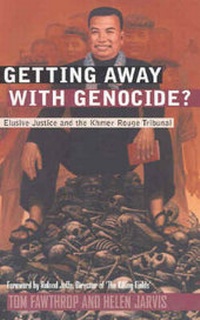
Getting Away with Genocide?
Elusive Justice and the Khmer Rouge Tribunal
Published on 1. December 2004
Book
Paperback/Softback
320 pages
978-0-86840-904-7 (ISBN)
Description
Twenty-five years after the overthrow of the Pol Pot regime, not one Khmer Rouge leader has stood in court to answer for their terrible crimes. Tom Fawthrop and Helen Jarvis show how governments that often speak the language of human rights shielded Pol Pot and his lieutenants from prosecution during the 1980s. After Vietnam ousted the Khmer Rouge regime in 1979, the US and UK governments backed the Khmer Rouge at the UN, and approved the re-supply of Pol Pot's army in Thailand. The authors explain how, in the late 1990s, the forgotten genocide became the subject of serious UN inquiry for the first time. The Cambodian government and the UN began complex and often controversial negotiations. In mid-2003 they reached agreement to hold a tribunal in Phnom Penh conducted jointly by international jurists and Cambodian lawyers and judges.
More details
Language
English
Place of publication
Sydney
Australia
Dimensions
Height: 215 mm
Width: 135 mm
Weight
400 gr
ISBN-13
978-0-86840-904-7 (9780868409047)
Copyright in bibliographic data and cover images is held by Nielsen Book Services Limited or by the publishers or by their respective licensors: all rights reserved.
Schweitzer Classification
Persons
Tom Fawthrop and Helen Jarvis reveal why it took 18 years for the UN to recognise the mass murder and crimes against humanity that took place under the Killing Fields regime. They assess the prospects for this tribunal that could embarrass some former world leaders and a number of governments. When the trial finally takes place the Khmer Rouge will be held accountable for the darkest chapter in Cambodian history.