

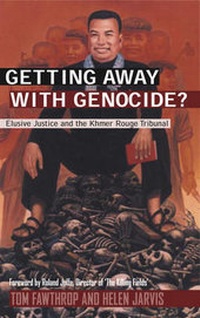
Getting Away with Genocide?
Elusive Justice and the Khmer Rouge Tribunal
Will be published approx. on 20. October 2004
Book
Paperback/Softback
336 pages
978-0-7453-2027-4 (ISBN)
Description
'This book is an insider's account of the twenty-five year struggle to bring the Khmer Rouge to justice. Until 1991, the morally bankrupt real-politik of the West not only supported seating the Khmer Rouge in the United Nations, but opposed trying them for their crimes. Over a decade later, a Cambodian - United Nations tribunal is about to convene. ... This book could not be more timely.'
Dr. Gregory H. Stanton, Founder of The Cambodian Genocide Project and President of Genocide Watch
'This book will be essential reading for academics, diplomats, journalists, Cambodia specialists and others who follow the Khmer Rouge trial closely. ... The diplomatic, legal and technical twists and turns detailed here are fascinating, instructive and, at times, alarming. For years to come - as the Khmer Rouge trial unfolds or collapses - scholars and commentators are going to find much in this book to inform their analysis of what happened and why.'
Bill Herod, head of a social service agency in Phnom Penh and a development worker in Cambodia for over thirty years
Twenty-five years after the overthrow of the Pol Pot regime, not one Khmer Rouge leader has stood in court to answer for their terrible crimes. Tom Fawthrop and Helen Jarvis show how governments that often speak the language of human rights shielded Pol Pot and his lieutenants from prosecution during the 1980s. After Vietnam ousted the Khmer Rouge regime in 1979, the US and UK governments backed the Khmer Rouge at the UN, and approved the re-supply of Pol Pot's army in Thailand.
The authors explain how, in the late 1990s, the forgotten genocide became the subject of serious UN inquiry for the first time. Finally, in 2003, the UN and the Cambodian government agreed to hold a trial in Phnom Penh conducted jointly by international jurists and Cambodian lawyers and judges. Tom Fawthrop and Helen Jarvis reveal why it took 18 years for the UN to recognise the mass murder and crimes against humanity that took place under the Killing Fields regime. They assess the prospects for the tribunal that could embarrass some former world leaders and a number of governments.
Dr. Gregory H. Stanton, Founder of The Cambodian Genocide Project and President of Genocide Watch
'This book will be essential reading for academics, diplomats, journalists, Cambodia specialists and others who follow the Khmer Rouge trial closely. ... The diplomatic, legal and technical twists and turns detailed here are fascinating, instructive and, at times, alarming. For years to come - as the Khmer Rouge trial unfolds or collapses - scholars and commentators are going to find much in this book to inform their analysis of what happened and why.'
Bill Herod, head of a social service agency in Phnom Penh and a development worker in Cambodia for over thirty years
Twenty-five years after the overthrow of the Pol Pot regime, not one Khmer Rouge leader has stood in court to answer for their terrible crimes. Tom Fawthrop and Helen Jarvis show how governments that often speak the language of human rights shielded Pol Pot and his lieutenants from prosecution during the 1980s. After Vietnam ousted the Khmer Rouge regime in 1979, the US and UK governments backed the Khmer Rouge at the UN, and approved the re-supply of Pol Pot's army in Thailand.
The authors explain how, in the late 1990s, the forgotten genocide became the subject of serious UN inquiry for the first time. Finally, in 2003, the UN and the Cambodian government agreed to hold a trial in Phnom Penh conducted jointly by international jurists and Cambodian lawyers and judges. Tom Fawthrop and Helen Jarvis reveal why it took 18 years for the UN to recognise the mass murder and crimes against humanity that took place under the Killing Fields regime. They assess the prospects for the tribunal that could embarrass some former world leaders and a number of governments.
Reviews / Votes
This book will be essential reading for academics, diplomats, journalists, Cambodia specialists and others who follow the Khmer Rouge trial closely. It will also be of special interest to those who follow other international criminal proceedings concerned with genocide and crimes against humanity. Arguments over the Cambodian model for a 'mixed' tribunal (domestic in form but international in character) will continue for years to come. This book explains how this unique model was created and why. The diplomatic, legal and technical twists and turns detailed here are fascinating, instructive and, at times, alarming. For years to come - as the Khmer Rouge trial unfolds or collapses - scholars and commentators are going to find much in this book to inform their analysis of what happened and why. -- Bill Herod, head of a social service agency in Phnom Penh and a development worker in Cambodia for over thirty years This book is an insider's account of the twenty-five year struggle to bring the Khmer Rouge to justice. Until 1991, the morally bankrupt real-politik of the West not only supported seating the Khmer Rouge in the United Nations, but opposed trying them for their crimes. Over a decade later, a Cambodian - United Nations tribunal is about to convene, if Western governments will donate the money to support it. After this past decade's trillion dollar wars, is sixty million dollars too much to ask to try the remaining leaders of a regime that murdered two million of its own people? This book could not be more timely. -- Dr. Gregory H. Stanton, Founder of The Cambodian Genocide Project and President of Genocide WatchMore details
Language
English
Place of publication
London
United Kingdom
Product notice
Paperback (UK-trade)
Dimensions
Height: 215 mm
Width: 135 mm
ISBN-13
978-0-7453-2027-4 (9780745320274)
Copyright in bibliographic data and cover images is held by Nielsen Book Services Limited or by the publishers or by their respective licensors: all rights reserved.
Schweitzer Classification
Persons
Tom Fawthrop is a British journalist who has covered South East Asia, including Cambodia, for major newspapers and journals since 1979. His reports have appeared in the Economist,the Guardian, the London Sunday Times and he has contributed to BBC radio and TV. He produced and directed the TV documentary 'Dreams & Nightmares' shown on Channel 4 in 1989. Helen Jarvis has been an adviser to the Cambodian government's Task Force on the Khmer Rouge trials since 1999. She was previously Documentation Consultant for Yale University's Cambodian Genocide Program.
Content
Introduction
1. The Rebirth Of A Nation And The Beginnings Of The Long Struggle For Justice
2. Keeping Pol Pot In The UN Cambodia Seat
3. The World's First Genocide Trial
4. Sympathy For The Devil -- The Secret Alliance To Back Pol Pot
5. Challenging The History Of Forgetting
6. Peace Without Justice
7. The International Community Wakes Up To Genocide
8. Truth, Justice And Reconciliation
9. Uneasy Partners
10. The Gangs Of New York
11. Clinching Convictions -- The Challenge For The Prosecution
12. One More River To Cross
Bibliography
Endnotes
Index
1. The Rebirth Of A Nation And The Beginnings Of The Long Struggle For Justice
2. Keeping Pol Pot In The UN Cambodia Seat
3. The World's First Genocide Trial
4. Sympathy For The Devil -- The Secret Alliance To Back Pol Pot
5. Challenging The History Of Forgetting
6. Peace Without Justice
7. The International Community Wakes Up To Genocide
8. Truth, Justice And Reconciliation
9. Uneasy Partners
10. The Gangs Of New York
11. Clinching Convictions -- The Challenge For The Prosecution
12. One More River To Cross
Bibliography
Endnotes
Index