

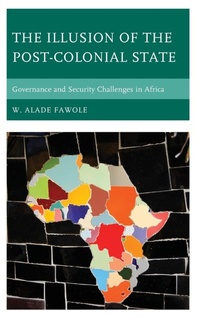
The Illusion of the Post-Colonial State
Governance and Security Challenges in Africa
Published on 1. June 2018
Book
Hardback
254 pages
978-1-4985-6460-1 (ISBN)
Description
This book challenges the long-held conventional wisdom that Africa is a post-colonial society of sovereign nation-states despite the outward attributes of statehood: demarcated territories, permanent populations, governments, national currencies, police, and armed forces. While it is true that African nation-states have been gifted flag independence by their respective colonial masters, few have reached fully developed status as a secure nation-state. Most African nation-states have, since independence, been grappling with the crisis of state-building, nation-building, governance, and myriad security challenges which have been chronically exacerbated by the dynamics of the post-Cold War era. To focus merely on the agency of the African political elite and their inability to sustain functional modern nation-states misses the point. The central argument of the book is that an understanding of Africa's contemporary governance and security challenges requires us to historicize the discourse surrounding nation-building and state-building throughout Africa.
Reviews / Votes
In The Illusion of the Post-Colonial State, William Fawole artfully and intelligently rewrites the political science rulebook on the African postcolonial state. Taking a distinctive multi-disciplinary and multi-country approach, Fawole takes the reader on an illuminating tour of the discursive milestones in the evolution of a much-contested institution. The result is a bracing and historically grounded analysis that will appeal equally to students of Africa's international relations, postcolonial history, state-society relations, foreign policy, and democratization. -- Ebenezer Obadare, University of Kansas The Illusion of the Post-Colonial State is an excellent, engaging, and illuminating book. With significant examples from different regions of Africa, Fawole challenges the dominant approach to the analyses of Africa as a post-colonial formation. He reinterprets Africa's history in refreshing ways while encouraging a reconsideration of the bases of the continent's core complications. -- Wale Adebanwi, University of Oxford Is Africa post-colonial, neo-colonial, or post-colonized? This important intervention takes on board the dominant orthodoxy in the ways we think about the historical foundations of the political and economic travails of contemporary Africa and its future. It builds upon a critical tradition of writing about Africa in this regard to unearth what it calls the Big Lie of post-colonial statehood in Africa and its implications for an understanding of the trajectory of governance, security and development on the continent. In 13 core chapters, the book raises key conceptual and theoretical issues, grounded in rich empirical illustrations from all the five sub-regions of the continent, about the way we perceive study, analyze, understand, explain and address the past, present and future of the continent in a manner that illuminates what it considers the real character of the state in Africa.This is a refreshing and mature voice, tempered by the author's more than three decades of teaching and research on Africa in Africa. It is compulsory reading for all those interested in the continent, and particularly for those not afraid to consider challenges to orthodoxies long held, or to engage other options for thinking about and encountering the state in Africa's governance, security and development-past, present, and future. -- Adigun Agbaje, University of Ibadan
More details
Series
Language
English
Place of publication
United States
Publishing group
Bloomsbury Publishing Plc
Target group
Professional and scholarly
College/higher education
Dimensions
Height: 235 mm
Width: 157 mm
Thickness: 20 mm
Weight
571 gr
ISBN-13
978-1-4985-6460-1 (9781498564601)
Copyright in bibliographic data and cover images is held by Nielsen Book Services Limited or by the publishers or by their respective licensors: all rights reserved.
Schweitzer Classification
Other editions
Additional editions
E-Book
06/2018
1st Edition
Lexington Books
€40.49
Available for download
Person
W. Alade Fawole is professor in the Department of International Relations, Obafemi Awolowo University.
Content
Preface: Is Africa Post-Colonial, Neo-colonial, or Post-Colonized?
Part I: Colonial Rule, Disengagement and the Post-Colonial State
Introduction and Conceptual Discourse
Chapter 1: Colonial Rule and the Political Architecture of the Post-Colonial State
Chapter 2: The Grant of Independence: Imperialist Conspiracy and the Subversion of the Post-Colonial State
Chapter 3: Britain and the Orchestration of Pseudo-Decolonization
Chapter 4: The Role of France in the Subversion of the Post-Colonial State
Chapter 5: Portugal: Forced Decolonization and its Consequences
Chapter 6: The United States and the Political and Economic Destabilization of Africa
Part II: Regional Examples of Illusive Post-Colonial States
Chapter 7: Nigeria: The Illusive Post-Colony
Chapter 8: Mali: From Instability to Insurgency and Near Obliteration
Chapter 9: Somalia: From State Collapse to Rogue State
Chapter 10: Algeria: Descent into Dictatorship
Chapter 11: Democratic Republic of Congo: The Colony that Never Became a State
Chapter 12: Mozambique: From Revolutionary Possibilities to Contrived Instability and State Failure
Chapter 13: Contemporary Nation-Building, Governance, and Security Challenges in Africa
Conclusion: The Illusive Post-Colonial State: What Hope for Survival?
Part I: Colonial Rule, Disengagement and the Post-Colonial State
Introduction and Conceptual Discourse
Chapter 1: Colonial Rule and the Political Architecture of the Post-Colonial State
Chapter 2: The Grant of Independence: Imperialist Conspiracy and the Subversion of the Post-Colonial State
Chapter 3: Britain and the Orchestration of Pseudo-Decolonization
Chapter 4: The Role of France in the Subversion of the Post-Colonial State
Chapter 5: Portugal: Forced Decolonization and its Consequences
Chapter 6: The United States and the Political and Economic Destabilization of Africa
Part II: Regional Examples of Illusive Post-Colonial States
Chapter 7: Nigeria: The Illusive Post-Colony
Chapter 8: Mali: From Instability to Insurgency and Near Obliteration
Chapter 9: Somalia: From State Collapse to Rogue State
Chapter 10: Algeria: Descent into Dictatorship
Chapter 11: Democratic Republic of Congo: The Colony that Never Became a State
Chapter 12: Mozambique: From Revolutionary Possibilities to Contrived Instability and State Failure
Chapter 13: Contemporary Nation-Building, Governance, and Security Challenges in Africa
Conclusion: The Illusive Post-Colonial State: What Hope for Survival?