

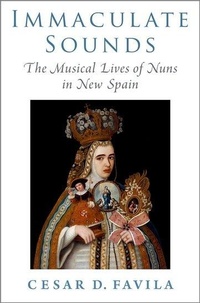
Immaculate Sounds
The Musical Lives of Nuns in New Spain
Published on 14. December 2023
Book
Hardback
360 pages
978-0-19-762189-9 (ISBN)
Description
In Catholic doctrine, the Immaculate Conception of the Virgin Mary is the belief that Mary, the mother of Christ, was exempt from original sin from the moment of her conception, and thereby a co-redeemer alongside her son. Praise for this complicated devotion took place in Europe throughout the medieval period and resounded in the Americas with the founding of the first convent in Mexico City under the Order of the Immaculate Conception in 1540. All other orders of nuns in New Spain branched out from this convent, spreading the Marian devotion throughout the region.
In this book, author Cesar D. Favila argues that the sonification of virginity and the Virgin Mary was fundamental to the promotion of the Immaculate Conception doctrine, and that this was part of a complex network of sonified practices in the lives of New Spanish nuns. These "immaculate sounds," a term Favila uses for the cloistered nuns' idealized vocalizations as well as the expression of doctrinal rhetoric through musical metaphors, echoed the highly regulated realm of the convent and played a pivotal role in mediating between the lives of New Spanish nuns and the expectation that they would save the secular world with their vocalized prayers. In addition to the sonification of discipline, Favila shows that immaculate sounds also enhanced the nuns' engagement with their religious practices and facilitated embodied and spiritual engagement with Catholic doctrines.
Throughout his study, he delves into rarely studied music sources from seventeenth- and eighteenth-century New Spain alongside the rulebooks, devotional literature, and nuns' biographies that regulated convent life and inspired nuns' hymns. In doing so, Favila brings together a narrative of salvation that shines a light on the musical lives of nuns and locates women's agency within a hierarchical society that silenced some women and required others to sing.
This is an open access title available under the terms of a CC BY-NC-ND 4.0 International licence. It is free to read on Oxford Academic and offered as a free PDF download from OUP and selected open access locations.
In this book, author Cesar D. Favila argues that the sonification of virginity and the Virgin Mary was fundamental to the promotion of the Immaculate Conception doctrine, and that this was part of a complex network of sonified practices in the lives of New Spanish nuns. These "immaculate sounds," a term Favila uses for the cloistered nuns' idealized vocalizations as well as the expression of doctrinal rhetoric through musical metaphors, echoed the highly regulated realm of the convent and played a pivotal role in mediating between the lives of New Spanish nuns and the expectation that they would save the secular world with their vocalized prayers. In addition to the sonification of discipline, Favila shows that immaculate sounds also enhanced the nuns' engagement with their religious practices and facilitated embodied and spiritual engagement with Catholic doctrines.
Throughout his study, he delves into rarely studied music sources from seventeenth- and eighteenth-century New Spain alongside the rulebooks, devotional literature, and nuns' biographies that regulated convent life and inspired nuns' hymns. In doing so, Favila brings together a narrative of salvation that shines a light on the musical lives of nuns and locates women's agency within a hierarchical society that silenced some women and required others to sing.
This is an open access title available under the terms of a CC BY-NC-ND 4.0 International licence. It is free to read on Oxford Academic and offered as a free PDF download from OUP and selected open access locations.
Reviews / Votes
Unlike preexisting studies of convent music, Favila's work cycles back to theological discourse and nuns' personal spirituality with every point he makes. * Lindsay M. Johnson, Journal of the American Musicological Society * Favila shows a remarkable skill in switching between typically isolated disciplines. * Karl Isaac Johnson, Antiphon * "The meticulous and thorough analysis of the lyrics and music of these villancicos is remarkable." - Ascension Mazuela-Anguita, Music & Letters Immaculate Sounds offers a new approach to the significance of devotional music performance by creating synergy between music, literature and visual arts in the context of New Spanish convents. The book is generously illustrated with pictures, musical examples, and tables that guide the reader through a unique journey inside the resonant cloisters of New Spain. * Luisa Morales, Diagonal * Favila has given us a glimpse into a fascinating world where divinity and humanity meet. * Jonathan Arnold, Theology * Cesar D. Favila writes with compassion and curiosity, and with a love of storytelling that brings his material to life. He makes it possible for us to hear the long-silenced voices of women religious-chanting, singing, speaking- through meticulous scholarship, vivid biography, and fresh analysis of a wealth of sources. Immaculate Sounds weaves together the varied cultures of New Spain, creating textures and layers from strands of race, gender, faith, creativity, and community, in a multisensory, absorbing, and ultimately tender narrative. * Laurie Stras, Professor Emerita of Music, University of Southampton * Cesar D. Favila's compelling monograph expertly weaves together scores, archival documents, biographies, art, and architecture to create a richly colored tapestry depicting musical culture in the convents of New Spain. The organization of the book-with its emphasis on both individual stories and the larger historical context- allows him to illustrate the soundscape of monastic life with musical examples that reflect a 'timeless, cyclical, and cosmic' approach to women's history. * Colleen Reardon, author of Holy Concord Within Sacred Walls: Nuns and Music in Siena, 1575-1700 * Favila discloses an expansive, new world of convent culture, abounding in fresh musical, visual, literary, biographical, and bibliographical information. Readers familiar with Western European traditions may sometimes nod in agreement as he situates New Spain's convent music in its devotional contexts. At other times, his eye-opening revelations might even make them blink. * Craig A. Monson, Paul Tietjens Professor Emeritus of Music, Washington University in Saint Louis * Blending cultural history, musical theory, and archival research, this work will definitely change the interpretation of the musical heritage of women's convents in colonial Mexico. * Asuncion Lavrin, Emerita Professor of History, Arizona State University * Immaculate Sounds makes important strides towards understanding the musical experience of New Spanish nuns as part of a more extensive set of devotional practices. Furthermore, the study models an effective methodological strategy for overcoming the difficulties of scattered and incomplete archives, a challenge that plagues scholars of colonial Latin America and beyond. All in all, Favila offers readers a rare opportunity to hear inside the imposing walls of New Spanish convents. His thoughtful reflections upon cloistered women's music make long-forgotten voices audible and open our ears to new possibilities. * Sarah Finley, Bulletin of the Comediantes * It is important to point out that this book serves as a valuable link between the extensive Latin American scholarship on female monasticism and the Anglo-Saxon literature that underpins much of this research. * Adriana Guadalupe Alonso Rivera, Hispanic American Historical Review * As a concluding note, Immaculate Sounds: The Musical Lives of Nuns in New Spain offers a detailed view of the musical lives of nuns in New Spain, highlighting their role as spiritual intercessors in the pursuit of Christian salvation through devotional music. This allows Favila to create a multidisciplinary perspective on a musical practice deeply rooted in specific historical and cultural contexts. This approach could serve as a foundation for future research into colonial music and the history of spirituality. * Pablo A. Suarez Marrero, Diagonal * Favila is to be commended for his diligence in excavating convent archives and other collections in search of the raw materials with which to build his case. It is a strong case, and it is bolstered by the author' skill in using theory and his resourcefulness in identifying other possible aids to understanding (for example, Fanny Calderon de la Barca's firsthand accounts of nineteenth-century convent singing), to help fill in gaps. It is also strengthened by felicitously expressed insights that derive not from theory but from the author's own sensitivity and historical imagination. * Margaret Chowning, Church History *More details
Series
Language
English
Place of publication
New York
United States
Product notice
sewn/stitched
Cloth over boards
Illustrations
21 color illustrations, 19 music examples, 2 tables
Dimensions
Height: 229 mm
Width: 160 mm
Thickness: 36 mm
Weight
771 gr
ISBN-13
978-0-19-762189-9 (9780197621899)
Copyright in bibliographic data and cover images is held by Nielsen Book Services Limited or by the publishers or by their respective licensors: all rights reserved.
Schweitzer Classification
Other editions
Additional editions
E-Book
10/2023
OUP eBook
€0.00
Available for download
E-Book
10/2023
OUP eBook
€69.99
Available for download
Person
Cesar D. Favila is Assistant Professor of Musicology at UCLA. His work focuses on Mexican music, ranging from colonial New Spain to the contemporary Chicano experience, and often residing at the intersections of music, religion, gender, and race. Favila's work has been funded by numerous grants and fellowships, including support from the American Council of Learned Societies, the American Philosophical Society, and the Fulbright Program, among others.
Content
Dedication Table of Contents
Preface, or an Autohistoria-Teoria
List of Figures
List of Examples
List of Tables
List of Appendices
Note on Sources Introduction: Veil and Voice Part I. Acousmatic Discipline 1. Immaculate Conflicts: Resounding Mary's Immaculate Conception, or Who Was Sister Flor de Santa Clara? 2. Sonic Thresholds: The Grates of the Cloister and the Lips of Nuns, or Who Was Sister Rosa? 3. Disciplined Sounds: Dowry Waivers and Race, or Who Was Sister Mariana Josefa de Senor San Ignacio? Part II. Unity 4. Feasting Sounds: The Eucharistic Honeymoon, or Who Was Sister Paula? 5. Redeeming Sounds: Resounding the Passion of Christ and His Spiritual Brides, or Who Was Sister Marina de San Francisco? Epilogue Acknowledgements
Appendices
Notes
Select Bibliography
Index
Preface, or an Autohistoria-Teoria
List of Figures
List of Examples
List of Tables
List of Appendices
Note on Sources Introduction: Veil and Voice Part I. Acousmatic Discipline 1. Immaculate Conflicts: Resounding Mary's Immaculate Conception, or Who Was Sister Flor de Santa Clara? 2. Sonic Thresholds: The Grates of the Cloister and the Lips of Nuns, or Who Was Sister Rosa? 3. Disciplined Sounds: Dowry Waivers and Race, or Who Was Sister Mariana Josefa de Senor San Ignacio? Part II. Unity 4. Feasting Sounds: The Eucharistic Honeymoon, or Who Was Sister Paula? 5. Redeeming Sounds: Resounding the Passion of Christ and His Spiritual Brides, or Who Was Sister Marina de San Francisco? Epilogue Acknowledgements
Appendices
Notes
Select Bibliography
Index