

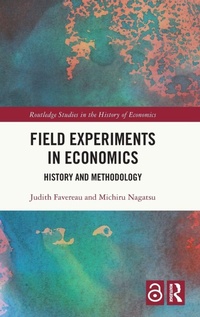
Field Experiments in Economics
History and Methodology
1st Edition
Published on 27. March 2025
Book
Hardback
120 pages
978-0-367-19464-2 (ISBN)
Description
This book adopts an integrated history and philosophy of science approach to consider the historical origins and methodological pitfalls of field experiments in economics.
It explains key concepts such as control and randomization and identifies two distinct origins of field experimentation in economics: controlled laboratory experiments and randomized field trials. Careful historical analysis reveals that two strands of field experiments have developed, with rather different methodological rationales regarding the validity, both internal and external, of inferences about experimental results. The authors propose a unified methodological framework that makes explicit the complementarity between the two strands of field experiments, as well as between experimentation and other research methods such as econometrics. In addition, the methodological framework aims not only to bridge both strands but also to make explicit often-assumed ethical and political values in experimental design and practice in the field.
This book will be valuable reading for advanced students and scholars in the history of economics, philosophy of economics, economic methodology, and experimental economics.
The Open Access version of this book, available at www.taylorfrancis.com, has been made available under a Creative Commons Attribution-Non Commercial-No Derivatives (CC-BY-NC-ND) 4.0 license.
It explains key concepts such as control and randomization and identifies two distinct origins of field experimentation in economics: controlled laboratory experiments and randomized field trials. Careful historical analysis reveals that two strands of field experiments have developed, with rather different methodological rationales regarding the validity, both internal and external, of inferences about experimental results. The authors propose a unified methodological framework that makes explicit the complementarity between the two strands of field experiments, as well as between experimentation and other research methods such as econometrics. In addition, the methodological framework aims not only to bridge both strands but also to make explicit often-assumed ethical and political values in experimental design and practice in the field.
This book will be valuable reading for advanced students and scholars in the history of economics, philosophy of economics, economic methodology, and experimental economics.
The Open Access version of this book, available at www.taylorfrancis.com, has been made available under a Creative Commons Attribution-Non Commercial-No Derivatives (CC-BY-NC-ND) 4.0 license.
More details
Series
Language
English
Place of publication
London
United Kingdom
Publishing group
Taylor & Francis Ltd
Target group
College/higher education
Professional and scholarly
Postgraduate and Professional
Illustrations
2 s/w Photographien bzw. Rasterbilder, 4 s/w Tabellen, 2 s/w Abbildungen
4 Tables, black and white; 2 Halftones, black and white; 2 Illustrations, black and white
Dimensions
Height: 240 mm
Width: 161 mm
Thickness: 12 mm
Weight
376 gr
ISBN-13
978-0-367-19464-2 (9780367194642)
Copyright in bibliographic data and cover images is held by Nielsen Book Services Limited or by the publishers or by their respective licensors: all rights reserved.
Schweitzer Classification
Other editions
Additional editions
E-Book
03/2025
Routledge
€0.00
Available for download
E-Book
03/2025
Routledge
€0.00
Available for download
Persons
Judith Favereau is Associate Professor in Philosophy of Economics and History of Economic Thought at the University Lumiere Lyon 2, France.
Michiru Nagatsu is Professor in Philosophy of Social Science and Sustainability at the Practical Philosophy Unit, Faculty of Social Sciences and Helsinki Institute of Sustainability Science, the University of Helsinki, Finland.
Michiru Nagatsu is Professor in Philosophy of Social Science and Sustainability at the Practical Philosophy Unit, Faculty of Social Sciences and Helsinki Institute of Sustainability Science, the University of Helsinki, Finland.
Content
1 Introduction 2 Types and goals of economics experiments 3 Two historical strands 4 External Validity: Methodological Issues and Practices 5 Bringing two strands together 6 Participatory Experiments, or Constructing the field 7 Conclusion Bibliography Index