

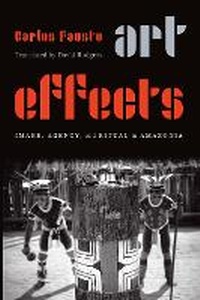
Art Effects
Image, Agency, and Ritual in Amazonia
Published on 1. June 2024
Book
Paperback/Softback
424 pages
978-1-4962-3874-0 (ISBN)
Description
In Art Effects Carlos Fausto explores the interplay between Indigenous material culture and ontology in ritual contexts, interpreting the agency of artifacts and Indigenous presences and addressing major themes in anthropological theory and art history to study ritual images in the widest sense. Fausto delves into analyses of the body, aerophones, ritual masks, and anthropomorphic effigies while making a broad comparison between Native visual regimes and the Christian imagistic tradition.
Drawing on his extensive fieldwork in Amazonia, Fausto offers a rich tapestry of inductive theorizing in understanding anthropology's most complex subjects of analysis, such as praxis and materiality, ontology and belief, the power of images and mimesis, anthropomorphism and zoomorphism, and animism and posthumanism. Art Effects also brims with suggestive, hemispheric comparisons of South American and North American Indigenous masks. In this tantalizing interdisciplinary work with echoes of Franz Boas, Pierre Clastres, and Claude LEvi-Strauss, among others, Fausto asks: how do objects and ritual images acquire their efficacy and affect human beings?
Drawing on his extensive fieldwork in Amazonia, Fausto offers a rich tapestry of inductive theorizing in understanding anthropology's most complex subjects of analysis, such as praxis and materiality, ontology and belief, the power of images and mimesis, anthropomorphism and zoomorphism, and animism and posthumanism. Art Effects also brims with suggestive, hemispheric comparisons of South American and North American Indigenous masks. In this tantalizing interdisciplinary work with echoes of Franz Boas, Pierre Clastres, and Claude LEvi-Strauss, among others, Fausto asks: how do objects and ritual images acquire their efficacy and affect human beings?
Reviews / Votes
"Art Effects is clearly a must-read for Americanists, who will find in it valuable syntheses, acute ethnographic analyses-particularly of Xinguanan and Parakana rituals, and a wealth of suggestive ideas. Beyond this specialized readership, anyone interested in the question of what art is and what it does will profit from reading this highly intelligent and engaging book."-Anne-Christine Taylor, Journal of Anthropological Research "[Art Effects] opens enormous comparative possibilities and understanding of other South American areas, helping us to unravel ethnological complexes and features of great breadth. . . . [It] constitutes a solid step in the forging of that comparative dialogue between Amerindian peoples of the vast South America that we so badly need."-Juan Javier Rivera Andia, Anthropos "The ethnographic depth and analytical richness of Fausto's Art Effects are remarkable. The book takes the reader on a fascinating journey through processes of image- and artifact-making among a number of Lowland South American societies."-Paolo Fortis, HAU: Journal of Ethnographic Theory "This is the book we have been waiting for. If perspectivism and the ontological turn brought Amazonia in from the cold to enter mainstream anthropology, Fausto's Art Effects moves the debate forward. . . . Fausto takes us beyond philosophizing and back to the real-life world of masks, musical instruments, and painted images at the heart of Amerindian culture."-Stephen Hugh-Jones, author of The Palm and the Pleiades: Initiation and Cosmology in Northwest Amazonia "A liberating text for all those seeking to escape the anthropomorphic bias of image theory. Carlos Fausto's immersion in two different Amazonian societies allows him to upend some of the reigning models of figuration, mimesis, and presence. Critically engaged, his writing is lucid and engaging."-Z. S. Strother, author of Inventing Masks: Agency and History in the Art of the Central Pende "[An] enriching and thought-provoking book. . . . Fausto establishes a constant dialogue between the interpretation of ethnography and the current debates in social anthropology, art history, aesthetics, and philosophy. A great achievement."-Carlo Severi, author of The Chimera Principle: An Anthropology of Memory and ImaginationMore details
Language
English
Place of publication
Lincoln
United States
Target group
Professional and scholarly
Product notice
Paperback (trade)
Illustrations
46 photographs, 7 illustrations, 5 maps, 7 tables, index
Dimensions
Height: 229 mm
Width: 152 mm
ISBN-13
978-1-4962-3874-0 (9781496238740)
Copyright in bibliographic data and cover images is held by Nielsen Book Services Limited or by the publishers or by their respective licensors: all rights reserved.
Schweitzer Classification
Other editions
Additional editions
E-Book
08/2020
1st Edition
University of Nebraska Press
€36.99
Available for download
Persons
Carlos Fausto is a professor of anthropology at the National Museum, Federal University of Rio de Janeiro, Brazil, and a Global Scholar at Princeton University. He is the author of Warfare and Shamanism in Amazonia and coeditor, with Michael Heckenberger, of Time and Memory in Indigenous Amazonia: Anthropological Perspectives. David Rodgers has been based in Brazil for twenty years, working as a translator of academic texts, including numerous books in anthropology.
Content
List of Illustrations
List of Tables
Acknowledgments
Orthographic Conventions
Introduction: The Smirk
1. Body-Artifact
2. Wild Mysteries
3. Whirlwinds of Images
4. The Pronominal Effigy
5. A Chief's Two Bodies
Conclusion: Masters of Deceit
Source Acknowledgments
Notes
Works Cited
Index
List of Tables
Acknowledgments
Orthographic Conventions
Introduction: The Smirk
1. Body-Artifact
2. Wild Mysteries
3. Whirlwinds of Images
4. The Pronominal Effigy
5. A Chief's Two Bodies
Conclusion: Masters of Deceit
Source Acknowledgments
Notes
Works Cited
Index