

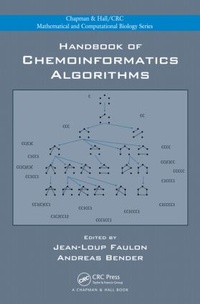
Handbook of Chemoinformatics Algorithms
1st Edition
Published on 21. April 2010
Book
Hardback
452 pages
978-1-4200-8292-0 (ISBN)
Description
Unlike in the related area of bioinformatics, few books currently exist that document the techniques, tools, and algorithms of chemoinformatics. Bringing together worldwide experts in the field, the Handbook of Chemoinformatics Algorithms provides an overview of the most common chemoinformatics algorithms in a single source.
After a historical perspective of the applications of algorithms and graph theory to chemical problems, the book presents algorithms for two-dimensional chemical structures and three-dimensional representations of molecules. It then focuses on molecular descriptors, virtual screening methods, and quantitative structure-activity relationship (QSAR) models, before introducing algorithms to enumerate and sample chemical structures. The book also covers computer-aided molecular design, reaction network generation, and open source software and database technologies. The remaining chapters describe techniques developed in the context of bioinformatics and computational biology and their potential applications to chemical problems.
This handbook presents a selection of algorithms relevant in practice, making the book useful to those working in the field. It offers an up-to-date account of many algorithmic aspects of chemoinformatics.
After a historical perspective of the applications of algorithms and graph theory to chemical problems, the book presents algorithms for two-dimensional chemical structures and three-dimensional representations of molecules. It then focuses on molecular descriptors, virtual screening methods, and quantitative structure-activity relationship (QSAR) models, before introducing algorithms to enumerate and sample chemical structures. The book also covers computer-aided molecular design, reaction network generation, and open source software and database technologies. The remaining chapters describe techniques developed in the context of bioinformatics and computational biology and their potential applications to chemical problems.
This handbook presents a selection of algorithms relevant in practice, making the book useful to those working in the field. It offers an up-to-date account of many algorithmic aspects of chemoinformatics.
More details
Series
Language
English
Place of publication
Oxford
United Kingdom
Publishing group
Taylor & Francis Ltd
Target group
Professional and scholarly
Professional
Product notice
Paper over boards
Illustrations
153 s/w Abbildungen, 18 s/w Tabellen
18 Tables, black and white; 153 Illustrations, black and white
Dimensions
Height: 234 mm
Width: 156 mm
Weight
1000 gr
ISBN-13
978-1-4200-8292-0 (9781420082920)
Copyright in bibliographic data and cover images is held by Nielsen Book Services Limited or by the publishers or by their respective licensors: all rights reserved.
Schweitzer Classification
Other editions
Additional editions
Jean-Loup Faulon | Andreas Bender
Handbook of Chemoinformatics Algorithms
E-Book
04/2010
1st Edition
Chapman & Hall/CRC
€225.99
Available for download
Jean-Loup Faulon | Andreas Bender
Handbook of Chemoinformatics Algorithms
E-Book
04/2010
1st Edition
Chapman and Hall
€225.99
Available for download
Persons
Jean-Loup Faulon is a professor in the Department of Biology at the University of Evry in France.
Andreas Bender is an assistant professor in the Leiden/Amsterdam Center for Drug Research (LACDR) at Leiden University in the Netherlands.
Andreas Bender is an assistant professor in the Leiden/Amsterdam Center for Drug Research (LACDR) at Leiden University in the Netherlands.
Content
Representing 2D Chemical Structures with Molecular Graphs. Algorithms to Store and Retrieve 2D Chemical Structures. 3D Molecular Representations. Molecular Descriptors. Ligand- and Structure-Based Virtual Screening. Predictive Quantitative Structure-Activity Relationships Modeling: Data Preparation and the General Modeling Workflow. Predictive Quantitative Structure-Activity Relationships Modeling: Development and Validation of QSAR Models. Structure Enumeration and Sampling. Computer-Aided Molecular Design: Inverse Design. Computer-Aided Molecular Design: De Novo Design. Reaction Network Generation. Open Source Chemoinformatics Software and Database Technologies. Sequence Alignment Algorithms: Applications to Glycans, Trees, and Tree-Like Structures. Machine Learning-Based Bioinformatics Algorithms: Application to Chemicals. Using Systems Biology Techniques to Determine Metabolic Fluxes and Metabolite Pool Sizes. Index.