

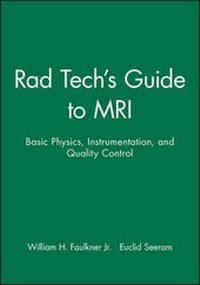
Rad Tech's Guide to MRI
Basic Physics, Instrumentation, and Quality Control
Published on 5. August 2001
Book
Paperback/Softback
120 pages
978-0-632-04505-1 (ISBN)
Description
This handy reference will give the practicing and training technologist a solid understanding of basic MRI principles on which further learning can be built. Beginning with a hardware overview and moving through tissue characteristics, image quality and flow imaging, Rad Tech's Guide to MRI: Basic Physics, Instrumenation, and Qaulity Control should be used as both an introduction and an examination preparation tool. Each book in the Rad Tech's Guide Series covers the essential basics for those preparing for their certifying examinations and those already in practice.
More details
Language
English
Place of publication
Hoboken
United Kingdom
Publishing group
John Wiley and Sons Ltd
Target group
College/higher education
Professional and scholarly
Dimensions
Height: 204 mm
Width: 115 mm
Thickness: 8 mm
Weight
118 gr
ISBN-13
978-0-632-04505-1 (9780632045051)
Copyright in bibliographic data and cover images is held by Nielsen Book Services Limited or by the publishers or by their respective licensors: all rights reserved.
Schweitzer Classification
Other editions
New editions
Book
02/2020
2nd Edition
Wiley
€50.00
Shipment within 15-20 days
Persons
William H. Faulkner Jr. is the author of Rad Tech's Guide to MRI: Basic Physics, Instrumentation, and Quality Control, published by Wiley. Euclid Seeram, PhD, MSc, BSc, FCAMRT, has academic appointments in Medical Imaging and is Honorary Senior Lecturer in the Department of Radiology of the University of Sydney, Australia.
Content
1. Hardware Overview. 2. Fundamental Principles.
3. Production of Magnetic Resonance Signal.
4. Relaxation.
5. Tissue Characteristics.
6. Data Acquisition and Image Formation.
7. Magnetic Resonance Image Quality.
8. Artifacts.
9. Flow Imaging.
3. Production of Magnetic Resonance Signal.
4. Relaxation.
5. Tissue Characteristics.
6. Data Acquisition and Image Formation.
7. Magnetic Resonance Image Quality.
8. Artifacts.
9. Flow Imaging.