

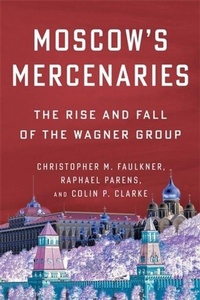
Moscow's Mercenaries
The Rise and Fall of the Wagner Group
Will be published approx. on 23. June 2026
Book
Hardback
360 pages
978-0-231-21691-3 (ISBN)
Description
The Wagner Group emerged from Russia's shadowy criminal underworld in 2014 and soon became one of the world's most infamous private military companies. Led by the provocative oligarch Yevgeny Prigozhin, Wagner developed into a key instrument of Russian power projection, with deep and direct ties to the Kremlin. Its mercenaries fought on the front lines in Ukraine, propped up regimes in the Middle East and Africa, and exploited chaos to secure lucrative resource contracts before Prigozhin's mutiny against Moscow in 2023 brought him down.
This book traces the Wagner Group's violent ascent and descent, exposing how a shadow army built an empire that seemed to have no end in sight until it turned on its masters. Drawing on a wide range of sources and interviews, Moscow's Mercenaries offers a comprehensive examination of Wagner's inner workings: its hybrid structure, battlefield tactics, propaganda campaigns, and connections to the Russian military. From Ukraine to brutal counterinsurgency campaigns in Syria, the Central African Republic, Mali, and beyond, the book shows how Wagner evolved into a global criminal syndicate and reveals why its ambitions led to a fatal collision with the Russian state.
Moscow's Mercenaries explores what Wagner's rise tells us about the future of modern warfare, the erosion of international norms, and how authoritarian regimes outsource violence. Anyone interested in the evolution of mercenary warfare, great power competition, and the dark underbelly of global security stands to learn important lessons from this well-timed and insightful book.
This book traces the Wagner Group's violent ascent and descent, exposing how a shadow army built an empire that seemed to have no end in sight until it turned on its masters. Drawing on a wide range of sources and interviews, Moscow's Mercenaries offers a comprehensive examination of Wagner's inner workings: its hybrid structure, battlefield tactics, propaganda campaigns, and connections to the Russian military. From Ukraine to brutal counterinsurgency campaigns in Syria, the Central African Republic, Mali, and beyond, the book shows how Wagner evolved into a global criminal syndicate and reveals why its ambitions led to a fatal collision with the Russian state.
Moscow's Mercenaries explores what Wagner's rise tells us about the future of modern warfare, the erosion of international norms, and how authoritarian regimes outsource violence. Anyone interested in the evolution of mercenary warfare, great power competition, and the dark underbelly of global security stands to learn important lessons from this well-timed and insightful book.
Reviews / Votes
The Wagner mercenary company may be all but defunct, but as this important and interesting study shows, we can expect not only Russia but also other countries to adapt its model of outsourced authoritarian violence and influence to their own ends. -- Mark Galeotti, coauthor of <i>Downfall: Putin, Prigozhin and the Fight for the Future of Russia</i> This book provides an in-depth analysis of the rise and transformation of the Wagner Group-the world's most influential mercenary group-and its complex relationship with Vladimir Putin's Kremlin. Tracking the Wagner Group from its prominent roles in the Russia-Ukraine and Syrian wars to its influential position in the politics of multiple African countries, Moscow's Mercenaries offers important insight into Russian foreign and defense policy. -- Chris Miller, author of <i>Chip War: The Fight for the World's Most Critical Technology</i> In a liminal world order where pseudopowerful states increasingly seek global influence on a shoestring budget, what does the Wagner Group's dynamic rise and precipitous fall reveal about the nature of state-sanctioned violence in the twenty-first century? Authored by some of the world's foremost observers, this timely book reveals how Moscow's premier mercenary force became an uncontrollable political and criminal blueprint for others. Moscow's Mercenaries is a chilling and necessary account of how irregular warfare serves as a primary and expanding instrument of authoritarian power. -- Jason Warner, coauthor of <i>The Islamic State in Africa: The Emergence, Evolution, and Future of the Next Jihadist Battlefront</i>More details
Series
Language
English
Place of publication
New York
United States
Target group
College/higher education
Product notice
Trade binding
Illustrations
4 b&w illustrations
Dimensions
Height: 229 mm
Width: 152 mm
ISBN-13
978-0-231-21691-3 (9780231216913)
Copyright in bibliographic data and cover images is held by Nielsen Book Services Limited or by the publishers or by their respective licensors: all rights reserved.
Schweitzer Classification
Other editions
Additional editions
Christopher M. Faulkner | Raphael Parens | Colin P. Clarke
Moscow's Mercenaries
The Rise and Fall of the Wagner Group
E-Book
approx. 06/2026
1st Edition
Columbia University Press
€33.99
Available for download
Persons
Christopher M. Faulkner is an assistant professor of national security affairs at the U.S. Naval War College and a nonresident senior fellow in the Foreign Policy Research Institute's Eurasia Program.
Raphael Parens is a fellow in the Foreign Policy Research Institute's Eurasia and Africa Programs and a senior fellow at the Delphi Global Research Center.
Colin P. Clarke is the executive director of the Soufan Center, an associate fellow at the International Centre for Counter-Terrorism-The Hague, and a nonresident senior fellow at the Foreign Policy Research Institute.
Raphael Parens is a fellow in the Foreign Policy Research Institute's Eurasia and Africa Programs and a senior fellow at the Delphi Global Research Center.
Colin P. Clarke is the executive director of the Soufan Center, an associate fellow at the International Centre for Counter-Terrorism-The Hague, and a nonresident senior fellow at the Foreign Policy Research Institute.
Content
Introduction
1. Unraveling the Enigma: The Complex Motives Behind the Creation of the Wagner Group
2. Theoretical and Practical Considerations
3. The Wagner Group's First Footprints
4. Wagner in Syria: Helping Friends, Gaining Experience
5. Wagner in Libya: Expanding to New Markets
6. Wagner in the Central African Republic: Counterinsurgency to Personal Security
7. Wagner in Mali: Opportunism in the Land of Gold
8. Wagner's Other Deployments: Sudan, Mozambique, Madagascar, and Chad
9. Wagner's Final Frontier: Russia's Special Military Operation
10. Distilling Lessons Observed
11. Conclusions: The Wagner Postmortem
Epilogue
Acknowledgments
Notes
Index
1. Unraveling the Enigma: The Complex Motives Behind the Creation of the Wagner Group
2. Theoretical and Practical Considerations
3. The Wagner Group's First Footprints
4. Wagner in Syria: Helping Friends, Gaining Experience
5. Wagner in Libya: Expanding to New Markets
6. Wagner in the Central African Republic: Counterinsurgency to Personal Security
7. Wagner in Mali: Opportunism in the Land of Gold
8. Wagner's Other Deployments: Sudan, Mozambique, Madagascar, and Chad
9. Wagner's Final Frontier: Russia's Special Military Operation
10. Distilling Lessons Observed
11. Conclusions: The Wagner Postmortem
Epilogue
Acknowledgments
Notes
Index