

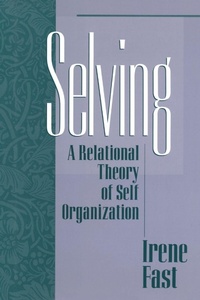
Selving
A Relational Theory of Self Organization
1st Edition
Published on 1. December 2014
Book
Paperback/Softback
200 pages
978-1-138-00975-2 (ISBN)
Description
In Selving: A Relational Theory of Self Organization, Irene Fast invokes the basic distinction between the self as "me" and the self as "I" in order to develop a contemporary theory of the self as subject. In a return to Freud's clinical finding that all psychological processes are personally motivated, she elaborates a notion of the "I-self" that is intrinsically dynamic and relational. Within this conception, our perceiving, thinking, feeling, and acting are not what our self does; rather, they are what our self is.
According to Fast, the basic unit of the dynamic I-self --of selving --is a scheme of personally motivated interaction between self and nonself. This notion, which comprehends development (and developmental failure) as a product of integration and differentiation among discrete I-schemes, provides a radically new framework for understanding those dynamic phenomena that Freud included within his structural model of the mind and that contemporary theorists have addressed within object relational perspectives. Via the notion of selving, Fast likewise brings fresh insight to a host of issues that have engaged psychoanalysts and developmental psychologists in recent years. These topics include the place of bodily experience in a relational model of mind, the organization of self as simultaneously individual and relational, the formulation of a constructivist model of psychic structure, among others.
Selving is not only a lucid demonstration of how a relational theory of self can reorder clinical observations in conceptually and therapeutically illuminating ways. It is also a convincing demonstration of how a constructivist model emphasizing the interactive nature of meaning-making provides bridges to Piagetian theory, developmental research, and observational infancy studies.
According to Fast, the basic unit of the dynamic I-self --of selving --is a scheme of personally motivated interaction between self and nonself. This notion, which comprehends development (and developmental failure) as a product of integration and differentiation among discrete I-schemes, provides a radically new framework for understanding those dynamic phenomena that Freud included within his structural model of the mind and that contemporary theorists have addressed within object relational perspectives. Via the notion of selving, Fast likewise brings fresh insight to a host of issues that have engaged psychoanalysts and developmental psychologists in recent years. These topics include the place of bodily experience in a relational model of mind, the organization of self as simultaneously individual and relational, the formulation of a constructivist model of psychic structure, among others.
Selving is not only a lucid demonstration of how a relational theory of self can reorder clinical observations in conceptually and therapeutically illuminating ways. It is also a convincing demonstration of how a constructivist model emphasizing the interactive nature of meaning-making provides bridges to Piagetian theory, developmental research, and observational infancy studies.
More details
Language
English
Place of publication
London
United Kingdom
Publishing group
Taylor & Francis Ltd
Target group
Professional and scholarly
Professional
Dimensions
Height: 229 mm
Width: 152 mm
Thickness: 11 mm
Weight
298 gr
ISBN-13
978-1-138-00975-2 (9781138009752)
Copyright in bibliographic data and cover images is held by Nielsen Book Services Limited or by the publishers or by their respective licensors: all rights reserved.
Schweitzer Classification
Other editions
Additional editions
E-Book
05/2013
1st Edition
Routledge
€47.49
Available for download
E-Book
05/2013
1st Edition
Routledge
€47.49
Available for download
Book
03/1998
1st Edition
Analytic Press,U.S.
€163.42
Article exhausted; check different version
Person
Irene Fast
Content
Preface. Toward the Notion of a Dynamic I-Self. Basic Structures. The I-Self: Our Ways of Making Meaning. Selving Without a Sense of I-Ness I: Encoding Experience in Global I-Schemes. Selving Without a Sense of I-Ness II: Id Experiences in Global I-Schemes. From Selving Without a Sense of I-Ness to First-Person Experiencing-I:
Toward an Internal World. From Selving Without a Sense of I-Ness to First-Person Experiencing-II: Toward an External World. What Sort of a Self Is This Dynamic Self?
Toward an Internal World. From Selving Without a Sense of I-Ness to First-Person Experiencing-II: Toward an External World. What Sort of a Self Is This Dynamic Self?