

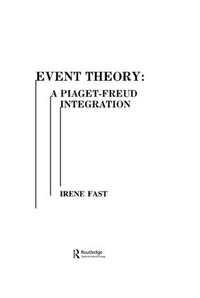
Event Theory
A Piaget-freud Integration
1st Edition
Published on 1. July 1985
Book
Hardback
192 pages
978-0-89859-618-2 (ISBN)
Description
First published in 1985. The event model presented in this study, attempts a framework for integrating psychoanalytic and Piagetian psychologies centered in the notion that development occurs by the differentiation of self and nonself. Its aim is to understand phenomena conceptualized in psychoanalytic terms in a model based on this Piagetian perspective, or, in other words, to provide an object-relational model for the development of psychic structure analytic and Piagetian psychologies centered in the notion that development occurs by the differentiation of self and nonself.
Reviews / Votes
"The writing throughout is careful, thoughtful, and analytic. The chapters critique contemporary conceptions and offer solutions from event theory."-Contemporary Psychology
More details
Language
English
Place of publication
Mahwah
United States
Publishing group
Taylor & Francis Inc
Target group
College/higher education
Dimensions
Height: 234 mm
Width: 156 mm
Weight
520 gr
ISBN-13
978-0-89859-618-2 (9780898596182)
Copyright in bibliographic data and cover images is held by Nielsen Book Services Limited or by the publishers or by their respective licensors: all rights reserved.
Schweitzer Classification
Other editions
Additional editions
E-Book
12/2013
1st Edition
Routledge
€73.49
Available for download
E-Book
12/2013
1st Edition
Routledge
€73.99
Available for download
Persons
Irene Fast The University of Michigan, Robert E. Erard Orchard Hills Psychiatric Center, Carol J. Fitzpatrick Case Western Reserve University,
Anne E. Thompson Harvard Graduate Linda Young School of Education, The University of Michigan
Anne E. Thompson Harvard Graduate Linda Young School of Education, The University of Michigan
Content
Introduction, Irene Fast; Chapter 1 Infantile Narcissism and the Active Infant, Irene Fast; Chapter 2 Primary Process Cognition, Irene Fast; Chapter 3 The Development and Loss of Self Boundaries, Irene Fast; Chapter 4 A Framework for a Theory of Object Relations, Irene Fast; Chapter 5 Children's Development out of Event-Bound Conceptions of Their Emotion, Carol J. Fitzpatrick; Chapter 6 Concrete Thinking and the Categorical Attitude, Robert E. Erard; Chapter 7 Omnipotence and Primary Creativity in Rorschach Responses, Linda Young, Irene Fast; Chapter 8 The Nature of Emotion and Its Development, Anne E. Thompson;