

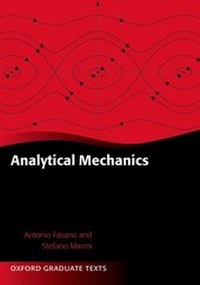
Analytical Mechanics
An Introduction
Published on 22. August 2013
Book
Paperback/Softback
788 pages
978-0-19-967385-8 (ISBN)
Description
Analytical Mechanics is the investigation of motion with the rigorous tools of mathematics, with remarkable applications to many branches of physics (Astronomy, Statistical and Quantum Mechanics, etc.). Rooted in the works of Lagrange, Euler, and Poincare, it is a classical subject with fascinating developments and still rich with open problems. It addresses such fundamental questions as: Is the solar system stable? Is there a unifying "economy" principle in mechanics? How can a point mass be described as a "wave"?
This book was written to fill a gap between elementary expositions and more advanced (and clearly more stimulating) material. It takes the challenge to explain the most relevant ideas and to show the most important applications using plain language and "simple" mathematics, often through an original approach. Basic calculus is enough for the reader to proceed through the book and when more is required, the new mathematical concepts are illustrated, again in plain language. The book is conceived in such a way that some difficult chapters can be bypassed, whilst still grasping the main ideas. However, anybody wishing to go deeper in some directions will find at least the flavour of recent developments and many bibliographical references.
Theory is always accompanied by examples. Many problems are suggested and some are completely worked out at the end of each chapter. The book may effectively be used (and it is in several Italian Universities) for undergraduate as well as for PhD courses in Physics and Mathematics at various levels.
This book was written to fill a gap between elementary expositions and more advanced (and clearly more stimulating) material. It takes the challenge to explain the most relevant ideas and to show the most important applications using plain language and "simple" mathematics, often through an original approach. Basic calculus is enough for the reader to proceed through the book and when more is required, the new mathematical concepts are illustrated, again in plain language. The book is conceived in such a way that some difficult chapters can be bypassed, whilst still grasping the main ideas. However, anybody wishing to go deeper in some directions will find at least the flavour of recent developments and many bibliographical references.
Theory is always accompanied by examples. Many problems are suggested and some are completely worked out at the end of each chapter. The book may effectively be used (and it is in several Italian Universities) for undergraduate as well as for PhD courses in Physics and Mathematics at various levels.
Reviews / Votes
Pleasantly presented. * K. Lindsay, University of Glasgow *More details
Series
Language
English
Place of publication
Oxford
United Kingdom
Target group
College/higher education
Illustrations
123 line drawings
Dimensions
Height: 239 mm
Width: 169 mm
Thickness: 43 mm
Weight
1278 gr
ISBN-13
978-0-19-967385-8 (9780199673858)
Copyright in bibliographic data and cover images is held by Nielsen Book Services Limited or by the publishers or by their respective licensors: all rights reserved.
Schweitzer Classification
Other editions
Additional editions
Book
04/2006
Oxford University Press
€153.40
Shipment within 15-20 days
Persons
Professor Antonio Fasano
Dipartimento di Matematica "U. Dini"
Universita di Firenze
Viale Morgagni 67A
50134 Firenze
Italy
Professor Stefano Marmi
Scuola Normale Superiore
Piazza dei Cavalieri 7
56126 Pisa
Italy
Dipartimento di Matematica "U. Dini"
Universita di Firenze
Viale Morgagni 67A
50134 Firenze
Italy
Professor Stefano Marmi
Scuola Normale Superiore
Piazza dei Cavalieri 7
56126 Pisa
Italy
Content
1. Geometric and kinematic foundations of Lagrangian mechanics ; 2. Dynamics: general laws and the dynamics of a point particle ; 3. One-dimensional motion ; 4. The dynamics of discrete systems. Lagrangian formalism ; 5. Motion in a central field ; 6. Rigid bodies: geometry and kinematics ; 7. The mechanics of rigid bodies: dynamics ; 8. Analytical mechanics: Hamiltonian formalism ; 9. Analytical mechanics: variational principles ; 10. Analytical mechanics: canonical formalism ; 11. Analytical mechanics: Hamilton-Jacobi theory and integrability ; 12. Analytical mechanics: canonical perturbation theory ; 13. Analytical mechanics: an introduction to ergodic theory and to chaotic motion ; 14. Statistical mechanics: kinetic theory ; 15. Statistical mechanics: Gibbs sets ; 16. Lagrangian formalism in continuum mechanics ; Appendices