

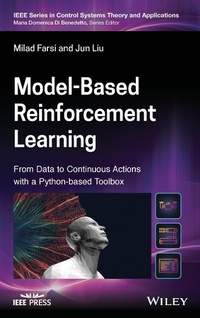
Model-Based Reinforcement Learning: From Data to C ontinuous Actions with a Python-based Toolbox
From Data to Actions with Python-based Toolbox
1st Edition
Published on 21. February 2023
Book
Hardback
256 pages
978-1-119-80857-2 (ISBN)
Description
Explore a comprehensive and practical approach to reinforcement learning
Reinforcement learning is an essential paradigm of machine learning, wherein an intelligent agent performs actions that ensure optimal behavior from devices. While this paradigm of machine learning has gained tremendous success and popularity in recent years, previous scholarship has focused either on theory-optimal control and dynamic programming - or on algorithms-most of which are simulation-based.
Model-Based Reinforcement Learning provides a model-based framework to bridge these two aspects, thereby creating a holistic treatment of the topic of model-based online learning control. In doing so, the authors seek to develop a model-based framework for data-driven control that bridges the topics of systems identification from data, model-based reinforcement learning, and optimal control, as well as the applications of each. This new technique for assessing classical results will allow for a more efficient reinforcement learning system. At its heart, this book is focused on providing an end-to-end framework-from design to application-of a more tractable model-based reinforcement learning technique.
Model-Based Reinforcement Learning readers will also find:
A useful textbook to use in graduate courses on data-driven and learning-based control that emphasizes modeling and control of dynamical systems from data
Detailed comparisons of the impact of different techniques, such as basic linear quadratic controller, learning-based model predictive control, model-free reinforcement learning, and structured online learning
Applications and case studies on ground vehicles with nonholonomic dynamics and another on quadrator helicopters
An online, Python-based toolbox that accompanies the contents covered in the book, as well as the necessary code and data
Model-Based Reinforcement Learning is a useful reference for senior undergraduate students, graduate students, research assistants, professors, process control engineers, and roboticists.
Reinforcement learning is an essential paradigm of machine learning, wherein an intelligent agent performs actions that ensure optimal behavior from devices. While this paradigm of machine learning has gained tremendous success and popularity in recent years, previous scholarship has focused either on theory-optimal control and dynamic programming - or on algorithms-most of which are simulation-based.
Model-Based Reinforcement Learning provides a model-based framework to bridge these two aspects, thereby creating a holistic treatment of the topic of model-based online learning control. In doing so, the authors seek to develop a model-based framework for data-driven control that bridges the topics of systems identification from data, model-based reinforcement learning, and optimal control, as well as the applications of each. This new technique for assessing classical results will allow for a more efficient reinforcement learning system. At its heart, this book is focused on providing an end-to-end framework-from design to application-of a more tractable model-based reinforcement learning technique.
Model-Based Reinforcement Learning readers will also find:
A useful textbook to use in graduate courses on data-driven and learning-based control that emphasizes modeling and control of dynamical systems from data
Detailed comparisons of the impact of different techniques, such as basic linear quadratic controller, learning-based model predictive control, model-free reinforcement learning, and structured online learning
Applications and case studies on ground vehicles with nonholonomic dynamics and another on quadrator helicopters
An online, Python-based toolbox that accompanies the contents covered in the book, as well as the necessary code and data
Model-Based Reinforcement Learning is a useful reference for senior undergraduate students, graduate students, research assistants, professors, process control engineers, and roboticists.
More details
Language
English
Place of publication
Hoboken
United States
Publishing group
John Wiley and Sons Ltd
Target group
Professional and scholarly
Dimensions
Height: 235 mm
Width: 157 mm
Thickness: 19 mm
Weight
540 gr
ISBN-13
978-1-119-80857-2 (9781119808572)
Copyright in bibliographic data and cover images is held by Nielsen Book Services Limited or by the publishers or by their respective licensors: all rights reserved.
Schweitzer Classification
Other editions
Additional editions
Milad Farsi | Jun Liu
Model-Based Reinforcement Learning
From Data to Continuous Actions with a Python-based Toolbox
E-Book
12/2022
1st Edition
Wiley
€107.99
Available for download
Milad Farsi | Jun Liu
Model-Based Reinforcement Learning
From Data to Continuous Actions with a Python-based Toolbox
E-Book
11/2022
1st Edition
Wiley
€103.99
Available for download
Person
Jun Liu received the Ph.D. degree in Applied Mathematics from the University of Waterloo, Canada, in 2010. He is currently an Associate Professor of Applied Mathematics and a Canada Research Chair in Hybrid Systems and Control at the University of Waterloo, Canada, where he directs the Hybrid Systems Laboratory. From 2012 to 2015, he was a Lecturer in Control and Systems Engineering at the University of Sheffield. During 2011 and 2012, he was a Postdoctoral Scholar in Control and Dynamical Systems at the California Institute of Technology. His main research interests are in the theory and applications of hybrid systems and control, including rigorous computational methods for control design with applications in cyber-physical systems and robotics.
Milad Farsi received the B.S. degree in Electrical Engineering (Electronics) from the University of Tabriz in 2010. He obtained his M.S. degree also in Electrical Engineering (Control Systems) from the Sahand University of Technology in 2013. Moreover, he gained industrial experience as a Control System Engineer between 2012 and 2016. Later, he acquired the Ph.D. degree in Applied Mathematics from the University of Waterloo, Canada, in 2022, and he is currently a Postdoctoral Fellow at the same institution. His research interests include control systems, reinforcement learning, and their applications in robotics and power electronics.
Milad Farsi received the B.S. degree in Electrical Engineering (Electronics) from the University of Tabriz in 2010. He obtained his M.S. degree also in Electrical Engineering (Control Systems) from the Sahand University of Technology in 2013. Moreover, he gained industrial experience as a Control System Engineer between 2012 and 2016. Later, he acquired the Ph.D. degree in Applied Mathematics from the University of Waterloo, Canada, in 2022, and he is currently a Postdoctoral Fellow at the same institution. His research interests include control systems, reinforcement learning, and their applications in robotics and power electronics.