

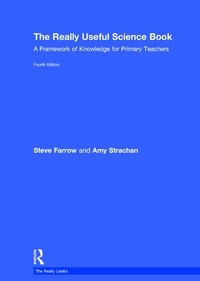
The Really Useful Science Book
A Framework of Knowledge for Primary Teachers
4th Edition
Published on 8. August 2017
Book
Hardback
262 pages
978-1-138-19206-5 (ISBN)
Description
Offering support to both trainee and practising teachers, the fourth edition of The Really Useful Science Book is the perfect tool for those who wish to extend their subject knowledge, enhance their teaching and create lessons which link directly to the National Curriculum. The easy-to-follow framework provides comprehensive science knowledge for Key Stages 1 and 2 and is fully updated with new material to inspire stimulating and engaging science lessons.
The book is divided into three sections: Biology, Chemistry and Physics. Each section integrates key scientific ideas and facts with innovative teaching methods and activity suggestions, and user-friendly language and illustrations help to explain key scientific concepts. With links to global learning, discussion of common misconceptions, and ideas for cross-curricular opportunities, each chapter connects knowledge to practice and informs creative and inspiring teaching.
The Really Useful Science Book is an invaluable reference resource for all classroom teachers who wish to develop the confidence to teach enquiry-based practical science with relevance to pupils and their global community.
The book is divided into three sections: Biology, Chemistry and Physics. Each section integrates key scientific ideas and facts with innovative teaching methods and activity suggestions, and user-friendly language and illustrations help to explain key scientific concepts. With links to global learning, discussion of common misconceptions, and ideas for cross-curricular opportunities, each chapter connects knowledge to practice and informs creative and inspiring teaching.
The Really Useful Science Book is an invaluable reference resource for all classroom teachers who wish to develop the confidence to teach enquiry-based practical science with relevance to pupils and their global community.
Reviews / Votes
The structure of this book is great: sectioned into biology, chemistry and physics, it is easy to navigate. . .and key ideas - for example, key idea 2.6 lists: energy transfer, food chains and webs, and the food cycle - demonstrate a natural link between topics, useful for planning for progression.At the end of each section, the National Curriculum programme of study guides display progression through year groups, offering an 'at a glance' view of what pupils' prior knowledge should be and what they are aiming towards. The teaching idea boxes reveal great ideas to use as 'awe and wonder' activities and hooks, and the concept confusion boxes are really easy to use; allowing teachers to identify common misconceptions that may occur during the lesson.
I really enjoyed the famous scientist fact-boxes, they are relevant, linking concepts and topic areas to scientists and allowing children to see where theories and ideas originate and that they are developing and changing.
Finally, working scientifically is an excellent feature of the book; for a teacher or trainee teacher, this ensures and reassures us that the children in our class are achieving all the different aspects of working scientifically.
- Anna Porto, Third Year Undergraduate Primary Science Education Specialist, St. Mary's University, UK
More details
Series
Edition
4th edition
Language
English
Place of publication
London
United Kingdom
Publishing group
Taylor & Francis Ltd
Target group
College/higher education
Professional and scholarly
Postgraduate, Professional, Professional Practice & Development, and Undergraduate
Illustrations
120 s/w Abbildungen, 120 s/w Zeichnungen, 39 s/w Tabellen
39 Tables, black and white; 120 Line drawings, black and white; 120 Illustrations, black and white
Dimensions
Height: 297 mm
Width: 210 mm
Weight
640 gr
ISBN-13
978-1-138-19206-5 (9781138192065)
Copyright in bibliographic data and cover images is held by Nielsen Book Services Limited or by the publishers or by their respective licensors: all rights reserved.
Schweitzer Classification
Other editions
Additional editions
Steve Farrow | Amy Strachan
The Really Useful Science Book
A Framework of Knowledge for Primary Teachers
Book
08/2017
4th Edition
Routledge
€66.30
Shipment within 10-20 days
Steve Farrow | Amy Strachan
The Really Useful Science Book
A Framework of Knowledge for Primary Teachers
E-Book
08/2017
4th Edition
Routledge
€41.99
Available for download
Steve Farrow | Amy Strachan
The Really Useful Science Book
A Framework of Knowledge for Primary Teachers
E-Book
08/2017
4th Edition
Routledge
€41.99
Available for download
Persons
Steve Farrow was Senior Lecturer in Science Education in the School of Education at Durham University, where he was also director of Primary ITT programmes.
Amy Strachan is Senior Lecturer in Primary Science Education at St Mary's University, Twickenham, UK. She has more than 10 years of experience as Head of Science in international, state and independent schools and has produced teacher materials for both the BBC and Oxfam.
Amy Strachan is Senior Lecturer in Primary Science Education at St Mary's University, Twickenham, UK. She has more than 10 years of experience as Head of Science in international, state and independent schools and has produced teacher materials for both the BBC and Oxfam.
Content
Section One - Introduction
Section Two - Biology
Key Idea 2.1 - The characteristics of living things
Key Idea 2.2 - Life processes
Key Idea 2.3 - Optimum conditions for survival
Key Idea 2.4 - The variety of life
Key Idea 2.5 - Adaptation to environment
Key Idea 2.6 - The transfer of energy
Section Three - Chemistry
Key Idea 3.1 - The particulate nature of matter
Key Idea 3.2 - The classification of materials
Key Idea 3.3 - Changing materials
Key Idea 3.4 - The rock cycle
Key Idea 3.5 - The water cycle
Section Four - Physics
Key Idea 4.1 - Sources and forms of energy
Key Idea 4.2 - Forces
Key Idea 4.3 - The Earth and beyond
Section Two - Biology
Key Idea 2.1 - The characteristics of living things
Key Idea 2.2 - Life processes
Key Idea 2.3 - Optimum conditions for survival
Key Idea 2.4 - The variety of life
Key Idea 2.5 - Adaptation to environment
Key Idea 2.6 - The transfer of energy
Section Three - Chemistry
Key Idea 3.1 - The particulate nature of matter
Key Idea 3.2 - The classification of materials
Key Idea 3.3 - Changing materials
Key Idea 3.4 - The rock cycle
Key Idea 3.5 - The water cycle
Section Four - Physics
Key Idea 4.1 - Sources and forms of energy
Key Idea 4.2 - Forces
Key Idea 4.3 - The Earth and beyond