

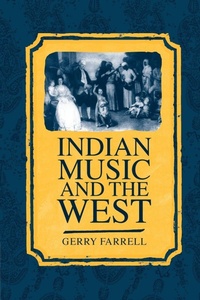
Indian Music and the West
Published on 9. December 1999
Book
Paperback/Softback
254 pages
978-0-19-816717-4 (ISBN)
Description
Indian Music and the West examines perceptions and representations of Indian music in the West over a period of two hundred years, ranging from orientalist studies of Indian history and culture in the eighteenth and nineteenth centuries, to the adoption of elements from Indian music in Western popular culture in the latter half of the twentieth century. Gerry Farrell charts the place of Indian music within the context of colonialism, the use of Indian imagery in Western popular songs and on the stage, and the use of the early days of the gramophone in India. Farrell also demonstrates how Indian music has been discovered and re-discovered in the West during the period discussed, and how these discoveries have reflected changing cultural, social, and political relations between India and the West.
Reviews / Votes
a welcome addition to scholarship devoted to Indian colonial and post-colonial cultural production. * Nilanjana Bhattacharjya, Asian Music: Fall/Winter 00/01. * Farrell's ... foray into archival sources compellingly details the subtleties of power play in India's and Britain's struggle to control Indian music. It is precisely these features that will prove most interesting to those scholars outside the field of music. * Nilanjana Bhattacharjya, Asian Music: Fall/Winter 00/01. * This is a remarkably balanced, wonderfully objective book * Yehudi Menuhin, THES * Taking an historical line, Gerry Farrell has a sharp eye for the sometimes wilful, sometimes comic misuses and failures of understanding that typified the colonial experience. * Robert Maycock, BBC Music * intriguing book ... Indian Music and The West is a substantial piece of scholarly research, with some musical analysis and examples ... you're interested in the web of routes that led to these contemporary sounds, Farrell's book is an ideal place to start. * Andy Hamilton, The Wire * intriguing book ... if you're interested in the web of routes that led to these contemporary sounds, Farrell's book is an ideal place to start * Andy Hamilton, Wire * a fine work, ambitious in conception and meticulous in execution ... these case studies amount to nothing less than an astounding two-century historical overview of (what Farrell variously terms) musical orientalism, colonialism, and postmodern exoticism ... I applaud Gerry Farrell's truly visionary work. I think that his book may prove to be as important a resource for South Asian studies as has been Daniel Neuman's The Life of Music in North India (1980). While Neuman's work was the first major anthropological study of a South Asian art music tradition, Farrell has blazed a pathway equally important for our time, articulating the interweaving of the many strands which have constructed the relationship between Indian Music and the West. * Matthew Allen, The Journal of Asian Studies * the first thoroughly researched work examining the ways the West has engaged Indian music over a period extending back to the eighteenth century. There is much to applaud in Farrell's work ... Farrell's book makes a positive contribution to the ethnomusicology of cultures in contact ... an engaging work that will be of particular interest to South Asianists and to ethnomusicologists who have a particular interest in crosscultural musical interactions. * Stephen Slawek, Yearbook for Traditional Music, 31/1999 *More details
Series
Language
English
Place of publication
Oxford
United Kingdom
Target group
Professional and scholarly
Illustrations
5 figures, music examples
Dimensions
Height: 234 mm
Width: 156 mm
Thickness: 14 mm
Weight
395 gr
ISBN-13
978-0-19-816717-4 (9780198167174)
Copyright in bibliographic data and cover images is held by Nielsen Book Services Limited or by the publishers or by their respective licensors: all rights reserved.
Schweitzer Classification
Person
Content
Acknowledgements ; Note on Transliteration ; Introduction ; 1. 'Wild by pleasing when understood.' Europeans and Indian music in the late eighteenth century ; 2. 'In short, almost everything Oriental appears to better advantage in European garb.' Indian music, notation, and nationalism in the nineteenth century ; 3. 'My naive heart...' Indian music in Western popular song ; 4. 'This talking machine is the marvel of the twentieth century.' The gramophone comes to India ; 5. 'Pomegranates with fingerboards added.' Three journeys to the West ; 6. 'We'll be able to get plastic sitars in our cornflakes soon.' Indian music in popular music and jazz ; 7. 'Listen to the story of an Asian man.' World Music and South Asian music in the West ; Appendix : Selected discography for chapters 6 and 7 ; List of Sources and Bibliography ; Index