

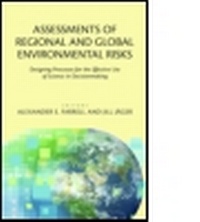
Assessments of Regional and Global Environmental Risks
Designing Processes for the Effective Use of Science in Decisionmaking
Published on 7. December 2005
Book
Hardback
320 pages
978-1-933115-04-7 (ISBN)
Description
As environmental challenges grow larger in scale and implications, it is increasingly important to apply the best scientific knowledge in the decisionmaking process. Editors Farrell and Jaeger present environmental assessments as the bridge between the expert knowledge of scientists and engineers on the one hand and decisionmakers on the other. When done well, assessments have a positive impact on public policy, the strategic decisions of private firms, and, ultimately, the quality of life for many people. This book is the result of an international, interdisciplinary research project to analyze past environmental assessments and understand how their design influenced their effectiveness in bringing scientific evidence and insight into the decisionmaking process. The case studies in the book feature a wide range of regional and global risks, including ozone depletion, transboundary air pollution, and climate change. Assessments of Regional and Global Environmental Risks offers several important contributions. It provides a clear account of the choices faced in the design of environmental assessments and a clear description of the lessons learned from past assessments. It illustrates why assessments are social processes, not simply reports. And, while they identify no universal, one-size-fits-all design, the authors find that, to be effective, environmental assessments must be viewed by those who produce and use them as being salient; credible in their scientific support; and legitimate, or fair in design and execution.
Reviews / Votes
'This book will be of great value to anyone interested in the role of science in international environmental policymaking. Large-scale environmental problems such as climate change and tropospheric ozone can only be tackled effectively when policies are based on a solid understanding of the underlying science. This book contains lessons from past assessments and useful advice for effective future assessments of environmental issues.'Leen Hordijk, Director, International Institute for Applied Systems Analysis
More details
Language
English
Place of publication
Washington
United States
Publishing group
Taylor & Francis Inc
Target group
Professional and scholarly
Weight
658 gr
ISBN-13
978-1-933115-04-7 (9781933115047)
Copyright in bibliographic data and cover images is held by Nielsen Book Services Limited or by the publishers or by their respective licensors: all rights reserved.
Schweitzer Classification
Other editions
Additional editions
Alexander E. Farrell | Jill Jaeger
Assessments of Regional and Global Environmental Risks
Designing Processes for the Effective Use of Science in Decisionmaking
E-Book
09/2010
1st Edition
Routledge
€46.99
Available for download
Alexander E. Farrell | Jill Jaeger
Assessments of Regional and Global Environmental Risks
Designing Processes for the Effective Use of Science in Decisionmaking
E-Book
09/2010
1st Edition
Routledge
€46.99
Available for download
Alexander E. Farrell | Jill Jaeger
Assessments of Regional and Global Environmental Risks
Designing Processes for the Effective Use of Science in Decisionmaking
Book
11/2005
Resources for the Future Press (RFF Press)
€73.22
Article exhausted; check different version
Persons
Alexander E. Farrell is assistant professor in the Energy and Resources Group of the University of California, Berkeley.
Jill Jaeger is an independent scholar in Vienna, Austria.
Jill Jaeger is an independent scholar in Vienna, Austria.
Content
Foreword -- William Clark, Nancy Dickson, Jill J ger, Sheila Jasanoff, and James J. McCarth
About the Contributors
Overview: Understanding Design Choices -- Alexander E. Farrell, Jill J ger, and Stacy D.VanDeveer
European Politics with a Scientific Face: Framing, Asymmetrical Participation, and Capacity in LRTAP -- Stacy D.VanDeveer
Dissent and Trust in Multilateral Assessments: Comparing LRTAP and OTAG -- Alexander E. Farrell and Terry J. Keating
Applying Assessment Lessons to New Challenges: From Sulfur to POPs -- Noelle Eckley Selin
Making Climate Change Impacts Meaningful: Framing, Methods, and Process in Coastal Zone and Agriculture Assessments -- Marybeth Long Martello and Alastair Iles
Dealing with Uncertainty: How Do You Assess the Impossible? -- Anthony Patt
Limits to Assessment: An Example from Regional Abrupt Climate Change Assessment in the United States -- David C. Lund
Can Assessments Learn, and If So, How? A Study of the IPCC -- Bernd Siebenh ner
The Design and Management of International Scientific Assessments: Lessons from the Climate Regime -- Clark A. Miller
Designing Better Environmental Assessments for Developing Countries: Lessons From the U.S. Country Studies Program -- Oladele A. Ogunseitan
Grounds for Hope: Assessing Technological Options to Manage Ozone Depletion -- Edward A. Parson
Global Hazards and Catastrophic Risk: Assessments in the Reinsurance Industry -- Mojdeh Keykhah
Making Sustainability Assessments More Useful for Institutional Investors -- Bernd Kasemir, Andrea S ess, and Raphael Schaub
Improving the Practice of Environmental Assessment -- Jill J ger and Alexander E. Farrell
About the Contributors
Overview: Understanding Design Choices -- Alexander E. Farrell, Jill J ger, and Stacy D.VanDeveer
European Politics with a Scientific Face: Framing, Asymmetrical Participation, and Capacity in LRTAP -- Stacy D.VanDeveer
Dissent and Trust in Multilateral Assessments: Comparing LRTAP and OTAG -- Alexander E. Farrell and Terry J. Keating
Applying Assessment Lessons to New Challenges: From Sulfur to POPs -- Noelle Eckley Selin
Making Climate Change Impacts Meaningful: Framing, Methods, and Process in Coastal Zone and Agriculture Assessments -- Marybeth Long Martello and Alastair Iles
Dealing with Uncertainty: How Do You Assess the Impossible? -- Anthony Patt
Limits to Assessment: An Example from Regional Abrupt Climate Change Assessment in the United States -- David C. Lund
Can Assessments Learn, and If So, How? A Study of the IPCC -- Bernd Siebenh ner
The Design and Management of International Scientific Assessments: Lessons from the Climate Regime -- Clark A. Miller
Designing Better Environmental Assessments for Developing Countries: Lessons From the U.S. Country Studies Program -- Oladele A. Ogunseitan
Grounds for Hope: Assessing Technological Options to Manage Ozone Depletion -- Edward A. Parson
Global Hazards and Catastrophic Risk: Assessments in the Reinsurance Industry -- Mojdeh Keykhah
Making Sustainability Assessments More Useful for Institutional Investors -- Bernd Kasemir, Andrea S ess, and Raphael Schaub
Improving the Practice of Environmental Assessment -- Jill J ger and Alexander E. Farrell