

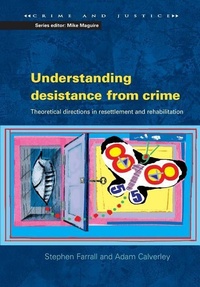
Understanding Desistance from Crime
Emerging Theoretical Directions in Resettlement and Rehabilitation
Published on 16. December 2005
Book
Paperback/Softback
248 pages
978-0-335-21948-3 (ISBN)
Description
Why do people stop offending?
What are the processes they undergo in stopping?
What can be done to help more people who have offended put their pasts behind them?
The growth of interest in why people stop offending and how they are resettled following punishment has been remarkable. Once a marginal topic in criminology, it is now a central topic of research and theorising amongst those studying criminal careers. This book is both an introduction to research on desistance, and the report on a follow-up of two hundred probationers sentenced to supervision in the late 1990s. The reader is introduced to some of the wider issues and debates surrounding desistance via a consideration of the criminal careers of a group of ex-offenders. This lively engagement with both data and theoretical matters makes the book a useful tool for both academics and students. The book will appeal to undergraduates, postgraduates and academics studying criminology, criminal justice, sociology, social work, social policy and psychology, as well as trainee probation officers.
What are the processes they undergo in stopping?
What can be done to help more people who have offended put their pasts behind them?
The growth of interest in why people stop offending and how they are resettled following punishment has been remarkable. Once a marginal topic in criminology, it is now a central topic of research and theorising amongst those studying criminal careers. This book is both an introduction to research on desistance, and the report on a follow-up of two hundred probationers sentenced to supervision in the late 1990s. The reader is introduced to some of the wider issues and debates surrounding desistance via a consideration of the criminal careers of a group of ex-offenders. This lively engagement with both data and theoretical matters makes the book a useful tool for both academics and students. The book will appeal to undergraduates, postgraduates and academics studying criminology, criminal justice, sociology, social work, social policy and psychology, as well as trainee probation officers.
More details
Other editions
Additional editions
Stephen Farrall
Understanding Desistance From Crime
E-Book
12/2005
1st Edition
McGraw-Hill Education
€69.39
Available for download
Persons
Dr. Stephen Farrall is a Senior Research Fellow in the School of Criminology, Education, Sociology and Social Work, Keele University. He previously worked at Centre for Criminological Research, University of Oxford and the Department of Law, University of Sheffield. He is the author of Rethinking What Works With Offenders (2002)and has held grants from the Leverhulme Trust and the ESRC. Adam Calverley is presently a PhD Candiate in the School of Criminology, Education, Sociology and Social Work, Keele University. He has previously been employed at the Universities of Glamorgan and Keele. He is the co-author of Black and Asian Offenders on Probation, Home Office Research Study 277, HMSO (2004).
Content
Preface & Acknowledgements
Dramatis Personae
Chapter One: Getting to Grips with Desistance
Chapter Two: Life After Probation
Chapter Three: The Long-term Impacts of Probation Supervision
Intermezzo: The Impact of Imprisonment
Chapter Four: The Existential Aspects of Desistance
Chapter Five: The Emotional Trajectories of Desistance
Chapter Six: Citizenship Values and Desistance
Chapter Seven: Criminal Victimisation and Desistance from Crime
Chapter Eight: Understanding Desistance from Crime
Methodological Appendix: Relocating our Sample
Bibliography
Index
Dramatis Personae
Chapter One: Getting to Grips with Desistance
Chapter Two: Life After Probation
Chapter Three: The Long-term Impacts of Probation Supervision
Intermezzo: The Impact of Imprisonment
Chapter Four: The Existential Aspects of Desistance
Chapter Five: The Emotional Trajectories of Desistance
Chapter Six: Citizenship Values and Desistance
Chapter Seven: Criminal Victimisation and Desistance from Crime
Chapter Eight: Understanding Desistance from Crime
Methodological Appendix: Relocating our Sample
Bibliography
Index