

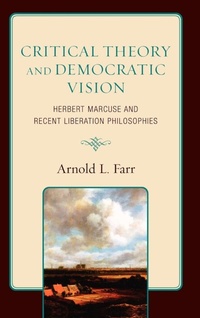
Critical Theory and Democratic Vision
Herbert Marcuse and Recent Liberation Philosophies
Published on 16. January 2009
Book
Hardback
196 pages
978-0-7391-1931-0 (ISBN)
Description
The most broad and general description of critical theory (one of the most important movements in social and political philosophy in the twentieth and now twenty-first century) is that it is a synthesis of Marxist social critique and Freudian psychoanalysis with traces of German idealism. Farr argues that the goal demand for social change by critical theorists is rooted in a desire for the completion of the U.S. democratic experiment. There is too much exploitation, surplus repression, alienation, dehumanization, oppression, and gross economic inequality in the U.S. for us to believe that we have achieved a complete or finished democracy. Herbert Marcuse's form of critical theory provides us with important theoretical tools for addressing the ways in which our attempt to create a democratic society based on fairness, justice, and equality has been de-railed.
While Marcuse experienced tremendous popularity in the 1960s and 1970s, his popularity has since waned in academic circles as well as in public political discourse. This book is an attempt to rescue from obscurity some of Marcuse's most helpful insights with respect to progressive, democratic social change. Its unique feature is an attempt to put Marcuse in dialogue with what Farr calls recent liberation philosophies such as feminism and African American philosophy. He takes all of these forms of philosophy to be driven by a democratic impulse whereby we are made to realize that there are many social groups that have been excluded from democratic decision-making processes.
While Marcuse experienced tremendous popularity in the 1960s and 1970s, his popularity has since waned in academic circles as well as in public political discourse. This book is an attempt to rescue from obscurity some of Marcuse's most helpful insights with respect to progressive, democratic social change. Its unique feature is an attempt to put Marcuse in dialogue with what Farr calls recent liberation philosophies such as feminism and African American philosophy. He takes all of these forms of philosophy to be driven by a democratic impulse whereby we are made to realize that there are many social groups that have been excluded from democratic decision-making processes.
Reviews / Votes
Farr carefully re-evaluates Herbert Marcuse's critical analysis of modern life in the U.S.A. and develops a unique new effort to ground contemporary critical theory in new democratic visions drawn from important current debates ranging from radical feminism to Africana philosophy to cultural studies. -- Timothy W. Luke, Virginia Polytechnic Institute and State University Arnold Farr's Critical Theory and Democratic Vision is one of the best books to come out on Marcuse and critical theory in years. Farr is the first to systematically develop Marcuse's thought in terms of democratic theory, liberation movements, and the challenges of race, class, gender, and sexual orientation. Using Marcuse to help develop a liberation philosophy for our times, Farr provides new perspectives on the relevance of Marcuse for contemporary issues and original perspectives of his own on current political and theoretical dynamics. -- Douglas Kellner, UCLA; author of Media Culture and Media Spectacle and the Crisis of Democracy Arnold Farr calls for liberation philosophers to reconsider Herbert Marcuse's critical theory. He rightly argues that John Rawls' 'justice as fairness' and Juergen Habermas' discourse ethics could benefit from corrections coming from Marcuse's philosophy. Farr's treatment proves promising and will serve students and scholars unfamiliar with critical theory and Marcuse; yet, it shows the limits of Marcuse's philosophy and of current debates in critical theory. * Marx and Philosophy Review of Books *More details
Language
English
Place of publication
United States
Publishing group
Bloomsbury Publishing Plc
Target group
Professional and scholarly
Dimensions
Height: 235 mm
Width: 157 mm
Thickness: 15 mm
Weight
445 gr
ISBN-13
978-0-7391-1931-0 (9780739119310)
Copyright in bibliographic data and cover images is held by Nielsen Book Services Limited or by the publishers or by their respective licensors: all rights reserved.
Schweitzer Classification
Person
Arnold L. Farr is associate professor of philosophy and director of the Africana Studies Program at Saint Joseph's University.
Content
Chapter 1 1. Liberation Philosophy and Democratic Struggles
Chapter 2 2. The Quest for the Revolutionary Subject: The Early Marcuse
Chapter 3 3. The Retrieval of Eros and the Quest for a New Sensibility
Chapter 4 4. Marcuse and the Problem of Intersubjectivity: Beyond Drive Theory
Chapter 5 5. One-Dimensional Society and the Demise of Dialectical Thinking
Chapter 6 6. Spectres of Liberation: Beyond One-Dimensional Man
Chapter 7 7. Liberal Democracy and Its Limits: The Challenge of Race, Class, Gender, and Sexual Orientation
Chapter 8 8. Marcuse and Discourse Ethics
Chapter 9 9. Liberation and the Democratic Vision: Educating for a New Sensibility
Chapter 2 2. The Quest for the Revolutionary Subject: The Early Marcuse
Chapter 3 3. The Retrieval of Eros and the Quest for a New Sensibility
Chapter 4 4. Marcuse and the Problem of Intersubjectivity: Beyond Drive Theory
Chapter 5 5. One-Dimensional Society and the Demise of Dialectical Thinking
Chapter 6 6. Spectres of Liberation: Beyond One-Dimensional Man
Chapter 7 7. Liberal Democracy and Its Limits: The Challenge of Race, Class, Gender, and Sexual Orientation
Chapter 8 8. Marcuse and Discourse Ethics
Chapter 9 9. Liberation and the Democratic Vision: Educating for a New Sensibility