

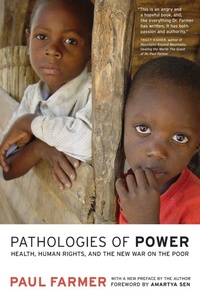
Pathologies of Power
Health, Human Rights, and the New War on the Poor
1st Edition
Published on 22. November 2004
Book
Paperback/Softback
438 pages
978-0-520-24326-2 (ISBN)
Description
Pathologies of Power uses harrowing stories of life--and death--in extreme situations to interrogate our understanding of human rights. Paul Farmer, a physician and anthropologist with twenty years of experience working in Haiti, Peru, and Russia, argues that promoting the social and economic rights of the world's poor is the most important human rights struggle of our times. With passionate eyewitness accounts from the prisons of Russia and the beleaguered villages of Haiti and Chiapas, this book links the lived experiences of individual victims to a broader analysis of structural violence. Farmer challenges conventional thinking within human rights circles and exposes the relationships between political and economic injustice, on one hand, and the suffering and illness of the powerless, on the other. Farmer shows that the same social forces that give rise to epidemic diseases such as HIV and tuberculosis also sculpt risk for human rights violations. He illustrates the ways that racism and gender inequality in the United States are embodied as disease and death. Yet this book is far from a hopeless inventory of abuse.
Farmer's disturbing examples are linked to a guarded optimism that new medical and social technologies will develop in tandem with a more informed sense of social justice. Otherwise, he concludes, we will be guilty of managing social inequality rather than addressing structural violence. Farmer's urgent plea to think about human rights in the context of global public health and to consider critical issues of quality and access for the world's poor should be of fundamental concern to a world characterized by the bizarre proximity of surfeit and suffering.
Farmer's disturbing examples are linked to a guarded optimism that new medical and social technologies will develop in tandem with a more informed sense of social justice. Otherwise, he concludes, we will be guilty of managing social inequality rather than addressing structural violence. Farmer's urgent plea to think about human rights in the context of global public health and to consider critical issues of quality and access for the world's poor should be of fundamental concern to a world characterized by the bizarre proximity of surfeit and suffering.
Reviews / Votes
"In his compelling book, Farmer captures the central dilemma of our times - the increasing disparities of health and well-being within and among societies. While all member countries of the United Nations denounce the gross violations of human rights perpetrated by those who torture, murder, or imprison without due process, the insidious violations of human rights due to structural violence involving the denial of economic opportunity, decent housing, or access to health care and education are commonly ignored. Pathologies of Power makes a powerful case that our very humanity is threatened by our collective failure to end these abuses." - Robert S. Lawrence, President of Physicians for Human Rights and Edyth Schoenrich Professor of Preventive Medicine at the Bloomberg School of Public Health, Johns Hopkins University "This is an angry and a hopeful book, and, like everything Dr. Farmer has written, it has both passion and authority. Pathologies of Power is an eloquent plea for a working definition of human rights that would not neglect the most basic rights of all: food, shelter, and health. This plea has special potency because it comes from Dr. Farmer, a person who has proven that the dream of universal and comprehensive human rights is possible, and who has brought food, shelter, health, and hope to some of the poorest people on this earth." - Tracy Kidder, author of Mountains beyond Mountains: Healing the World: The Quest of Dr. Paul Farmer"More details
Series
Edition
First Edition, With a New Preface by the Author
Language
English
Place of publication
Berkerley
United States
Target group
College/higher education
Professional and scholarly
Product notice
Paperback (trade)
Dimensions
Height: 230 mm
Width: 154 mm
Thickness: 29 mm
Weight
595 gr
ISBN-13
978-0-520-24326-2 (9780520243262)
Copyright in bibliographic data and cover images is held by Nielsen Book Services Limited or by the publishers or by their respective licensors: all rights reserved.
Schweitzer Classification
Other editions
Additional editions
E-Book
11/2004
1st Edition
Naval Institute Press
€28.99
Available for download
Persons
Paul Farmer is Professor of Medical Anthropology at Harvard Medical School and Founding Director of Partners In Health. Among his books are Infections and Inequalities: The Modern Plagues (California, 1999), The Uses of Haiti (1994), and AIDS and Accusation: Haiti and the Geography of Blame (California, 1992). Farmer is the winner of a MacArthur Foundation "genius" award and the Margaret Mead Award for his contributions to public anthropology. He recently held the Blaise Pascal International Chair at the College de France. Amartya Sen, whose work challenges conventional market-driven economic paradigms, is the winner of the 1998 Nobel Prize in economics. He teaches at Trinity College, Cambridge University.
Content
Foreword by Amartya Sen
Acknowledgments
Introduction
PART I. BEARING WITNESS
1. On Suffering and Structural Violence
Social and Economic Rights in the Global Era
2. Pestilence and Restraint
Guantanamo, AIDS, and the Logic of Quarantine
3. Lessons from Chiapas
4. A Plague on All Our Houses?
Resurgent Tuberculosis inside Russia's Prisons
PART II. ONE PHYSICIAN'S PERSPECTIVE ON HUMAN RIGHTS
5. Health, Healing, and Social Justice
Insights from Liberation Theology
6. Listening for Prophetic Voices
A Critique of Market-Based Medicine
7. Cruel and Unusual
Drug-Resistant Tuberculosis as Punishment
8. New Malaise
Medical Ethics and Social Rights in the Global Era
9. Rethinking Health and Human Rights
Time for a Paradigm Shift
Afterword
Notes
Bibliography
Credits
Index
Acknowledgments
Introduction
PART I. BEARING WITNESS
1. On Suffering and Structural Violence
Social and Economic Rights in the Global Era
2. Pestilence and Restraint
Guantanamo, AIDS, and the Logic of Quarantine
3. Lessons from Chiapas
4. A Plague on All Our Houses?
Resurgent Tuberculosis inside Russia's Prisons
PART II. ONE PHYSICIAN'S PERSPECTIVE ON HUMAN RIGHTS
5. Health, Healing, and Social Justice
Insights from Liberation Theology
6. Listening for Prophetic Voices
A Critique of Market-Based Medicine
7. Cruel and Unusual
Drug-Resistant Tuberculosis as Punishment
8. New Malaise
Medical Ethics and Social Rights in the Global Era
9. Rethinking Health and Human Rights
Time for a Paradigm Shift
Afterword
Notes
Bibliography
Credits
Index