

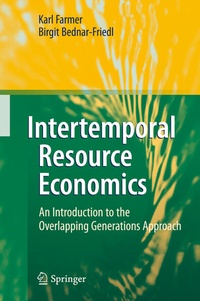
Intertemporal Resource Economics
An Introduction to the Overlapping Generations Approach
1st Edition
Published on 4. August 2010
Book
Hardback
X, 173 pages
978-3-642-13228-5 (ISBN)
Description
Professor Dr. Karl Farmer, Department Chair Karl-Franzens-University, Graz, AustriaDr. Birgit Bednar-Friedl, Researcher, Wegener Center for Climate and Global Change, Karl-Franzens-University, Graz, Austria
More details
Edition
2010
Language
English
Place of publication
Berlin
Germany
Publishing group
Springer Berlin
Target group
Primary & secondary/elementary & high school
Graduate
Illustrations
X, 173 p.
Dimensions
Height: 23.5 cm
Width: 15.5 cm
Weight
970 gr
ISBN-13
978-3-642-13228-5 (9783642132285)
DOI
10.1007/978-3-642-13229-2
Schweitzer Classification
Other editions
Additional editions
Karl Farmer | Birgit Bednar-Friedl
Intertemporal Resource Economics
An Introduction to the Overlapping Generations Approach
Book
10/2014
Springer
€106.99
Shipment within 7-9 days
Karl Farmer | Birgit Bednar-Friedl
Intertemporal Resource Economics
An Introduction to the Overlapping Generations Approach
E-Book
07/2010
1st Edition
Springer
€96.29
Available for download
Persons
Professor Dr. Karl Farmer, Department Chair Karl-Franzens-University, Graz, AustriaDr. Birgit Bednar-Friedl, Researcher, Wegener Center for Climate and Global Change, Karl-Franzens-University, Graz, Austria
Content
Basics.- Economic Growth and Natural Resources.- Efficiency and Market Equilibrium under Resource Abundance.- Intergenerational Efficiency in Log-linear Cobb-Douglas OLG Models.- Intertemporal Market Equilibrium and Short-Run Intergenerational Efficiency.- Steady-State Market Equilibrium, Long-Run Intergenerational Efficiency, and Optimality.- Efficiency and Market Equilibrium with Scarce Renewable Resources.- Renewable Resources and Intergenerational Efficiency.- Intertemporal Market Equilibrium and Intergenerational Efficiency with Renewable Resources.- Intergenerational Equity and Market Equilibrium with Scarce Renewable Resources.- Sustainable Economic Growth with Linear Resource Regeneration.- Steady-State Sustainability under Logistically Regenerating Resources.- Shocks to Harvest Technology and Natural Regeneration.- Resource Use with Physical Harvest Costs.- Effects of Harvest Cost and Biological Shocks.