

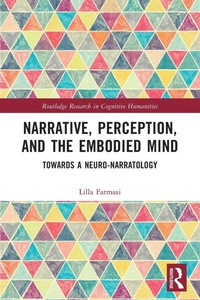
Narrative, Perception, and the Embodied Mind
Towards a Neuro-narratology
1st Edition
Published on 26. August 2024
Book
Paperback/Softback
160 pages
978-1-032-15276-9 (ISBN)
Description
This book encourages cross-disciplinary dialogues toward introducing a new framework for neuro-narratology, expanding on established theory within cognitive narratology to more fully encompass the different faculties involved in the reading process.
To investigate narrative cognition, the book traces the ways in which cognitive patterns of embodiment - and the neural connections that comprise them - in the reading process are translated into patterns in narrative fiction. Drawing theories of episodic memories and nonvisual perception of space, Farmasi draws on theories of episodic memories and nonvisual perception of space in analyzing a range of narratives from twentieth century prose. The first set of analyses shines a light on perception and emotion in narrative discourses and the construction of storyworlds, while the second foregrounds the reader's experience. The volume makes the case for the fact that narratives need to be understood as dynamic elements of the interaction between mind, body, and environment, generating new insights and inspiring further research.
This book will appeal to scholars interested in narrative theory, literary studies, cognitive science, neuroscience, and philosophy.
To investigate narrative cognition, the book traces the ways in which cognitive patterns of embodiment - and the neural connections that comprise them - in the reading process are translated into patterns in narrative fiction. Drawing theories of episodic memories and nonvisual perception of space, Farmasi draws on theories of episodic memories and nonvisual perception of space in analyzing a range of narratives from twentieth century prose. The first set of analyses shines a light on perception and emotion in narrative discourses and the construction of storyworlds, while the second foregrounds the reader's experience. The volume makes the case for the fact that narratives need to be understood as dynamic elements of the interaction between mind, body, and environment, generating new insights and inspiring further research.
This book will appeal to scholars interested in narrative theory, literary studies, cognitive science, neuroscience, and philosophy.
More details
Series
Language
English
Place of publication
London
United Kingdom
Publishing group
Taylor & Francis Ltd
Target group
College/higher education
Professional and scholarly
Academic and Postgraduate
Dimensions
Height: 229 mm
Width: 152 mm
Thickness: 9 mm
Weight
254 gr
ISBN-13
978-1-032-15276-9 (9781032152769)
Copyright in bibliographic data and cover images is held by Nielsen Book Services Limited or by the publishers or by their respective licensors: all rights reserved.
Schweitzer Classification
Other editions
Additional editions
E-Book
09/2022
1st Edition
Routledge
€55.49
Available for download
E-Book
09/2022
1st Edition
Routledge
€55.49
Available for download
Book
09/2022
1st Edition
Routledge
€205.90
Shipment within 10-20 days
Person
Lilla Farmasi is a Senior Assistant Professor at the English Department of the University of Szeged, Hungary. She earned her PhD in literature from the University of Szeged. Her research interests include narratology, (neuro)phenomenology of perception, cognitive science, and illness narratives.
Content
Table of Contents
Part I.
Introduction 1
Chapter 1. Neuro-narratology
Chapter 2. Spatial perception, negative emotions, and narratives
Part II.
Chapter 3. "Sense perceptions and representation of consciousness in Vladimir Nabokov's Invitation to a Beheading and Poe's 'The Pit and the Pendulum'"
Chapter 4: "Storytelling with Tourette's Syndrome in Jonathan Lethem's Motherless Brooklyn"
Chapter 5. "Narrative Space and Motion(lessness) in 'The Ivory Acrobat'"
Part III.
Chapter 6. "Narrative experience as kinetosis for the reader: Spatial perception in The Body Artist"
Chapter 7. "Disorientation, dislocation, and disnarration in Mark Z. Danielewski's House of Leaves."
Chapter 8. Representation of Dissociation and Negative Emotions in Haruki Murakami's "Sleep"
Conclusion
Reference List
Index
Part I.
Introduction 1
Chapter 1. Neuro-narratology
Chapter 2. Spatial perception, negative emotions, and narratives
Part II.
Chapter 3. "Sense perceptions and representation of consciousness in Vladimir Nabokov's Invitation to a Beheading and Poe's 'The Pit and the Pendulum'"
Chapter 4: "Storytelling with Tourette's Syndrome in Jonathan Lethem's Motherless Brooklyn"
Chapter 5. "Narrative Space and Motion(lessness) in 'The Ivory Acrobat'"
Part III.
Chapter 6. "Narrative experience as kinetosis for the reader: Spatial perception in The Body Artist"
Chapter 7. "Disorientation, dislocation, and disnarration in Mark Z. Danielewski's House of Leaves."
Chapter 8. Representation of Dissociation and Negative Emotions in Haruki Murakami's "Sleep"
Conclusion
Reference List
Index