

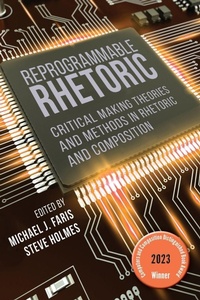
Reprogrammable Rhetoric
Critical Making Theories and Methods in Rhetoric and Composition
Published on 1. September 2022
Book
Paperback/Softback
320 pages
978-1-64642-257-9 (ISBN)
Description
Reprogrammable Rhetoric offers new inroads for rhetoric and composition scholars' past and present engagements with critical making. Moving beyond arguments of inclusion and justifications for scholarly legitimacy and past historicizations of the "material turn" in the field, this volume explores what these practices look like with both a theoretical and hands-on "how-to" approach. Chapters function not only as critical illustrations or arguments for the use of reprogrammable circuits but also as pedagogical instructions that enable readers to easily use or modify these compositions for their own ends.
This collection offers nuanced theoretical perspectives on material and cultural rhetorics alongside practical tutorials for students, researchers, and teachers to explore critical making across traditional areas such as wearable sensors, Arduinos, Twitter bots, multimodal pedagogy, Raspberry Pis, and paper circuitry, as well as underexplored areas like play, gaming, text mining, bots, and electronic monuments.
Designed to be taught in upper division undergraduate and graduate classrooms, these tutorials will benefit non-expert and expert critical makers alike. All contributed codes and scripts are also available on Utah State University Press's companion website to encourage downloading, cloning, and repurposing.
Contributors: Aaron Beveridge, Kendall Gerdes, Kellie Gray, Matthew Halm, Steven Hammer, Cana Uluak Itchuaqiyaq, John Jones, M.Bawar Khan, Bree McGregor, Sean Morey, Ryan Omizo, Andrew Pilsch, David Rieder, David Sheridan, Wendi Sierra, Nicholas Van Horn
This collection offers nuanced theoretical perspectives on material and cultural rhetorics alongside practical tutorials for students, researchers, and teachers to explore critical making across traditional areas such as wearable sensors, Arduinos, Twitter bots, multimodal pedagogy, Raspberry Pis, and paper circuitry, as well as underexplored areas like play, gaming, text mining, bots, and electronic monuments.
Designed to be taught in upper division undergraduate and graduate classrooms, these tutorials will benefit non-expert and expert critical makers alike. All contributed codes and scripts are also available on Utah State University Press's companion website to encourage downloading, cloning, and repurposing.
Contributors: Aaron Beveridge, Kendall Gerdes, Kellie Gray, Matthew Halm, Steven Hammer, Cana Uluak Itchuaqiyaq, John Jones, M.Bawar Khan, Bree McGregor, Sean Morey, Ryan Omizo, Andrew Pilsch, David Rieder, David Sheridan, Wendi Sierra, Nicholas Van Horn
Reviews / Votes
"Incredibly important for anyone in rhet/comp who does work on making."-Danielle Nicole DeVoss, Michigan State University
More details
Language
English
Place of publication
Colorado
United States
Target group
Professional and scholarly
Interest Age: From 18 to 99 years
Product notice
Paperback (trade)
Dimensions
Height: 229 mm
Width: 152 mm
Thickness: 17 mm
Weight
434 gr
ISBN-13
978-1-64642-257-9 (9781646422579)
Copyright in bibliographic data and cover images is held by Nielsen Book Services Limited or by the publishers or by their respective licensors: all rights reserved.
Schweitzer Classification
Persons
Michael J. Faris is associate professor in the Technical Communication and Rhetoric Program in the English department at Texas Tech University, where he coadministered the First-Year Writing Program (2018-2021). His work has appeared in College Composition and Communication, Kairos, Journal of Business and Technical Communication, and Composition Forum. He is coeditor of Soundwriting Pedagogies.
Steve Holmes is associate professor in the Technical Communication and Rhetoric Program at Texas Tech University, where he directs the BA in technical communication. He is the author of Procedural Habits: The Rhetoric of Videogames as Embodied Practice and coauthor of Rhetoric, Technology and the Virtues.
Steve Holmes is associate professor in the Technical Communication and Rhetoric Program at Texas Tech University, where he directs the BA in technical communication. He is the author of Procedural Habits: The Rhetoric of Videogames as Embodied Practice and coauthor of Rhetoric, Technology and the Virtues.