

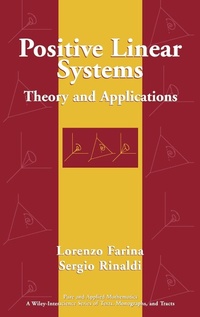
Positive Linear Systems
Theory and Applications
1st Edition
Published on 10. July 2000
Book
Hardback
320 pages
978-0-471-38456-4 (ISBN)
Description
A complete study on an important class of linear dynamicalsystems-positive linear systems
One of the most often-encountered systems in nearly all areas ofscience and technology, positive linear systems is a specific butremarkable and fascinating class. Renowned scientists LorenzoFarina and Sergio Rinaldi introduce readers to the world ofpositive linear systems in their rigorous but highly accessiblebook, rich in applications, examples, and figures.
This professional reference is divided into three main parts: Thefirst part contains the definitions and basic properties ofpositive linear systems. The second part, following the theoreticalexposition, reports the main conceptual results, consideringapplicable examples taken from a number of widely used models. Thethird part is devoted to the study of some classes of positivelinear systems of particular relevance in applications (such as theLeontief model, the Leslie model, the Markov chains, thecompartmental systems, and the queueing systems). Readers familiarwith linear algebra and linear systems theory will appreciate theway arguments are treated and presented.
Extraordinarily comprehensive, Positive Linear Systemsfeatures:
* Applications from a variety of backgrounds including modeling,control engineering, computer science, demography, economics,bioengineering, chemistry, and ecology
* References and annotated bibliographies throughout the book
* Two appendices concerning linear algebra and linear systemstheory for readers unfamiliar with the mathematics used
Farina and Rinaldi make no effort to hide their enthusiasm for thetopics presented, making Positive Linear Systems: Theory andApplications an indispensable resource for researchers andprofessionals in a broad range of fields.
One of the most often-encountered systems in nearly all areas ofscience and technology, positive linear systems is a specific butremarkable and fascinating class. Renowned scientists LorenzoFarina and Sergio Rinaldi introduce readers to the world ofpositive linear systems in their rigorous but highly accessiblebook, rich in applications, examples, and figures.
This professional reference is divided into three main parts: Thefirst part contains the definitions and basic properties ofpositive linear systems. The second part, following the theoreticalexposition, reports the main conceptual results, consideringapplicable examples taken from a number of widely used models. Thethird part is devoted to the study of some classes of positivelinear systems of particular relevance in applications (such as theLeontief model, the Leslie model, the Markov chains, thecompartmental systems, and the queueing systems). Readers familiarwith linear algebra and linear systems theory will appreciate theway arguments are treated and presented.
Extraordinarily comprehensive, Positive Linear Systemsfeatures:
* Applications from a variety of backgrounds including modeling,control engineering, computer science, demography, economics,bioengineering, chemistry, and ecology
* References and annotated bibliographies throughout the book
* Two appendices concerning linear algebra and linear systemstheory for readers unfamiliar with the mathematics used
Farina and Rinaldi make no effort to hide their enthusiasm for thetopics presented, making Positive Linear Systems: Theory andApplications an indispensable resource for researchers andprofessionals in a broad range of fields.
Reviews / Votes
"Explores a class of linear dynamical systems called positivelinear systems whose state variables take only non-negativevalues." (SciTech Book News,Vol. 24, No. 4, December 2000)"The exposition of the topics is consistent and clear. The book isaddressed to graduate students, scientists and engineers incontrol." (Mathematical Reviews, Issue 2001g)
"This book gives an interesting overview of results regardingsingle-input single-output, time-invariant, finite-dimensionallinear poitive systems." (Mathematical Reviews, 2001g:93001)
"There are lots of things to like about this book. In particular, Iliked the appendix on element so f linear systems theory.... Thenthere is the clear enthusiasm of the authors for thesubject...useful for self study or as a supplement in a moreadvanced course..." (SIAM Review, Vol. 43, No. 3)
"Very well-written and well-organized suitable for students whohave had a first course in differential equations." (AmericanMathematical Monthly, January 2002)
"...the authors really succeed in conveying their enthusiasm andthe flavor of the subject..." (Zentralblatt Math, Vol.988, No.13,2002)
More details
Series
Language
English
Place of publication
United States
Publishing group
John Wiley & Sons Inc
Target group
Professional and scholarly
Edition type
Annotated edition
Product notice
sewn/stitched
Cloth over boards
Dimensions
Height: 240 mm
Width: 161 mm
Thickness: 22 mm
Weight
648 gr
ISBN-13
978-0-471-38456-4 (9780471384564)
Copyright in bibliographic data and cover images is held by Nielsen Book Services Limited or by the publishers or by their respective licensors: all rights reserved.
Schweitzer Classification
Other editions
Additional editions
E-Book
09/2011
Wiley
€178.99
Available for download
Persons
LORENZO FARINA, PhD, is Associate Professor of Modeling and Simulation, Dipartimento di Informatica e Sistemistica, Universita di Roma "La Sapienza," Italy. SERGIO RINALDI, PhD, is Full Professor of Systems Theory, Dipartimento di Elettronica e Informazione, Politecnico di Milano, Italy.
Content
DEFINITIONS.
Definitions and Conditions of Positivity.
Influence Graphs.
Irreducibility, Excitability and Transparency.
PROPERTIES.
Stability.
Spectral Characterization of Irreducible Systems.
Positivity of Equilibria.
Reachability and Observability.
Realization.
Minimum Phase.
Interconnected Systems.
APPLICATIONS.
Input-Output Analysis.
Age-Structured Population Models.
Markov Chains.
Compartmental Systems.
Queueing Systems.
Conclusions.
Annotated Bibliography.
Bibliography.
Appendices.
Index.
Definitions and Conditions of Positivity.
Influence Graphs.
Irreducibility, Excitability and Transparency.
PROPERTIES.
Stability.
Spectral Characterization of Irreducible Systems.
Positivity of Equilibria.
Reachability and Observability.
Realization.
Minimum Phase.
Interconnected Systems.
APPLICATIONS.
Input-Output Analysis.
Age-Structured Population Models.
Markov Chains.
Compartmental Systems.
Queueing Systems.
Conclusions.
Annotated Bibliography.
Bibliography.
Appendices.
Index.