

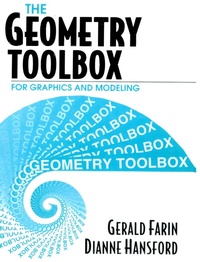
The Geometry Toolbox for Graphics and Modeling
1st Edition
Published on 1. August 1998
Book
288 pages
978-1-56881-074-4 (ISBN)
Description
The Geometry Toolbox takes a novel and particularly visual approach to teaching the basic concepts of two- and three-dimensional geometry. It explains the geometry essential for today's computer modeling, computer graphics, and animation systems. While the basic theory is completely covered, the emphasis of the book is not on abstract proofs but rather on examples and algorithms. The Geometry Toolbox is the ideal text for professionals who want to get acquainted with the latest geometric tools. The chapters on basic curves and surfaces form an ideal stepping stone into the world of graphics and modeling. It is also a unique textbook for a modern introduction to linear algebra and matrix theory.
More details
Language
English
Place of publication
Natick
United States
Publishing group
Taylor & Francis Inc
Target group
College/higher education
Professional and scholarly
Professional Practice & Development
Dimensions
Height: 260 mm
Width: 208 mm
Thickness: 21 mm
Weight
882 gr
ISBN-13
978-1-56881-074-4 (9781568810744)
Schweitzer Classification
Other editions
Additional editions
Gerald Farin | Dianne Hansford
The Geometry Toolbox for Graphics and Modeling
Book
12/2019
1st Edition
CRC Press
€92.00
Shipment within 15-20 days
Gerald Farin | Dianne Hansford
The Geometry Toolbox for Graphics and Modeling
E-Book
07/2017
1st Edition
CRC Press
€69.99
Available for download
Gerald Farin | Dianne Hansford
The Geometry Toolbox for Graphics and Modeling
E-Book
07/2017
Routledge
€69.99
Available for download
Persons
Farin, Gerald; Hansford, Dianne
Content
1. Descartes' Discovery 2. Here and There: Points and Vectors in 2D 3. Lining Up - 2D Lines 4. Linear Maps in 2D 5. 2 x 2 Linear Systems 6. Moving Things Around: Affine Maps 7. Eigen Things 8. Breaking It Up: Triangles 9. Conics 10. 3D Geometry 11. Interactions in 3D 12. Linear Maps in 3D 13. Affine Maps in 3D 14. General Linear Systems 15. Putting Lines Together: Polylines and Polygons 16. Curves