

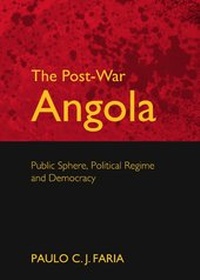
The Post-War Angola
Public Sphere, Political Regime and Democracy
Published on 4. February 2013
Book
Hardback
335 pages
978-1-4438-4371-3 (ISBN)
Description
The quest for a broader reform of the current political regime and for equitable redistribution of Angola's wealth constitutes the most surmountable challenge this country faces since the end of civil war in 2002. State power has become a personalized affair to the extent of perpetuating an entrenched, centralised and overly bureaucratic structure of governance. To understand these dynamics, this book explores the role of the 'public' in post-war Angolan politics.The reality mimics the activities of a 'genuine' public sphere, yet such a 'public sphere' is owned and controlled by the regime. The review of the Angolan context begins with Juergen Habermas's seminal contribution on the theme of the public sphere, and the debate it elicited. Subsequently, it is argued that for many reasons Habermas's approach is not suitable for studying the 'public' in Angola. This work outlines an alternative approach in which the 'public' is constituted through practices of truth-telling as studied by Michel Foucault.Furthermore, the constitutional, legal, political and socio-economic framework within which the public sphere exists is taken into account. Finally, the book examines the workings of the 'public' during and after Pope Benedict's visit to Angola in 2009, as well as looking at one of the country's few media outlets that managed to preserve its independence vis-a-vis the political regime, the catholic Radio Ecclesia.The present book is timely and will certainly deepen the knowledge about conditions of public life and look afresh at Angola's possibilities for further democratic development. Its primary readership will be scholars, students, politicians, policy-makers and civil society organizations. On the whole, this may prove to be an important and original contribution to the understanding of Angolan politics and society today.
Reviews / Votes
". . . [A]n important and innovative contribution to the study of Angolan politics. It combines the originality of an analytical approach new in African studies with a solid empirical knowledge of Angolan realities. It thus constitutes not only a valuable support for the understanding of these intricate realities, but opens up an alley for challenging comparative studies, on African countries and beyond. For all these reasons, I warmly recommend the publication . . ."- Franz-Wilhelm Heimer, Emeritus Professor of Sociology and African Studies, ISCTE - University Institute of Lisbon"I am delighted to recommend the book by Dr Paulo Faria. It casts genuine new light on civil society in Angola, and the work of the Catholic Church in helping to establish a space for free expression. Dr Faria considers in depth the effect of the Papal visit on this process and [reflects on] the need for our considerations of civil society to move beyond the merely secular and embrace also religious and spiritual impulses. I view this as an important book that will be consulted by other scholars for some time to come."- Stephen Chan, OBE, PhD, Professor of International RelationsMore details
Edition
Unabridged edition
Language
English
Place of publication
Newcastle upon Tyne
United Kingdom
Target group
College/higher education
Professional and scholarly
Edition type
Unabridged edition
Product notice
With dust jacket
Dimensions
Height: 212 mm
Width: 148 mm
ISBN-13
978-1-4438-4371-3 (9781443843713)
Copyright in bibliographic data and cover images is held by Nielsen Book Services Limited or by the publishers or by their respective licensors: all rights reserved.
Schweitzer Classification
Other editions
Additional editions
E-Book
09/2014
1st Edition
Cambridge Scholars Publishing
€132.59
Available for download
Person
Paulo C. J. Faria was born in Malanje in the Northern Province of Angola. He is a Visiting Research Fellow at the Centro de Estudos e Investigacao Cientifica at the Universidade Catolica de Angola and holds a PhD in Politics and Government (2012); an MA in International Relations (2006) from the University of Kent, United Kingdom; and a BSc in Philosophy and Humanities (2002) from the Catholic University of Portugal.