

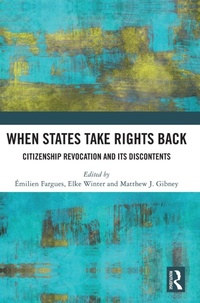
When States Take Rights Back
Citizenship Revocation and Its Discontents
1st Edition
Published on 17. March 2020
Book
Hardback
130 pages
978-0-367-89645-4 (ISBN)
Description
When States Take Rights Back draws on contributions by international experts in history, law, political science, and sociology, offering a rare interdisciplinary and comparative examination of citizenship revocation in five countries, revealing hidden government rationales and unintended consequences.
Once considered outdated, citizenship revocation - also called deprivation or denationalization - has come back to the political center in many Western liberal states. Contributors scrutinize the positions of stakeholders (e.g. civil servants, representatives of civil society, judges, supranational institutions) and their diverse rationales for citizenship revocation (e.g. allegations of terrorism, treason, espionage, criminal behaviour, and fraud in the naturalisation process). The volume also uncovers the variety of tools that national governments have at their disposition to change existing citizenship revocation laws and policies, and the constraints that they are faced with to actually implement citizenship revocation in daily operations. Finally, contributors underscore the extraordinary severity of sanctions implied by citizenship revocation and offer a nuanced picture of the material and symbolic forms of exclusion not only for those whose citizenship is withdrawn but also for minority groups (wrongly) associated with the aforementioned allegations. Indeed, revocation policies target not merely individuals but specific collective categories, which tend to be ethno-racially constructed and attributed specific location within the international status hierarchy of nation-states.
International and interdisciplinary in scope, When States Take Rights Back will be of great interest to scholars of politics, international law, sociology and political and legal history, and Human Rights. The chapters were originally published in Citizenship Studies.
Once considered outdated, citizenship revocation - also called deprivation or denationalization - has come back to the political center in many Western liberal states. Contributors scrutinize the positions of stakeholders (e.g. civil servants, representatives of civil society, judges, supranational institutions) and their diverse rationales for citizenship revocation (e.g. allegations of terrorism, treason, espionage, criminal behaviour, and fraud in the naturalisation process). The volume also uncovers the variety of tools that national governments have at their disposition to change existing citizenship revocation laws and policies, and the constraints that they are faced with to actually implement citizenship revocation in daily operations. Finally, contributors underscore the extraordinary severity of sanctions implied by citizenship revocation and offer a nuanced picture of the material and symbolic forms of exclusion not only for those whose citizenship is withdrawn but also for minority groups (wrongly) associated with the aforementioned allegations. Indeed, revocation policies target not merely individuals but specific collective categories, which tend to be ethno-racially constructed and attributed specific location within the international status hierarchy of nation-states.
International and interdisciplinary in scope, When States Take Rights Back will be of great interest to scholars of politics, international law, sociology and political and legal history, and Human Rights. The chapters were originally published in Citizenship Studies.
More details
Language
English
Place of publication
London
United Kingdom
Publishing group
Taylor & Francis Ltd
Target group
College/higher education
Postgraduate and Undergraduate Core
Dimensions
Height: 250 mm
Width: 175 mm
Thickness: 12 mm
Weight
437 gr
ISBN-13
978-0-367-89645-4 (9780367896454)
Copyright in bibliographic data and cover images is held by Nielsen Book Services Limited or by the publishers or by their respective licensors: all rights reserved.
Schweitzer Classification
Other editions
Additional editions
Emilien Fargues | Elke Winter | Matthew J. Gibney
When States Take Rights Back
Citizenship Revocation and Its Discontents
Book
06/2024
1st Edition
Routledge
€71.98
Shipment within 10-20 days
Emilien Fargues | Elke Winter | Matthew J. Gibney
When States Take Rights Back
Citizenship Revocation and Its Discontents
E-Book
06/2020
1st Edition
Routledge
€59.49
Available for download
Emilien Fargues | Elke Winter | Matthew J. Gibney
When States Take Rights Back
Citizenship Revocation and Its Discontents
E-Book
06/2020
1st Edition
Routledge
€59.49
Available for download
Persons
Emilien Fargues is a Max Weber Fellow at the European University Institute and a research associate in the Global Citizenship Governance project at the Robert Schuman Centre for Advanced Studies. He holds a PhD in Political Science from Sciences Po Paris.
Elke Winter is the William Lyon Mackenzie King Professor of Sociology at Harvard University, Professor of Sociology at the University of Ottawa, and Research Director at the Centre for Interdisciplinary Research on Citizenship and Minorities (CIRCEM). Her research is concerned with questions of migration, ethnic diversity, multiculturalism, and citizenship.
Matthew J. Gibney is Professor of Politics and Forced Migration at the University of Oxford, Official Fellow of Linacre College, Oxford, and Director of the Refugee Studies Centre. He specialises in the political and ethical issues raised by refugees, citizenship, and migration control.
Elke Winter is the William Lyon Mackenzie King Professor of Sociology at Harvard University, Professor of Sociology at the University of Ottawa, and Research Director at the Centre for Interdisciplinary Research on Citizenship and Minorities (CIRCEM). Her research is concerned with questions of migration, ethnic diversity, multiculturalism, and citizenship.
Matthew J. Gibney is Professor of Politics and Forced Migration at the University of Oxford, Official Fellow of Linacre College, Oxford, and Director of the Refugee Studies Centre. He specialises in the political and ethical issues raised by refugees, citizenship, and migration control.
Content
1. Conditional membership: what revocation does to citizenship Emilien Fargues and Elke Winter 2. Governing imperial citizenship: a historical account of citizenship revocation Deirdre Troy 3. Discussing the human rights limits on loss of citizenship: a normative-legal perspective on egalitarian arguments regarding Dutch Nationality laws targeting Dutch-Moroccans Tom L. Boekestein and Gerard-Rene de Groot 4. The politics of un-belonging: lessons from Canada's experiment with citizenship revocation Elke Winter and Ivana Previsic 5. Denaturalisation and conceptions of citizenship in the 'war on terror" Patrick Sykes 6. Simply a matter of compliance with the rules? The moralising and responsibilising function of fraud-based citizenship deprivation in France and the UK Emilien Fargues 7. The concept of allegiance in citizenship law and revocation: an Australian study Helen Irving 8. Citizenship revocation: a stress test for liberal democracy Janie Pelabay and Rejane Senac