

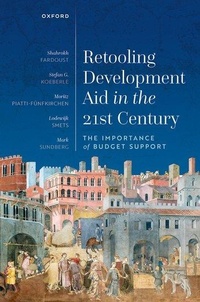
Retooling Development Aid in the 21st Century
The Importance of Budget Support
Published on 20. April 2023
Book
Hardback
304 pages
978-0-19-288219-6 (ISBN)
Description
Aid instruments need to adjust to new challenges and priorities. Global pandemics, climate change, increased inequality, low economic growth, and conflict have made it increasingly difficult for developing countries to achieve the Sustainable Development Goals. Retooling Development Aid in the 21st Century: The Importance of Budget Support examines the critical role of budget support by both multilateral and bilateral aid agencies to address the 21st century's development goals of eliminating poverty and protecting our global commons. Timely and smartly designed budget support remains a powerful tool to help address the new reality developing countries face, providing fast disbursing finance in support of critical reforms.
Set against the background of a dramatically changing international financial architecture, the volume examines how budget support has evolved from its controversial past, addresses the evidence on performance and debates over conditionality, and it reflects on unmet expectations from the 2005 Paris Declaration. With the global financial crisis, the Covid pandemic, and the spillovers from conflict and climate change, budget support re-emerged as a key financing instrument to support policy reforms and catalyze private capital. Drawing on the lessons of the last two decades, the volume proposes a retooling of budget support as a versatile instrument to address both essential global public goods and tackle country-specific development challenges.
Set against the background of a dramatically changing international financial architecture, the volume examines how budget support has evolved from its controversial past, addresses the evidence on performance and debates over conditionality, and it reflects on unmet expectations from the 2005 Paris Declaration. With the global financial crisis, the Covid pandemic, and the spillovers from conflict and climate change, budget support re-emerged as a key financing instrument to support policy reforms and catalyze private capital. Drawing on the lessons of the last two decades, the volume proposes a retooling of budget support as a versatile instrument to address both essential global public goods and tackle country-specific development challenges.
More details
Language
English
Place of publication
Oxford
United Kingdom
Target group
Professional and scholarly
Product notice
sewn/stitched
Cloth over boards
Dimensions
Height: 238 mm
Width: 159 mm
Thickness: 25 mm
Weight
664 gr
ISBN-13
978-0-19-288219-6 (9780192882196)
Copyright in bibliographic data and cover images is held by Nielsen Book Services Limited or by the publishers or by their respective licensors: all rights reserved.
Schweitzer Classification
Other editions
Additional editions
Shahrokh Fardoust | Stefan G. Koeberle | Moritz Piatti-Fünfkirchen
Retooling Development Aid in the 21st Century
The Importance of Budget Support
E-Book
04/2023
1st Edition
OUP eBook
€68.49
Available for download
Shahrokh Fardoust | Stefan G. Koeberle | Moritz Piatti-Fünfkirchen
Retooling Development Aid in the 21st Century
The Importance of Budget Support
E-Book
03/2023
1st Edition
OUP eBook
€68.49
Available for download
Persons
Shahrokh Fardoust is Research Professor at the Global Research Institute and Visiting Scholar in Economics at the College of William and Mary, and a senior consultant to international and regional development institutions. He has more than 30 years' experience in crafting economic development policy, analyzing the global economy and prospects, and evaluating development effectiveness of international and regional development institutions. From 2008 to 2011, he was Director of Strategy and Operations, Development Economics, the World Bank, where he contributed to the research and policy priorities of the Chief Economist, the G20's development agenda, and the quality assurance of the World Bank's flagship reports. He holds a MA and a Ph.D. in Economics from the University of Pennsylvania.
Stefan G. Koeberle is the Director, Strategy and Operations, Middle East and North Africa Region at the World Bank. Dr. Koeberle has worked in a variety of countries and regions, including postings in Bangkok and Jakarta. His most recent positions at the World Bank included the following: Director, Strategy and Operations, Integrity Vice Presidency; Director Strategy, Results and Risk in Operations Policy and Country Services; Country Director for Indonesia; and Director, Strategy and Operations in the Latin America and Caribbean Region. Prior to joining the World Bank, Dr. Koeberle worked as a post-graduate fellow at the German Development Institute in Berlin. He holds a Ph.D. in economics from Cambridge University. He has published a number of articles and several books on competitiveness, conditionality and budget support.
Moritz Piatti-Fuenfkirchen is a Senior Economist at the World Bank working at the nexus of public finance and health. He is interested in how to balance fiscal control with service delivery needs and has published widely in the public financial management and health finance space. His work is currently focused on the Africa region where he leads various analytical and lending programs. During his time at the World Bank's Independent Evaluation Group, he led various evaluations of World Bank support to public financial management and budget support operations. Prior to joining the World Bank, he worked as an advisor in the Ministry of Health in Tanzania, where he supported the government in budget management and the introduction of health finance reforms. Mr. Piatti-Fuenfkirchen holds a MSc in Economics for Development from Oxford University and a MA in Economics from the University of Aberdeen.
Lodewijk Smets is a Senior Economist at the World Bank working on Solomon Islands and Vanuatu. In this role, he is responsible for macroeconomic monitoring, policy dialogue on macro-fiscal matters and the provision of budget support. Over the years, Dr Smets developed a deep interest in how donors can support policy reform processes and published several papers on the topic in peer-reviewed journals. Before joining the World Bank, Dr Smets was a Senior Economist at the Inter-American Development Bank. Prior to this, he led evaluations of budget support for low-income countries, at the World Bank Group's Independent Evaluation Group, where he also provided methodological support to a wide variety of evaluation teams. He holds a Ph.D. in Economics from the University of Antwerp, Belgium, and was a Post-doctoral Research Fellow at Katholieke Universiteit Leuven, Belgium.
Mark Sundberg is the Millennium Challenge Corporation's Chief Economist and Deputy Vice President of the Department of Policy and Evaluation. He oversees the economic analysis of growth, poverty impact, and project cost-benefit analysis for the US Agency. Prior to this he was the Manager for the Economic Management and Country Evaluation work of the World Bank's Independent Evaluation Group. He led numerous evaluations of World Bank strategy and project work, including learning products on conditionality, macroeconomic frameworks, fiscal management and use of guarantees in budget support operations. He worked as an economist for many country programs and from 1996 to 1998 he was regional Chief Economist, Emerging Markets, for Salomon Brothers/Citibank in Hong Kong. Mr. Sundberg holds a Ph.D. in economics from Harvard University and a BA in Economics and East Asian studies from Yale University.
Stefan G. Koeberle is the Director, Strategy and Operations, Middle East and North Africa Region at the World Bank. Dr. Koeberle has worked in a variety of countries and regions, including postings in Bangkok and Jakarta. His most recent positions at the World Bank included the following: Director, Strategy and Operations, Integrity Vice Presidency; Director Strategy, Results and Risk in Operations Policy and Country Services; Country Director for Indonesia; and Director, Strategy and Operations in the Latin America and Caribbean Region. Prior to joining the World Bank, Dr. Koeberle worked as a post-graduate fellow at the German Development Institute in Berlin. He holds a Ph.D. in economics from Cambridge University. He has published a number of articles and several books on competitiveness, conditionality and budget support.
Moritz Piatti-Fuenfkirchen is a Senior Economist at the World Bank working at the nexus of public finance and health. He is interested in how to balance fiscal control with service delivery needs and has published widely in the public financial management and health finance space. His work is currently focused on the Africa region where he leads various analytical and lending programs. During his time at the World Bank's Independent Evaluation Group, he led various evaluations of World Bank support to public financial management and budget support operations. Prior to joining the World Bank, he worked as an advisor in the Ministry of Health in Tanzania, where he supported the government in budget management and the introduction of health finance reforms. Mr. Piatti-Fuenfkirchen holds a MSc in Economics for Development from Oxford University and a MA in Economics from the University of Aberdeen.
Lodewijk Smets is a Senior Economist at the World Bank working on Solomon Islands and Vanuatu. In this role, he is responsible for macroeconomic monitoring, policy dialogue on macro-fiscal matters and the provision of budget support. Over the years, Dr Smets developed a deep interest in how donors can support policy reform processes and published several papers on the topic in peer-reviewed journals. Before joining the World Bank, Dr Smets was a Senior Economist at the Inter-American Development Bank. Prior to this, he led evaluations of budget support for low-income countries, at the World Bank Group's Independent Evaluation Group, where he also provided methodological support to a wide variety of evaluation teams. He holds a Ph.D. in Economics from the University of Antwerp, Belgium, and was a Post-doctoral Research Fellow at Katholieke Universiteit Leuven, Belgium.
Mark Sundberg is the Millennium Challenge Corporation's Chief Economist and Deputy Vice President of the Department of Policy and Evaluation. He oversees the economic analysis of growth, poverty impact, and project cost-benefit analysis for the US Agency. Prior to this he was the Manager for the Economic Management and Country Evaluation work of the World Bank's Independent Evaluation Group. He led numerous evaluations of World Bank strategy and project work, including learning products on conditionality, macroeconomic frameworks, fiscal management and use of guarantees in budget support operations. He worked as an economist for many country programs and from 1996 to 1998 he was regional Chief Economist, Emerging Markets, for Salomon Brothers/Citibank in Hong Kong. Mr. Sundberg holds a Ph.D. in economics from Harvard University and a BA in Economics and East Asian studies from Yale University.
Author
Research ProfessorResearch Professor, Global Research Institute
Director, Strategy and Operations, Middle East and North Africa RegionDirector, Strategy and Operations, Middle East and North Africa Region, World Bank
Senior EconomistSenior Economist, World Bank
Senior EconomistSenior Economist, World Bank
Chief Economist and Deputy Vice President, Department of Policy and EvaluationChief Economist and Deputy Vice President, Department of Policy and Evaluation, Millennium Challenge Corporation
Content
1: The Purpose and Promise of Budget Support
2: Global Finance and the Changing Aid Landscape
3: The Evolution of Budget Support
4: The Performance of Budget Support
5: Promise, Disenchantment, and Sobriety: Learning from Experience with Budget Support
6: How Can Budget Support Meet 21st Century Challenges?
7: Conclusion
Bibliography
2: Global Finance and the Changing Aid Landscape
3: The Evolution of Budget Support
4: The Performance of Budget Support
5: Promise, Disenchantment, and Sobriety: Learning from Experience with Budget Support
6: How Can Budget Support Meet 21st Century Challenges?
7: Conclusion
Bibliography