

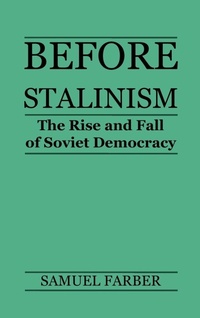
Before Stalinism
The Rise and Fall of Soviet Democracy
1st Edition
Published on 27. September 1990
Book
Hardback
312 pages
978-0-7456-0791-7 (ISBN)
Description
This book provides an historical study of democratic life and institutions and their decline in the early years of the Russian Revolution. Rather than an event-by-event description of this period, it is an attempt at interpretation and synthesis of the vast and relatively recent specialist literature on a subject usually neglected by those analysing Soviet politics for the public at large. While attempting to synthesize a wealth of historical materials, Farber also assesses the extent to which the disappearance of Soviet democracy was due to objective circumstances, for example, the impact of the Civil War, and the extent to which it was the result of Bolshevik politics and ideology. In this context, the author shows how there were, contrary to later Stalinist and Cold War mythologies, considerable and significant disputes within the pre-Stalinist Bolshevik camp on matters relevant to the preservation of the substantial democratic elements of the October upheaval.
As the processes of glasnost and perestroika in the Soviet Union find a response from below in a movement for democracy that may not be willing to respect the limits of Gorbachev's programme, Farber's work acquires a timely quality for those who, inside or outside the Soviet Union, are searching for a usable past in which to root the new Soviet Spring.
In presenting data known only to specialists to a larger public ion an original, novel and accessible interpretative framework, Farber adds an important new dimension to our thinking about the Russian Revolution and the origins of the Soviet state.
As the processes of glasnost and perestroika in the Soviet Union find a response from below in a movement for democracy that may not be willing to respect the limits of Gorbachev's programme, Farber's work acquires a timely quality for those who, inside or outside the Soviet Union, are searching for a usable past in which to root the new Soviet Spring.
In presenting data known only to specialists to a larger public ion an original, novel and accessible interpretative framework, Farber adds an important new dimension to our thinking about the Russian Revolution and the origins of the Soviet state.
Reviews / Votes
'This is a book that everyone interested in the future of socialism should read, and a book that will inform and enlighten all who are interested in the history of the Soviet Union.' Professor S A Smith, University of Essex 'When did the Russian Revolution go wrong and why? Whether one shares Samuel Farber's views or not, his is an important, at once thoughtful and passionate contribution to one of the major debates of our time.' Daniel Singer'An honest and searching attempt to identify the roots of Stalinism in the pre-Stalin period. It can be recommended as a painstaking and scrupulous assessment, animated by a commitment to socialist democracy.' New Left Review
'The author surveys comprehensively the 'moments of choice' between the Bolshevick Revolution and the death of Lenin.' Labour History Review
'Farber has done much to enrich our understanding of the tradition which was never reducible just to Lenin.' Socialist
More details
Language
English
Place of publication
Oxford
United Kingdom
Publishing group
John Wiley and Sons Ltd
Target group
College/higher education
Professional and scholarly
Product notice
Laminated cover
Dimensions
Height: 229 mm
Width: 152 mm
Thickness: 18 mm
Weight
577 gr
ISBN-13
978-0-7456-0791-7 (9780745607917)
Copyright in bibliographic data and cover images is held by Nielsen Book Services Limited or by the publishers or by their respective licensors: all rights reserved.
Schweitzer Classification
Person
Content
Dedication. Acknowledgements.
Major Events in Russian History 1917-1924.
Introduction.
1. The Rise and Decline of Democratic Soviets.
2. The Fate of Workers Control and Trade Union Independence.
3. Freedom of the Press.
4. Repression.
5. Socialist Legality.
Part II: Before Stalinism: Political Alternatives. .
6. Revolutionary Alternatives to Mainstream Bolshevism.
7. After the Civil War: Lenin's NEP as an Alternative (1921-1923).
Epilogue.
Bibliography.
Major Events in Russian History 1917-1924.
Introduction.
1. The Rise and Decline of Democratic Soviets.
2. The Fate of Workers Control and Trade Union Independence.
3. Freedom of the Press.
4. Repression.
5. Socialist Legality.
Part II: Before Stalinism: Political Alternatives. .
6. Revolutionary Alternatives to Mainstream Bolshevism.
7. After the Civil War: Lenin's NEP as an Alternative (1921-1923).
Epilogue.
Bibliography.